FM Sitharaman: India story written on farms, not just Delhi
Synopsis
Finance Minister Nirmala Sitharaman told corporate leaders at the NDTV Profit Business Leadership Awards 2026 that India's growth story is written on farms and shop floors, not in New Delhi, and called on government and industry together to deliver on the Viksit Bharat 2047 vision.
Key Takeaways
Nirmala Sitharaman addressed the NDTV Profit Business Leadership Awards 2026 on 26 July 2026 .
She described India's youth as the country's 'deepest asset' and called on both government and industry to be 'worthy' of their optimism.
She argued the India story is shaped on 'shop floors and farms, in start-ups and research laboratories, in classrooms and clinics' — not only in New Delhi .
The remarks were anchored in the Viksit Bharat 2047 vision, first formally articulated by PM Modi in his Independence Day address in August 2023 .
She called for a government-industry compact to 'write the next chapter together' toward a developed India by 2047 .
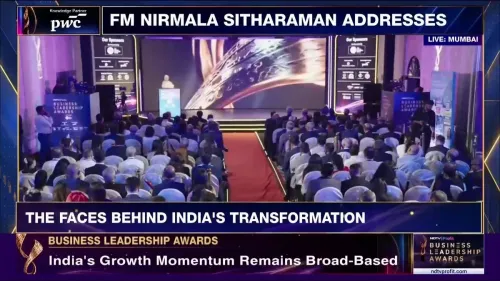
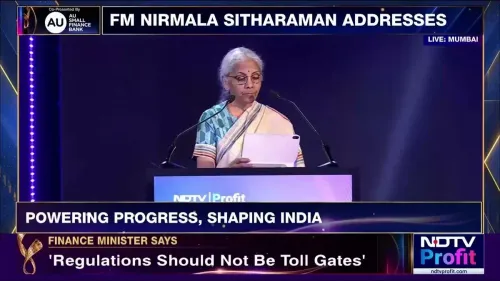
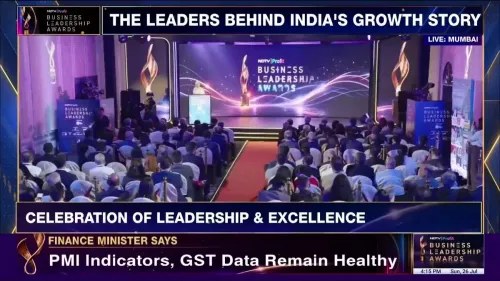
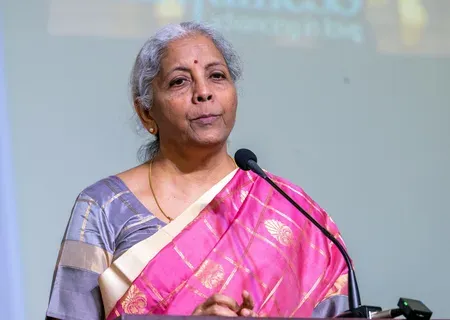
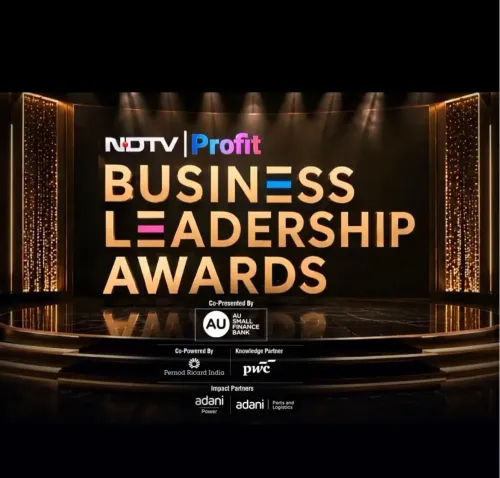
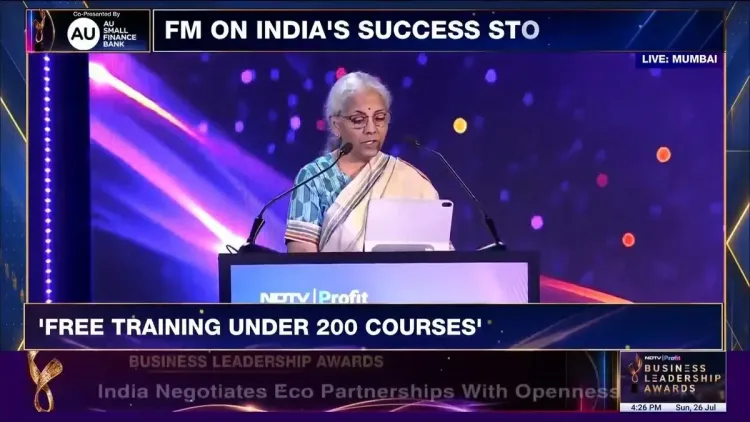
Union Finance Minister Nirmala Sitharaman on Sunday, 26 July 2026, called on government and industry to match the optimism of India's youth, delivering a pointed reminder that the country's growth story is shaped far beyond the corridors of power in New Delhi. The remarks came at the NDTV Profit Business Leadership Awards 2026.
Context
Speaking at the awards ceremony, Sitharaman said, 'India's deepest asset is the strong, magnificent optimism of our young people. Our task, government's and industry's alike, is to be worthy of it.' The statement framed youth not as beneficiaries of policy but as the primary drivers of national ambition — a rhetorical shift that places the burden of delivery squarely on institutions.
She went further to argue that the India story 'is not written in New Delhi' but 'on shop floors and farms, in start-ups and research laboratories, in classrooms and clinics, also in corporate offices.' The formulation was a deliberate decentralisation of credit and responsibility, signalling that the government sees multi-sectoral, sub-national activity as the true engine of growth.
Policy Backdrop
The remarks are anchored in the Viksit Bharat 2047 vision — Prime Minister Narendra Modi's long-horizon goal to transform India into a fully developed economy by the centenary of independence. Modi formally articulated the vision in his Independence Day address in August 2023, calling for whole-of-society participation across government, business, and civil society.
Sitharaman's framing at the awards echoes that whole-of-society language, positioning the 2047 target not as a government programme but as a shared national project. This continues a pattern of messaging that links individual Budget cycles and industrial policies to a single, long-term developmental arc. Earlier initiatives such as Atmanirbhar Bharat and Make in India laid the rhetorical and policy groundwork for this public-private compact.
Stakeholders and Impact
The audience at a business leadership forum made the choice of message pointed: Sitharaman was, in effect, telling India's corporate leadership that their legitimacy is tied to how well they serve the broader national ambition rather than narrow sectoral interests. The explicit mention of MSMEs-adjacent spaces — shop floors, farms, start-ups — alongside corporate offices was a signal that the government expects large industry to invest beyond its immediate ecosystem.
For Indian youth, the speech reinforces government messaging around skilling, entrepreneurship, and employment as centrepieces of the Viksit Bharat roadmap. The framing also carries implicit pressure on industry to expand hiring, support startups, and invest in research and development rather than rely on policy protection alone.
What's Next
Analysts and industry bodies will watch the next Union Budget for concrete measures that translate this rhetoric into incentives — particularly around youth employment, startup regulation, and manufacturing. Sitharaman closed her remarks with a call to 'celebrate the India story in the only way it truly deserves, by writing its next chapter together, on the road to a Viksit Bharat by 2047.' Whether the next budget cycle delivers policy architecture commensurate with that ambition will be the real test of the government-industry compact she invoked.
Point of View
Subtly shifting the burden of proof onto industry. The explicit enumeration of farms, shop floors, and clinics alongside corporate offices is a signal that the government is sensitive to perceptions of crony-capitalist growth and wants to broaden the visible constituency of development. This continues a long arc from Atmanirbhar Bharat through Make in India, where each iteration has tried to deepen private-sector ownership of national economic targets. The 2047 horizon gives every successive budget a ready narrative anchor — but the gap between inspirational framing and measurable youth employment outcomes will define whether the rhetoric lands or rings hollow.
NationPress
25 Oct 2026
Frequently Asked Questions
What did Nirmala Sitharaman say at the NDTV Profit Business Leadership Awards 2026?
She said India's deepest asset is the optimism of its young people and urged both government and industry to be worthy of it, adding that the India story is written on shop floors, farms, start-ups, and laboratories — not just in New Delhi.
What is Viksit Bharat 2047?
Viksit Bharat 2047 is India's national vision to become a fully developed economy by 2047, the centenary of independence. Prime Minister Narendra Modi formally launched the goal in his Independence Day address in August 2023.
Why did Sitharaman say the India story is not written in New Delhi?
She used the phrase to emphasise that real economic growth happens across farms, factories, clinics, classrooms, and start-ups nationwide — not only in the central government — and to call on industry to share responsibility for national development.
What is the government's target for India by 2047?
The government's Viksit Bharat 2047 goal aims to transform India into a developed nation by the 100th anniversary of independence, guided by multi-sectoral growth involving youth, private industry, MSMEs, and research institutions.
How does Sitharaman's speech connect to earlier economic programmes like Atmanirbhar Bharat?
Her call for a government-industry compact continues a policy lineage that includes Atmanirbhar Bharat and Make in India, all of which stress public-private collaboration and decentralised economic activity as drivers of national growth.