Why Has the South Korean Startup Delayed Its 1st Commercial Orbit Launch Again?
Click to start listening
Synopsis
In a significant setback for the South Korean space sector, Innospace has yet again postponed its first commercial orbit launch due to technical issues. This delay raises questions about the startup's readiness as it aims to become a pioneer in private space ventures.
Key Takeaways
- Innospace has postponed its first commercial orbit launch due to technical issues.
- The launch was originally slated for Wednesday from Brazil's Alcantara Space Center.
- The Hanbit-Nano rocket is intended to deploy multiple payloads into a low orbit.
- South Korea has ambitious plans for lunar exploration, including a communication orbiter and lander.
- KASA is focused on enhancing the nation's space capabilities and achieving a high success rate for future launches.
Seoul, Dec 20 (NationPress) South Korean space startup Innospace announced on Saturday that its inaugural commercial orbit launch has faced yet another delay due to technical difficulties.
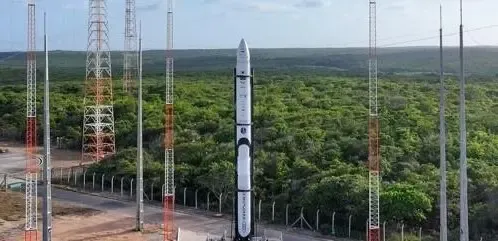
The Hanbit-Nano rocket was initially set to launch from the Alcantara Space Center in Brazil earlier today, yet the event has been postponed. Innospace had originally targeted a launch on Wednesday.
The startup stated that a new launch date will be coordinated with the Brazilian Air Force, as reported by the Yonhap news agency.
The Hanbit-Nano vehicle is designed to carry eight payloads, including five satellites, and will deploy them into a low orbit at an altitude of 300 kilometers.
This two-stage rocket utilizes a 25-ton thrust hybrid engine for the first stage, while the second stage is powered by a liquid methane and oxygen engine.
If the mission succeeds, Innospace will mark a significant milestone as the first private South Korean firm to launch a customer satellite into orbit.
In the meantime, South Korea is aiming to launch a lunar communication orbiter in 2029 and a lunar lander by 2032 as part of its comprehensive space exploration strategy. This was disclosed last week by the head of the Korea AeroSpace Administration (KASA).
KASA Administrator Yoon Young-bin detailed these ambitious goals during a policy briefing to President Lee Jae Myung held in the central administrative city of Sejong, emphasizing the agency's commitment to enhancing the nation's space capabilities.
Yoon noted that the 2029 orbiter mission will utilize the domestically developed Nuri rocket. The country recently celebrated the successful completion of its fourth launch of this homegrown space vehicle, which successfully placed 13 satellites into orbit.
He added that acquiring deep-space communication technology through the lunar communication orbiter will lay the foundation for sending an unmanned lunar lander in 2032.
A lunar communication orbiter is crucial for moon missions, as it enables communication with Earth from the far side of the moon, where direct communication is otherwise impossible.
According to Yoon, KASA intends to conduct a minimum of one Nuri launch each year until 2032, with the goal of achieving a success rate exceeding 90 percent, and plans to develop a reusable next-generation launch vehicle by 2035.
Point of View
I believe that while delays in space launches can be disheartening, they are often a necessary part of ensuring safety and reliability. Innospace's commitment to resolving technical issues before launch is commendable and reflects a broader trend of prioritizing thorough preparation in the fast-evolving field of space exploration. The nation's aspirations for lunar missions highlight its ambition and potential as a leader in global space initiatives.
NationPress
21/12/2025
Frequently Asked Questions
What caused the delay in Innospace's launch?
The launch was delayed due to technical problems that needed to be resolved before proceeding.
When was the launch initially scheduled?
The launch was initially scheduled for Wednesday but has been postponed.
What payloads will the Hanbit-Nano carry?
The Hanbit-Nano will carry eight payloads, including five satellites.
What are South Korea's future space plans?
South Korea aims to launch a lunar communication orbiter in 2029 and a lunar lander in 2032.
What is the significance of the Hanbit-Nano launch?
If successful, it will make Innospace the first private South Korean company to place a customer satellite into orbit.