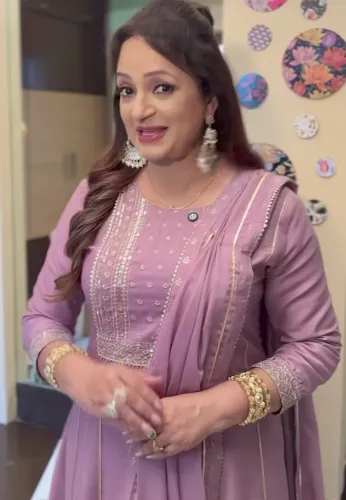
Geeta Kapur on dancing for money: 'It was never a career in the 90s'

Synopsis
Geeta Kapur's candid recall of earning ₹500 per show in the 1990s — when dance was considered anything but a career — is a rare first-person window into how Bollywood's choreography world actually took shape. The journey from classical Kathak classes to three decades at the top of Hindi film dance is the kind of origin story that reframes how India thinks about the arts as livelihood.
Key Takeaways
Geeta Kapur began dancing in the early 1990s , when it was not considered a viable career in India.
She trained in folk dance , Kathak , and Bharatanatyam before entering the professional circuit.
Early performance fees ranged from ₹500 to ₹1,000 per assignment, which she described as significant at the time.
Collaborating with Jaaved Jaaferi proved a turning point, steadily increasing her income and visibility.
She assisted choreographer Farah Khan on multiple hit productions and appeared in the iconic song from Kuch Kuch Hota Hai (1998).
Kapur has been active in the Bollywood industry for nearly three decades .
Choreographer and television personality Geeta Kapur has opened up about her formative years in the Bollywood industry during the early 1990s, a time when dance was widely dismissed as a hobby rather than a livelihood. Speaking candidly, Kapur revealed that financial necessity and growing opportunities gradually transformed what began as a passion into a full-fledged profession.
When Dance Was Not a Career
'The dance concept has changed. It is now looked at as a career option. When we were dancing, it was not a career option,' Kapur said. She recalled that her entry into dance was rooted in classical training rather than any professional ambition. 'My mother enrolled me in classes where I learnt the basics of folk dance, Kathak and Bharatanatyam. I never thought I would earn money from it, make a career out of it, or become a choreographer,' she added.
How Money Changed the Equation
Kapur acknowledged that financial considerations played a significant role in sustaining her commitment to the art form. 'We did it because we wanted to earn money. We were getting work at that time. But I won't say it was only about earning money. We did it because we loved it. It was a hobby that turned into a career,' she explained. In the early days, performers were paid as little as ₹500 to ₹1,000 per assignment — sums that, she noted, felt substantial at the time.
The Turning Point: Working with Jaaved Jaaferi
A decisive shift came when Kapur began collaborating with actor and dancer Jaaved Jaaferi. 'When I saw that it could be a source of income, especially after I started working with Jaaved Jaaferi, I realised the income was increasing,' she recalled. That association marked the beginning of her rise through the industry's choreography circuit.
Three Decades in Bollywood
Kapur has since spent nearly three decades shaping the visual language of Hindi film dance. She worked closely as an assistant to celebrated choreographer Farah Khan on several chart-topping productions. Notably, she also featured on screen in the iconic song 'Tujhe Yaad Na Meri Aayi' from the 1998 blockbuster Kuch Kuch Hota Hai. Beyond films, she has built a parallel identity as a judge and mentor on popular dance reality television, helping mainstream competitive dance for a new generation of performers.
A Transformed Landscape
Kapur's journey mirrors a broader cultural shift in India, where structured dance education, reality television, and the global spread of Bollywood have collectively elevated dance from a recreational pursuit to a recognised profession. Today, dedicated dance academies, choreography studios, and performance management firms operate across major cities — a far cry from the informal performance circuits of the 1990s. Her story stands as an early data point in that transformation.
Point of View
But through the slow convergence of opportunity and passion. What her story also surfaces, without quite stating it, is how little institutional support existed for dance as a profession in 1990s India. The absence of formal industry structures meant that talent alone was insufficient; access to the right collaborators, as her Jaaved Jaaferi reference illustrates, was the real differentiator. That dynamic has not entirely disappeared, even as the landscape has formalised.
NationPress
25 Jun 2026
Frequently Asked Questions
Why did Geeta Kapur say she started dancing for money?
Geeta Kapur said that while she loved dance, financial opportunity was a key motivating factor in her early career. She explained that paid assignments began arriving and she realised dance could provide income, earning as little as ₹500 to ₹1,000 per show in the early 1990s.
Was dance considered a career option in India in the 1990s?
According to Geeta Kapur, dance was not viewed as a legitimate career option in the 1990s. It was treated primarily as a hobby or recreational activity, and professional choreography as a structured industry was still in its infancy.
How did Geeta Kapur begin her dance training?
Kapur's mother enrolled her in dance classes where she learnt the basics of folk dance, Kathak, and Bharatanatyam. She has said she had no professional ambitions at the time and never imagined she would become a choreographer.
What role did Jaaved Jaaferi play in Geeta Kapur's career?
Working with Jaaved Jaaferi was a turning point for Kapur. She noted that her income grew steadily after that collaboration, which helped her recognise dance as a financially viable profession.
What is Geeta Kapur known for in Bollywood?
Geeta Kapur is known for nearly three decades of work in Bollywood, including assisting choreographer Farah Khan on several hit productions. She also appeared in the song 'Tujhe Yaad Na Meri Aayi' from the 1998 film Kuch Kuch Hota Hai and is widely recognised as a judge on dance reality television.