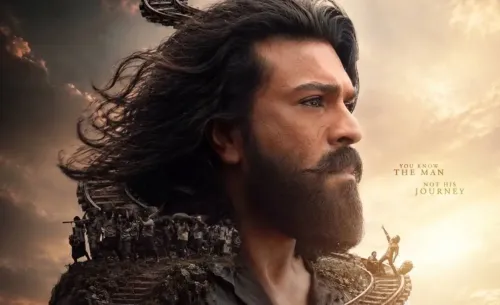
Janhvi Kapoor on 'Peddi' objectification row: 'Glad it became a big deal'

Synopsis
Janhvi Kapoor didn't just defend herself — she turned the 'Peddi' objectification row into a call for industry-wide change. On 'Koffee With Karan', she confirmed the portrayal 'propagated sexual assault narratively', said she should have pushed back harder, and expressed hope that the backlash will make the industry take actresses' discomfort seriously. It is a rare moment of unguarded accountability from a mainstream Bollywood star.
Key Takeaways
Janhvi Kapoor addressed the objectification controversy around her character in 'Peddi' on 'Koffee With Karan' alongside Varun Dhawan .
She said she is 'glad it became such a big deal', hoping it creates greater sensitivity toward actresses who voice discomfort.
Kapoor admitted she 'could have been more vigilant' and should have 'made a bigger scene' during the shoot.
She confirmed the portrayal was 'extreme objectification' and said it 'propagated sexual assault narratively'.
She cited professional pressure to defer to the director as a factor in her not speaking up more forcefully at the time.
Actress Janhvi Kapoor has spoken candidly about the widespread controversy surrounding her character's portrayal in the sports drama 'Peddi', saying she is ultimately relieved the debate grew as large as it did. Appearing on 'Koffee With Karan' alongside actor Varun Dhawan, Kapoor addressed the criticism of objectification head-on — a conversation that has resonated strongly across the Indian film industry.
Why Janhvi Welcomed the Backlash
Rather than deflecting the criticism, Kapoor offered a measured and self-aware response. She expressed hope that the public outcry could shift attitudes toward actresses who raise concerns about their on-screen depiction.
'I'm glad it became such a big deal, my portrayal in 'Peddi', so maybe next time an actress says she's uncomfortable, they won't look at her like an alien,' she said on the show.
Her remarks signal a broader reckoning — one in which the discomfort of performers is treated as a legitimate creative and ethical concern, not a professional inconvenience.
The Weight She Carried
Kapoor — known for her earlier films 'Dhadak' and 'Mili' — admitted she was initially hesitant to speak out, mindful of the many crew members who had invested in the project.
'I really didn't know what to say or if there was anything really to even say because it's important that I take ownership from my half of…whatever that fiasco was because it weighs heavily on my conscience the sort of negative impact and a narrative like that can have on our society, specific to my gender,' she stated.
She acknowledged carrying a sense of shame over the potential societal impact of the narrative, and said she recognises she could have been more assertive during production.
Her Self-Reckoning on Set
'Could have I done more? Could I have been more vigilant? Could I have made a bigger scene? A hundred percent, yes. Was it problematic? Was it extreme objectification? Did it even propagate sexual assault narratively? Yes,' Kapoor said, in what amounts to one of the more unflinching self-assessments by a mainstream Bollywood actress in recent memory.
She added that she repeatedly questioned herself about whether she should have objected more firmly during the shoot, while also noting the professional pressures that made that difficult.
The Director Dynamic She Navigated
'I don't like saying this because it sounds like I am shifting blame but you know how it's like, 'Yes, whatever the director says, you have to be professional, you have to listen to the director.' So, I was really navigating how to make things less problematic as best I thought, as and when information was becoming available to me,' she explained.
Her comments touch on a structural tension familiar to many performers — the expectation of deference to the director versus the imperative to protect one's own boundaries and the broader message a project sends.
What This Signals for Bollywood
Kapoor's remarks arrive at a moment of heightened scrutiny over gender representation in Hindi cinema. Critics argue that the industry has long normalised the objectification of female actors under the banner of 'artistic vision', and that performers who push back risk being labelled difficult. Notably, Kapoor's willingness to name the problem — including the phrase 'propagate sexual assault narratively' — breaks from the more guarded language typically employed in promotional interviews. How the industry responds to such candour may determine whether this marks a genuine inflection point or remains an isolated moment of accountability.
Point of View
She has set a standard of candour that will be difficult for the industry to ignore. Yet the structural issue she identifies — the near-total authority of the director over a performer's objections — remains unaddressed by any formal mechanism in Bollywood. The real question is not whether Janhvi should have spoken up sooner, but why the industry still has no institutional channel for performers to flag concerns during production without career risk. Her guilt, while admirable in its honesty, should not substitute for the systemic accountability that is still absent.
NationPress
29 Oct 2026
Frequently Asked Questions
What did Janhvi Kapoor say about her portrayal in 'Peddi'?
Janhvi Kapoor confirmed on 'Koffee With Karan' that her portrayal in 'Peddi' involved extreme objectification and, in her own words, 'propagated sexual assault narratively'. She said she is glad the controversy became a major public discussion, hoping it encourages the industry to take actresses' discomfort more seriously in the future.
Why did Janhvi Kapoor not object more during the filming of 'Peddi'?
Kapoor cited the professional pressure to defer to the director as a key reason she did not push back more firmly on set. She acknowledged this openly, saying she was 'navigating how to make things less problematic as best I thought' as she became aware of the issues, while noting she could and should have been more assertive.
What is the significance of Janhvi Kapoor's remarks for Bollywood?
Her remarks are among the most direct by a mainstream Hindi film actress about objectification in a commercially released film. By publicly owning her self-described failure to act and calling out the industry's director-deference culture, she has raised the bar for how the film industry handles performer discomfort — though critics note no structural safeguards yet exist.
Where did Janhvi Kapoor make these revelations?
She made these remarks during an appearance on the chat show 'Koffee With Karan', alongside actor Varun Dhawan, who also appeared in 'Peddi'.
What film is at the centre of the objectification controversy?
The film is 'Peddi', a sports drama featuring Janhvi Kapoor. The specific nature of her character's portrayal sparked a broad public debate about objectification of female actors in Indian cinema.