Madhuri Dixit on gender double standards: 'Maa Behen' breaks society's rules
Synopsis
At 59, Madhuri Dixit is not just starring in rule-breaking films — she is talking about why those rules need breaking. Her candid remarks on patriarchal double standards, tied to the release of 'Maa Behen' on Netflix, put a veteran star's credibility behind a conversation that Hindi cinema has historically sidestepped.
Key Takeaways
Madhuri Dixit has spoken out against gender double standards, saying men are celebrated as 'Casanovas' while women making the same romantic choices are condemned.
Her latest film, 'Maa Behen' , is a black comedy thriller directed by Suresh Triveni , now streaming on Netflix .
The film stars Madhuri Dixit , Triptii Dimri , Dharna Durga , and Ravi Kishan , among others.
Dixit, 59 , described the film's characters as 'chaotic', 'confused', and deeply relatable — deliberately breaking social conventions.
She also recently appeared in Mrs.
Deshpande , directed by Nagesh Kukunoor , playing a serial killer.
Veteran Bollywood actress Madhuri Dixit has spoken candidly about the persistent double standards women face in matters of love and relationships, saying patriarchal norms have long been normalised in Indian society. Her remarks come ahead of the release of her latest film, 'Maa Behen', a black comedy thriller now streaming on Netflix.
What Madhuri Said
'It's a patriarchal society. I mean, from the beginning, it's like, that's the way it is. Men can have girlfriends… If he has girlfriends, he's a Casanova. If a woman does the same, she's called names. You know, she's like a very negative thing,' the actress said.
The 59-year-old actress noted that such biases have been accepted as social norms for generations, with men often celebrated for the same romantic choices for which women are condemned.
How 'Maa Behen' Challenges These Norms
'In this movie, we have broken every rule that the society has created. And we have had fun doing that. Though, I think the characters in this film are so, so chaotic and so, what do you call it? Confused. They are so real. You know, real, relatable people,' Dixit said.
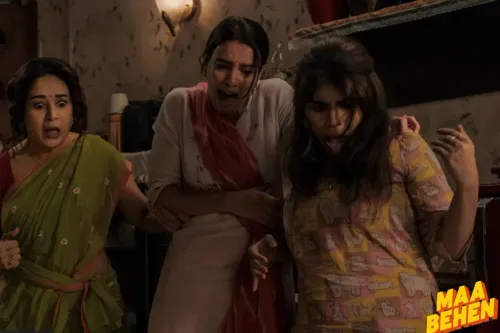
The film, directed by Suresh Triveni, centres on Rekha, a mother whose life is upended when a dead body turns up in her kitchen. She must navigate the crisis alongside her two daughters — Jaya, the responsible one, and Sushma, the wild card — while keeping suspicious neighbours at bay.
Cast and Streaming Details
'Maa Behen' stars Madhuri Dixit, Triptii Dimri, Dharna Durga, and Ravi Kishan, with supporting roles from Geetanjali Kulkarni, Arunoday Singh, and Shardul Bhardwaj. The film is currently available on Netflix.
Madhuri's Broader Recent Work
Beyond 'Maa Behen', Dixit also recently appeared in Mrs. Deshpande, directed by Nagesh Kukunoor, where she played a serial killer — a sharp departure from the roles she built her career on. The back-to-back unconventional choices signal a deliberate shift in the kind of stories she is choosing to tell at this stage of her career.
As conversations around gender equity and representation in Hindi cinema grow louder, Dixit's willingness to front films that directly engage with patriarchal conditioning adds a layer of cultural relevance to her latest releases.
Point of View
And it is worth asking whether 'Maa Behen' genuinely subverts them or packages rebellion as entertainment. Still, a star of her stature lending her voice to this conversation, rather than deflecting it, is not nothing. The real measure will be whether the film's audience — and the industry — treats it as a moment of reflection or simply another streaming release.
NationPress
22 Oct 2026
Frequently Asked Questions
What is 'Maa Behen' about?
'Maa Behen' is a black comedy thriller directed by Suresh Triveni, streaming on Netflix. It follows a mother named Rekha whose life spirals after a dead body appears in her kitchen, and she must manage the fallout with her two daughters while hiding the truth from nosy neighbours.
What did Madhuri Dixit say about gender double standards?
Madhuri Dixit said that patriarchal norms have long allowed men to be celebrated for romantic choices for which women are harshly judged. She pointed out that a man with multiple girlfriends is called a Casanova, while a woman in the same situation is condemned.
Who else stars in 'Maa Behen'?
The film features Triptii Dimri, Dharna Durga, and Ravi Kishan alongside Madhuri Dixit, with supporting roles from Geetanjali Kulkarni, Arunoday Singh, and Shardul Bhardwaj.
Where can viewers watch 'Maa Behen'?
'Maa Behen' is currently streaming on Netflix.
What other recent film has Madhuri Dixit appeared in?
Madhuri Dixit also appeared in Mrs. Deshpande, directed by Nagesh Kukunoor, in which she played a serial killer — a significant departure from her earlier screen persona.