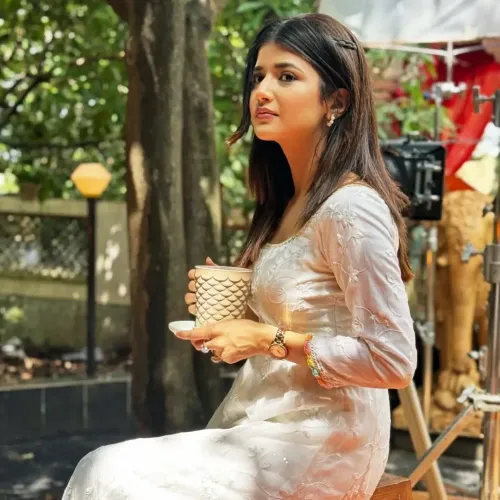
Samridhii Shukla on gender roles: 'Why should one person sacrifice all the time?'

Synopsis
Samridhii Shukla, who plays Abhira in Yeh Rishta Kya Kehlata Hai, has called out the structural unfairness of expecting women to manage both career and household alone. Her argument — that roles must flex with circumstances rather than follow a fixed gender script — echoes a growing conversation around domestic equality in urban India.
Key Takeaways
Samridhii Shukla , lead actress of Yeh Rishta Kya Kehlata Hai , spoke out on 26 July about breaking traditional gender roles at home.
She argued that household management and childcare should be a shared responsibility between both partners, not defaulted to women.
Shukla called for flexible, situation-based division of roles rather than rigid gender expectations.
She connected her views to her on-screen character Abhira , who juggles multiple responsibilities under constant pressure.
Her remarks reflect a broader national conversation about unpaid domestic labour and the mental load carried by working women in India.
Yeh Rishta Kya Kehlata Hai actress Samridhii Shukla has spoken candidly about the need to dismantle traditional gender roles within households, arguing that domestic responsibilities must be shared equally between partners. The actress, who plays the lead role of Abhira in the long-running Star Plus drama, made the remarks on 26 July, drawing on both her on-screen character's struggles and broader social realities.
The Unequal Burden Women Carry
Shukla did not mince words when describing the invisible load that continues to fall disproportionately on women. “Many women are still expected to do it all. They are expected to take care of the children, work if they choose to, and then come back home and manage the household as well. Even if they are not personally cooking, they are expected to organise everything, coordinate with the cook, and make sure the house runs smoothly. The responsibility of managing everything somehow automatically falls on the woman,” she said.
The actress argued that this expectation is structurally unfair, particularly in dual-income households where both partners share the same living space and the same parental role. “I honestly think that expectation is unfair. When two people get married, they build a life together. They both live in the same house, they both use everything in it, and most importantly, the children belong to both parents. So why should one person be expected to carry the larger share of the responsibility? Roles can and should change depending on the situation,” she added.
Flexibility Over Rigid Roles
Rather than prescribing a fixed model, Samridhii advocated for a fluid, situation-based approach to dividing responsibilities. She described a scenario where a husband steps up professionally when his partner has just given birth, and reciprocates by managing the home when she is ready to return to work or pursue personal goals.
“It’s about making space for each other’s dreams instead of expecting one person to sacrifice all the time,” she said. The framing positions domestic equality less as a political demand and more as a practical partnership — a distinction that resonates with younger urban audiences who are renegotiating household norms.
How Abhira Mirrors Real-Life Pressures
Shukla connected her views directly to her character on Yeh Rishta Kya Kehlata Hai, noting that Abhira’s on-screen arc reflects a tension many women navigate daily. “Abhira is trying to be everywhere and do everything at once. It’s not easy at all. There is so much pressure on her, and that’s something many women experience in real life too. They constantly feel the need to prove themselves both at home and outside, and that emotional load is very real,” she said.
The show, one of Indian television’s longest-running family dramas, has frequently used its central characters to explore evolving gender dynamics — making Shukla’s comments an extension of the narrative her character already inhabits on screen.
Wider Conversation on Domestic Equality
Shukla’s remarks arrive at a moment when the conversation around unpaid domestic labour and the ‘mental load’ has gained traction in India, particularly on social media and in urban professional circles. Studies and surveys in recent years have consistently shown that Indian women spend significantly more hours on unpaid household work than their male counterparts, even when both are employed full-time. While Shukla speaks from the vantage point of an entertainer rather than a policy advocate, her platform gives the conversation considerable reach. As Abhira’s story continues to unfold on screen, the character’s struggles may well keep this dialogue alive for the show’s large viewership.
Point of View
Which means a popular actress articulating the concept of the ‘mental load’ — without using the term — carries real cultural weight. What the conversation still lacks, however, is a concrete counter-narrative to the structural conditions that produce these imbalances: workplace inflexibility, inadequate parental leave for fathers, and social stigma around men who step back professionally. Celebrity advocacy can shift norms at the margins, but without those structural levers, the burden-sharing Shukla describes remains aspirational for most households.
NationPress
24 Oct 2026
Frequently Asked Questions
What did Samridhii Shukla say about gender roles at home?
Samridhii Shukla said that the responsibility of managing the household and raising children should be shared equally between both partners, and that it is unfair to expect women to handle everything alone. She argued that domestic roles should adapt to each partner’s circumstances rather than follow a fixed gender script.
Who is Samridhii Shukla?
Samridhii Shukla is an Indian television actress best known for playing the lead role of Abhira in the long-running Star Plus drama Yeh Rishta Kya Kehlata Hai. She has used her character’s on-screen journey to highlight real-world pressures faced by women who balance professional and domestic responsibilities.
How does Abhira's character relate to Samridhii Shukla's views?
Shukla described her character Abhira as someone who is constantly trying to be everywhere and do everything at once, mirroring the real-life emotional load many women carry. She said the pressure Abhira faces on screen reflects a genuine social reality for working women in India.
Why is the conversation about domestic equality gaining attention in India?
Studies consistently show that Indian women spend significantly more hours on unpaid household work than men, even when both partners are employed full-time. The issue has gained visibility on social media and in urban professional circles, with public figures like Shukla helping bring it to a wider mainstream audience.
What solution did Samridhii Shukla propose for unequal domestic burdens?
Shukla advocated for a flexible approach where partners take turns stepping up at home or at work depending on life circumstances — such as one partner managing professionally while the other recovers post-childbirth, and then switching when needed. She framed it as making space for each other’s dreams rather than expecting one person to sacrifice continuously.