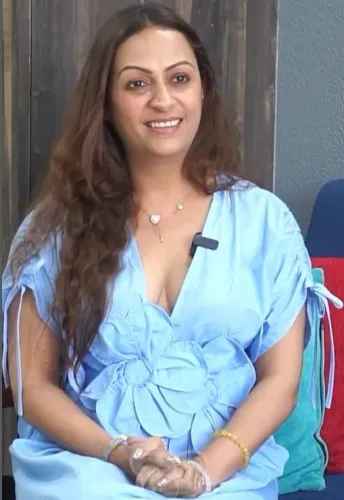
Aashiesh Sharrma on TV's return to finite storytelling: 'It has come full circle'
Synopsis
Television has come full circle, according to actor Aashiesh Sharrma. As audiences gravitate toward limited series over open-ended narratives, the medium is rediscovering the discipline that enforces tighter writing and more meaningful storytelling. In his new role in 'Khejri', Sharrma champions a trans narrative that treats identity as part of a universal human journey, not a subject for external commentary.
Key Takeaways
Actor Aashiesh Sharrma observes that television is returning to finite storytelling formats, moving away from open-ended daily soaps.
Limited series with clear narrative arcs are gaining audience preference, encouraging more intentional and meaningful content.
Sharrma plays a transgender character in the recently released drama Khejri , based on the short story Sanjha .
He emphasised that Khejri presents a trans narrative as a universal human journey of identity and belonging, free from external framing or conditioning.
The shift toward limited storytelling addresses the structural problem of open-ended narratives stretching thin plots and sacrificing coherence.
Television actor Aashiesh Sharrma has observed that the industry is undergoing a cyclical shift, returning to finite storytelling formats after years of open-ended narratives. In an exclusive conversation, Sharrma noted that audiences today increasingly prefer limited series with clear narrative arcs, a trend he believes will catalyse more meaningful and intentional content creation across the medium.
Television's structural reset
"Television has come full circle," Sharrma explained. "Earlier, we had finite storytelling formats, and now we are returning to that structure. Audiences today prefer limited series with a clear beginning and end. This shift is encouraging better storytelling and more meaningful content." The actor's observation reflects a broader industry pattern: as streaming platforms fragment viewership, traditional broadcast television and digital platforms alike are gravitating toward closed narratives that demand tighter writing and character arcs.
Why limited series matter
The move away from open-ended daily soaps toward anthology and limited-run formats addresses a structural problem that plagued Indian television for two decades — the pressure to sustain ratings forced writers to stretch thin plots, introduce implausible twists, and sacrifice narrative coherence. Limited series, by contrast, enforce discipline: a story must earn its runtime and deliver resolution. This constraint, Sharrma suggested, naturally elevates storytelling quality.
Sharrma's choice: 'Khejri' and authentic trans narratives
Aashiesh Sharrma recently appeared in the drama Khejri, playing a transgender character. The actor revealed that the project's foundation — a short story titled Sanjha — had resonated with him for years after his father introduced it to him. "The story deeply reflected the truth and emotions of society," he said.
What distinguished Khejri from prior trans-focused narratives, Sharrma emphasised, was its refusal to impose external framing. "Stories about trans individuals are usually told from a very subjective lens," he observed. "This was the first time I encountered a narrative that felt like a pure human journey. It was not influenced by conditioning or external perspectives. It was open, honest, and deeply personal."
Universal identity, not identity politics
Rather than treating the character's transgender identity as a plot device or a vehicle for social messaging, Sharrma described Khejri as a story about belonging and self-discovery that transcends categorical identity. "This is not just the story of one trans person; it is a universal story about identity and belonging. Every individual struggles to find their place in society, and this narrative captures that journey beautifully," he concluded. The framing underscores a shift in how Indian cinema and television are beginning to approach marginalised identities — not as subjects to be explained, but as protagonists within fully realised human stories.
Point of View
But incomplete. The real driver is not audience preference alone — it is the economic fragmentation of viewership. When a single broadcast slot no longer guarantees 20 million simultaneous viewers, producers can no longer justify 400-episode runs of threadbare plots. Limited series are economically rational, not just artistically superior. The second insight — that trans narratives should be treated as universal human stories rather than identity-focused tracts — is welcome but overdue. Indian cinema has spent a decade treating marginalised identities as subjects to be explained. Khejri's approach is not revolutionary; it is baseline storytelling competence. The fact that it reads as noteworthy reflects how low the bar has been.
NationPress
25 Sept 2026
Frequently Asked Questions
What does Aashiesh Sharrma mean by television coming 'full circle'?
Sharrma refers to television's return to finite storytelling formats with clear beginnings and endings, after decades of open-ended daily soaps. He argues that audiences now prefer limited series, a structure that encourages tighter writing and more meaningful narratives — a reversion to television's earlier narrative model.
Why is the shift toward limited series significant for Indian television?
Limited series enforce narrative discipline: stories must earn their runtime and deliver resolution. This constraint naturally reduces the pressure to stretch thin plots and introduce implausible twists, which plagued open-ended daily soaps for two decades. The result is higher-quality storytelling and more intentional content.
What role does Aashiesh Sharrma play in 'Khejri'?
Sharrma plays a transgender character in the recently released drama 'Khejri', which is based on a short story titled 'Sanjha'. The narrative focuses on identity and belonging as a universal human journey rather than a subject for external commentary or conditioning.
Why was Sharrma drawn to the 'Khejri' project?
Sharrma was drawn to 'Khejri' because it was based on a short story his father had given him years earlier. More importantly, he valued that the narrative presented a trans character's journey as a pure human story free from subjective framing or external perspectives — an approach he found rare in Indian cinema.
How does 'Khejri' differ from other trans-focused narratives in Indian cinema?
Unlike most trans narratives in Indian cinema, which are often told from a subjective or identity-focused lens, 'Khejri' treats the character's journey as a universal story about identity and belonging. It is presented as an honest, personal narrative uninfluenced by external conditioning or messaging.