How Should AI Be Measured in Healthcare? Insights from Anupriya Patel
Synopsis
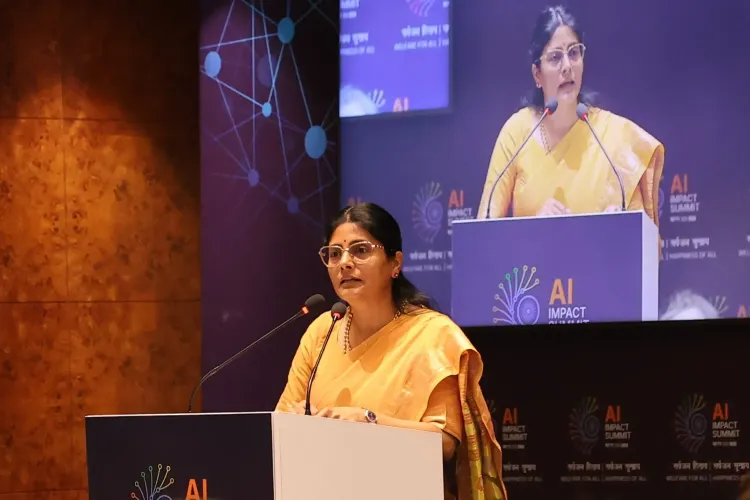
At the India AI Impact Summit 2026, Minister Anupriya Patel emphasized the importance of AI in addressing health inequities across India. She highlighted the transformative role of AI in healthcare, showcasing its impact on public health outcomes and the necessity for responsible deployment.
Key Takeaways
AI is essential for addressing health inequities in India.
Technological advancements are improving public health outcomes.
AI tools are enhancing disease surveillance and diagnosis.
Responsible and ethical deployment of AI is crucial.
The government is fostering an AI ecosystem in healthcare.
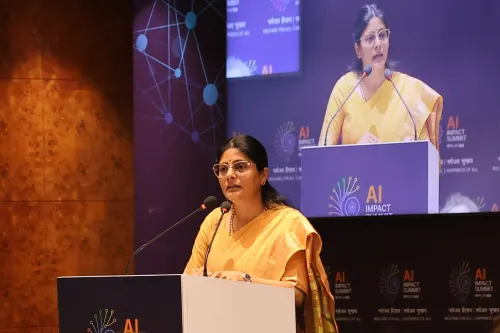
New Delhi, Feb 17 (NationPress) When India discusses AI in healthcare, the focus goes beyond advanced algorithms or precision medicine. It revolves around how technology impacts lives and tackles health disparities throughout the nation, according to Minister of State for Health and Family Welfare, Anupriya Patel, during her remarks on Tuesday.
Addressing the audience at the ‘India AI Impact Summit 2026’ held at Bharat Mandapam, she emphasized the essential role of AI in enhancing public health outcomes and fortifying India’s healthcare systems.
Patel noted that “AI for India, as envisioned by our Prime Minister Narendra Modi, stands for not just Artificial Intelligence but also All-Inclusive Intelligence.”
As India strives for the goal of a Viksit Bharat by 2047, health is recognized as a pivotal area of development.
The country's vast and varied population, along with the rural-urban divide and the combined challenges posed by communicable as well as non-communicable diseases, creates distinct hurdles.
In this scenario, Patel emphasized the necessity of technology — especially AI — as a crucial facilitator.
“AI has been embedded throughout the healthcare spectrum—from disease surveillance and prevention to diagnosis and treatment,” the minister stated.
The Media Disease Surveillance System, an AI-driven tool that tracks disease trends in 13 languages, offers real-time alerts and enhances outbreak preparedness.
This system illustrates how AI can bolster India’s disease management initiatives and improve surveillance capabilities.
The Indian Council of Medical Research (ICMR) has introduced AI-driven tools for genomic surveillance, which can forecast potential zoonotic outbreaks prior to their transmission from animals to humans. Such predictive abilities mark a significant shift in proactive public health measures.
Furthermore, the minister pointed out the rollout of AI-integrated handheld X-ray devices and Computer-Aided Detection tools for tuberculosis (CA-TB), which have made advanced diagnostic services more accessible to communities.
These innovations have led to a rise of about 16% in TB case detection. Additionally, AI tools that predict adverse TB treatment outcomes have contributed to a 27% reduction in negative treatment results, thereby reinforcing India’s battle against tuberculosis.
The government is diligently working to cultivate a robust AI ecosystem within healthcare, including establishing three Centres of Excellence for AI at AIIMS Delhi, PGIMER Chandigarh, and AIIMS Rishikesh to integrate top-tier AI expertise into public health delivery.
Experts at the session affirmed that Artificial Intelligence has the potential to be a game-changer in public health, provided it is implemented responsibly, ethically, and on a large scale.
Point of View
It is evident that India’s healthcare framework is undergoing a revolution, driven by AI. The emphasis on addressing health inequities underscores the need for inclusive technology that serves all demographics. This strategic approach not only enhances healthcare delivery but also positions India on a path toward a healthier future.
NationPress
26 Sept 2026
Frequently Asked Questions
What is the role of AI in healthcare according to Anupriya Patel?
Anupriya Patel highlighted that AI in healthcare should not only focus on advanced algorithms but also on its impact on lives and addressing health inequities.
What are some examples of AI applications in India’s healthcare?
AI applications include the Media Disease Surveillance System for real-time alerts, genomic surveillance tools for predicting zoonotic outbreaks, and AI-enabled diagnostic tools for tuberculosis.