Assam artificial insemination drive: 6.7 lakh cattle bred in 2025-26, CM Sarma
Synopsis
Assam completed over 6.7 lakh artificial inseminations in 2025-26 — producing more than 2.1 lakh improved-breed calves in a single year. It is the state's most ambitious livestock modernisation push to date, and CM Sarma is framing it as a direct driver of rural income growth and dairy self-reliance.
Key Takeaways
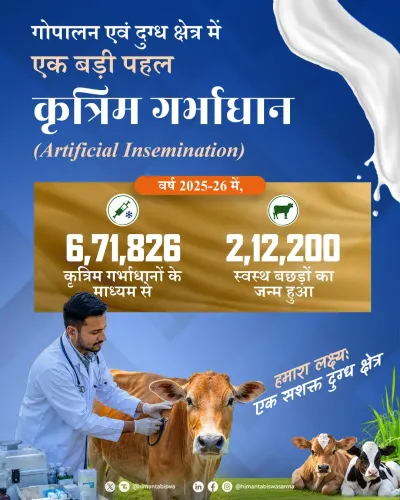
Assam carried out 6,71,826 artificial inseminations during 2025-26 , according to figures shared by CM Himanta Biswa Sarma .
The programme resulted in the birth of 2,12,200 healthy calves, improving the state's cattle genetic stock.
The initiative aims to reduce breeding costs, raise milk yields, and strengthen rural livelihoods across Assam.
It forms part of a broader animal husbandry strategy encompassing scientific breeding, veterinary support, and dairy infrastructure upgrades.
The government's stated goal is dairy self-reliance while aligning with Prime Minister Modi's Viksit Bharat vision.
Assam Chief Minister Himanta Biswa Sarma on Monday, 29 June announced that the state's large-scale artificial insemination programme has completed 6,71,826 inseminations during 2025-26, resulting in the birth of 2,12,200 healthy calves — a milestone the government says is fundamentally reshaping the state's dairy sector and rural economy.
Scale of the Programme
The figures, shared by Chief Minister Sarma in a social media post, underscore the breadth of the initiative. With over 6.7 lakh artificial inseminations carried out in a single year, Assam has significantly scaled up its livestock modernisation effort. The programme connects livestock farmers with scientifically superior cattle breeds that carry higher milk-yield potential, reducing dependence on traditional, lower-productivity breeding methods.
'Our government has launched a new initiative for rural prosperity by connecting local livestock farmers to modern dairy systems,' Sarma said. He added that the state is progressing in line with Prime Minister Narendra Modi's vision of a Viksit Bharat by modernising the livestock and dairy sectors.
Impact on Farmers and the Dairy Value Chain
Officials say the programme is designed to strengthen the dairy value chain at multiple levels. By enabling access to superior breeds, it is expected to reduce breeding costs, improve overall livestock health, and create more sustainable livelihood opportunities in rural Assam. The birth of 2,12,200 calves through the programme represents a direct injection of improved genetic stock into the state's cattle population.
This comes amid a broader national push to raise dairy productivity, with India already the world's largest milk producer — yet facing persistent gaps in per-animal yield compared to global averages. Assam's targeted intervention through artificial insemination addresses precisely this productivity deficit at the grassroots level.
Broader Strategy for Animal Husbandry
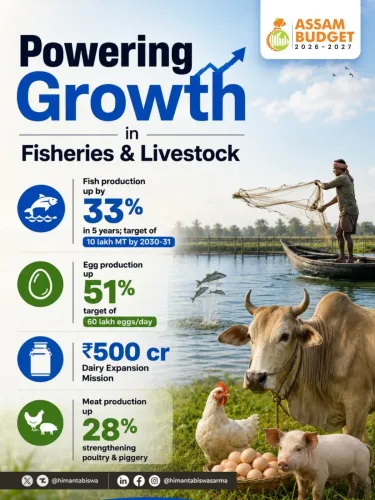
The artificial insemination drive forms part of Assam's wider animal husbandry modernisation strategy, which includes scientific breeding protocols, expanded veterinary support networks, and improved access to dairy infrastructure across districts. Animal husbandry and dairy development have been designated priority sectors by the state government, with multiple parallel schemes aimed at encouraging scientific farming practices.
Notably, the government's stated objective is to achieve self-reliance in milk production while generating higher incomes for livestock rearers — a dual goal that targets both supply-side sufficiency and rural income growth. Officials indicated that sustained investment in modern livestock management techniques will be critical to meeting the state's growing demand for milk and dairy products.
What Comes Next
The state government is expected to continue scaling the programme in the coming financial year, with officials pointing to veterinary outreach and dairy infrastructure upgrades as the next priority areas. The success of the 2025-26 cycle is likely to inform target-setting for the next phase, with Guwahati serving as the administrative hub for coordinating district-level implementation.
Point of View
2.1 lakh calves — are significant, but the real metric that matters is per-animal milk yield improvement over the next two to three lactation cycles. Assam's cattle productivity has historically lagged national averages, and artificial insemination alone does not guarantee outcomes without parallel investment in animal nutrition and veterinary follow-up. The government's framing around Viksit Bharat is politically convenient, but the programme will be judged on whether farmer incomes actually rise — and that data has yet to be independently verified. Worth watching: whether the calf survival rate and eventual milk yield figures are published transparently, or remain confined to press releases.
NationPress
29 Sept 2026
Frequently Asked Questions
What is Assam's artificial insemination programme for cattle?
It is a state government initiative that uses artificial insemination to connect livestock farmers with superior cattle breeds carrying higher milk-yield potential. In 2025-26, the programme completed 6,71,826 inseminations across Assam, resulting in the birth of 2,12,200 healthy calves.
How many calves were born under Assam's artificial insemination drive in 2025-26?
A total of 2,12,200 healthy calves were born as a result of the programme during 2025-26, according to figures shared by Chief Minister Himanta Biswa Sarma. This is described by the government as a significant milestone in improving cattle productivity.
Why is artificial insemination important for Assam's dairy sector?
Artificial insemination enables farmers to access superior cattle breeds without the cost of maintaining high-breed bulls, reducing breeding expenses while improving milk yield potential. It is seen as a key intervention to strengthen Assam's dairy value chain and raise rural incomes.
How does this programme fit into Assam's broader animal husbandry strategy?
The artificial insemination drive is part of a wider state strategy that includes scientific breeding protocols, expanded veterinary support, and improved dairy infrastructure. The government aims to achieve self-reliance in milk production while boosting rural livelihoods.
What did CM Himanta Biswa Sarma say about the programme?
CM Sarma said the government has 'launched a new initiative for rural prosperity by connecting local livestock farmers to modern dairy systems.' He added that Assam is advancing in line with Prime Minister Modi's Viksit Bharat vision through modernisation of the livestock and dairy sectors.