How is the consortium-driven innovation model transforming research commercialisation?
Synopsis
Union Minister Dr. Jitendra Singh highlights the revolutionary impact of the consortium-driven innovation model initiated by IIT Madras Research Park, which is now influencing various academic institutions nationwide. This model is crucial for fast-tracking technology commercialization, aligning research with industry needs, and positioning India as a leader in global technology.
Key Takeaways
Consortium-driven innovation model enables swift commercialization of technology.
Involvement of industry partners ensures alignment with market needs.
Supports development in urban mobility, space technology, and more.
ITEL Foundation aims to position India as a global tech leader.
Private startups play an increasing role in India's space sector.
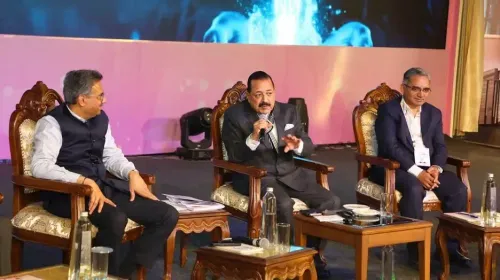
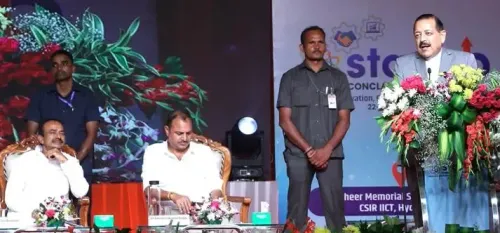
New Delhi, Feb 15 (NationPress) Union Minister of State Dr. Jitendra Singh recently commended the consortium-driven innovation model established by IIT Madras Research Park, noting its role in facilitating swift and effective commercialization of technology. This model is being embraced by numerous other academic institutions and universities throughout the nation.
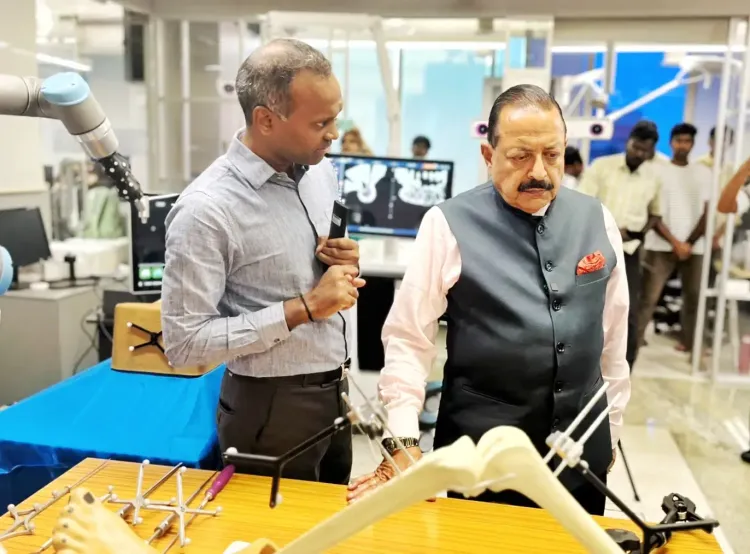
During his visit to the Immersive Technology and Entrepreneurship Labs (ITEL) Foundation and other cutting-edge research facilities at the Indian Institute of Technology Madras, the Minister, who oversees the Science and Technology and Earth Sciences ministries and also works within the Prime Minister’s Office, made these observations.
“This model is now being eagerly adopted by various academic institutions and universities as well,” he remarked.
During his tour, Dr. Singh assessed ongoing projects in sectors like urban mobility, space technology, medical devices, and brain research.
“The consortium approach, which involves industry partners from the earliest phases of research and development, guarantees that innovations meet actual market demands,” Dr. Singh explained.
“This comprehensive model enables research findings to be swiftly converted into practical, market-ready solutions,” he added.
The ITEL Foundation, launched in July 2024 as a non-profit Section 8 company and endorsed by the Department of Science and Technology, seeks to establish India as a world leader in technology.
It unites academic institutions, industry leaders, and investors to collaboratively develop deep-tech innovations and transfer them directly to the commercial market.
A notable demonstration during the visit was the HASHTIC mobility initiative, which aims to alleviate traffic congestion in Indian cities.
This project proposes AI-enabled small electric vehicles operating on elevated tracks above existing roads, aiming to reduce a 15-kilometre commute to approximately 20 minutes.
Dr. Singh also evaluated the initiatives of Agnikul Cosmos, a private space startup incubated within the IIT Madras ecosystem.
This company specializes in developing launch vehicles for flexible, on-demand satellite launches and achieved its inaugural mission in May 2024, with support from the Indian Space Research Organisation and IN-SPACe.
The startup is currently preparing for a commercial mission of its reusable rocket later this year, reflecting the increasing influence of private entities in India’s space sector.
Point of View
It is evident that the consortium-driven innovation model is a significant advancement in bridging the gap between academic research and practical application. By integrating industry partners early in the research process, this model not only enhances the relevance of innovations but also positions India favorably in the global technology landscape. It is imperative that we continue to support such initiatives for sustainable growth and development.
NationPress
9 Oct 2026
Frequently Asked Questions
What is the consortium-driven innovation model?
The consortium-driven innovation model is an approach where multiple stakeholders, including academic institutions and industry partners, collaborate from the early stages of research and development to ensure that innovations meet market needs.
How does this model affect technology commercialization?
This model facilitates immediate and effective commercialization of technology by aligning research outcomes with real-world applications, ensuring that innovations can quickly transition into market-ready solutions.
What is the role of IIT Madras in this model?
IIT Madras, through its Research Park, has pioneered this consortium-driven innovation model, which is now being adopted by various other institutions across India to enhance technology commercialization.
What are some projects associated with this model?
Projects include initiatives in urban mobility, space technology, medical devices, and brain research, highlighting the model's versatility across different sectors.
How can this model benefit India’s position in technology?
By fostering collaboration between academia and industry, this model positions India as a global technology leader, driving innovation and economic growth.