Did the Delhi HC Uphold AIIMS Eligibility for Fragmented Residency?

Synopsis
In a landmark decision, the Delhi High Court ruled that fragmented residency across different institutions can fulfill the AIIMS eligibility criteria for a medical aspirant. This ruling reinforces the importance of merit and fairness in educational admissions, emphasizing that eligibility requirements should be clear and unambiguous.
Key Takeaways
Delhi High Court overturns AIIMS's rejection of a medical aspirant.
Residency requirements can be fulfilled cumulatively from different institutions.
Importance of clear and explicit eligibility criteria emphasized.
Merit and fairness in educational admissions are crucial.
Ruling could benefit many aspiring medical professionals.
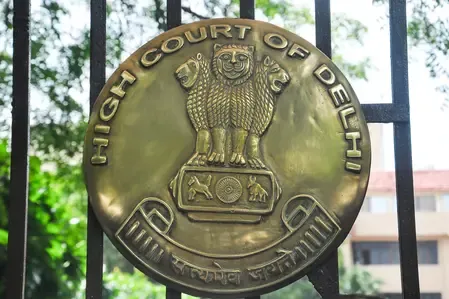
New Delhi, Feb 3 (NationPress) The Delhi High Court has annulled the cancellation of a medical candidate's eligibility for the DM Critical Care Medicine program at AIIMS, asserting that the required three-year postgraduate residency can be totaled even if completed in different institutions.
In response to a writ petition filed by Meet Bhadresh Shah, who achieved an All India Rank of 4 in the Institute of National Importance Super-Specialty (INI-SS) January 2026 examination, a single-judge Bench presided by Justice Jasmeet Singh overturned the rejection letter from AIIMS dated January 2, which had invalidated his application.
The Delhi High Court determined that Clause 4.3.2 of the INI-SS prospectus merely requires the completion of "3 years (1,095 days)" of necessary qualification and tenure by the specified cut-off date, without mandating that such residency must be completed at a single institution.
Justice Singh stated, "A straightforward interpretation of the prospectus indicates that it demands the requisite qualification, degree, and tenure of three years by the deadline. There is no mention that the three-year period must be served at one institution."
The petitioner accomplished his MD (Anaesthesiology) residency at three NMC-recognized institutions due to changes in counseling during the Covid-19 pandemic, totaling over 1,095 days of training, which was certified by Gujarat University.
However, AIIMS rejected his application at the final stage, arguing that the residency experience was fragmented.
Rejecting AIIMS's interpretation, the Delhi High Court stated that eligibility requirements should be "clear, explicit, and uniformly applicable" and cannot be supplemented by interpretive additions later.
Justice Singh asserted, "Once the language of the prospectus is clear and unambiguous, it cannot be left to the institution's discretion to add words and interpret it in a way that is not supported by its plain reading."
The order noted that AIIMS had accepted the petitioner's application, issued an admit card, allowed him to participate in counseling, and declared him successful without raising any eligibility objections until the final stage.
“An action by the institution that surprises candidates at the very end of the selection process does not withstand judicial scrutiny,” the Delhi High Court remarked, emphasizing that such actions compromise meritocracy.
“Merit and fairness must triumph over technicalities. The right to pursue higher education, while not explicitly defined as a fundamental right, imposes a positive duty on the state and cannot be lightly restricted on merely technical or procedural grounds,” Justice Singh concluded.
Determining that denying admission in this instance would lead to "a travesty to merit," the Delhi High Court permitted the petition and ruled that the petitioner's fragmented residency, totaling 1,095 days in the same field, met the eligibility criteria as per the prospectus and ordered that his application be reinstated.
Point of View
The Delhi High Court's ruling underscores the necessity for clear and fair admission standards. This decision not only addresses the immediate concerns of the petitioner but also sets a precedent that could benefit many aspiring medical professionals in navigating similar challenges. At NationPress, we advocate for meritocracy and fairness in education.
NationPress
23 Sept 2026
Frequently Asked Questions
What was the main ruling of the Delhi High Court?
The Delhi High Court ruled that fragmented residency across multiple institutions can count towards the three-year postgraduate residency requirement for AIIMS admission.
Who is Meet Bhadresh Shah?
Meet Bhadresh Shah is a medical aspirant who secured an All India Rank of 4 in the INI-SS January 2026 exam and had his candidature cancelled by AIIMS.
Why was Shah's candidature initially rejected?
His candidature was rejected on the grounds that his residency experience was fragmented across different institutions.
What does the prospectus state about residency requirements?
The prospectus states that candidates must complete three years (1,095 days) of postgraduate residency but does not specify that it must be completed at a single institution.
What implications does this ruling have for future medical aspirants?
This ruling has positive implications for future medical aspirants as it clarifies that residency can be completed across multiple institutions, promoting fairness in admissions.