Are Disrupted Sleep Patterns Linked to More Aggressive Breast Cancer?
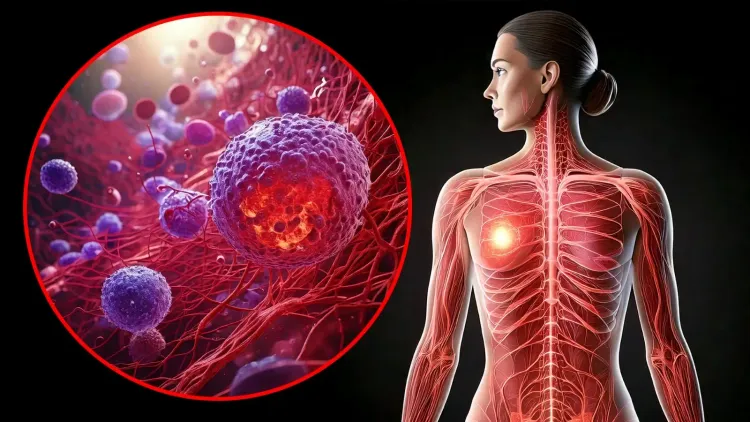
Synopsis
A groundbreaking study has revealed that women with disrupted sleep cycles, often due to night shifts or frequent travel, may face a significantly higher risk of aggressive breast cancer. This research highlights the importance of maintaining a healthy circadian rhythm to safeguard against this deadly disease.
Key Takeaways
Disrupted sleep patterns can increase the risk of aggressive breast cancer.
Circadian rhythms play a vital role in regulating bodily functions and immune responses.
Models with disrupted circadian rhythms showed earlier and more aggressive cancer development.
Maintaining a stable sleep schedule may help mitigate cancer risks.
Long-term disruptions can alter the structure of healthy breast tissue.
New Delhi, Dec 26 (NationPress) Women engaged in night shifts or those who frequently travel across time zones, leading to irregular sleep patterns, may face a heightened risk of aggressive breast cancer, as indicated by a recent study. The research team from the Texas A&M University College of Arts and Sciences elucidated that disruptions to circadian rhythms not only alter the structure of mammary glands but also compromise the immune system's ability to defend against cancer, highlighting potential strategies to mitigate these impacts.
Dr. Tapasree Roy Sarkar, Co-Director of the Center for Statistical Bioinformatics at Texas A&M, noted, "Cancer operates on a schedule. When your internal clock is out of sync, cancer can exploit this weakness -- but we've discovered a novel approach to counter it."
Circadian rhythms – the body's internal 24-hour clock – perform multiple functions beyond regulating sleep. They play crucial roles in hormone secretion, tissue repair, and monitoring immune responses.
When these rhythms are disrupted, the body's innate defenses begin to weaken.
"The circadian rhythm governs how our tissues behave and how our immune system identifies threats," Sarkar emphasized. "Disruptions to this rhythm can have perilous consequences."
The researchers studied two groups of genetically modified models prone to aggressive breast cancer. One group adhered to a standard day-night cycle, while the other experienced a disrupted light schedule that unsettled their internal clocks.
Results published in the journal Oncogene revealed that normal models typically exhibit cancer around the 22-week mark; however, the circadian-disrupted group showed early signs of cancer by approximately 18 weeks.
The tumors in the models with circadian disruptions were notably more aggressive and had a higher propensity to metastasize to the lungs, which is a critical indicator of adverse outcomes in breast cancer patients.
Furthermore, the disruption of the internal clock dampened immune defenses, fostering an environment conducive to cancer proliferation.
"It wasn't merely that the tumors expanded faster," Sarkar explained. "The immune system was actively suppressed, creating more favorable conditions for cancer cells to thrive and disseminate."
Additionally, the long-term disruption of circadian rhythms altered the composition of healthy breast tissue, rendering it more susceptible to cancer.
"We noted significant changes in the structure of the mammary glands, specifically in the milk-producing tissue of the breast," Sarkar remarked.
Point of View
It is crucial to understand the implications of the recent study linking disrupted sleep patterns to aggressive breast cancer. The findings underscore the significance of maintaining a stable circadian rhythm, particularly for women who work night shifts or travel frequently. This insight could inform public health recommendations and personal choices regarding sleep hygiene.
NationPress
24 Sept 2026
Frequently Asked Questions
What did the study find about sleep disruption and breast cancer?
The study found that women with disrupted sleep cycles, often due to night shifts or frequent travel, have an increased risk of developing aggressive breast cancer.
How do circadian rhythms affect cancer risk?
Circadian rhythms regulate various bodily functions, including immune response and hormone release. Disruption of these rhythms can weaken the immune system, making the body more susceptible to cancer.
What were the main findings of the Texas A&M study?
The study revealed that genetically engineered models with disrupted circadian rhythms developed aggressive breast cancer earlier and with more severe characteristics compared to those on a normal schedule.
What are the implications of these findings?
These findings highlight the importance of maintaining a stable sleep schedule as a potential preventive measure against aggressive forms of breast cancer.
How can one maintain a healthy circadian rhythm?
To maintain a healthy circadian rhythm, it is advisable to establish a consistent sleep schedule, limit exposure to screens before bedtime, and manage light exposure during the night.