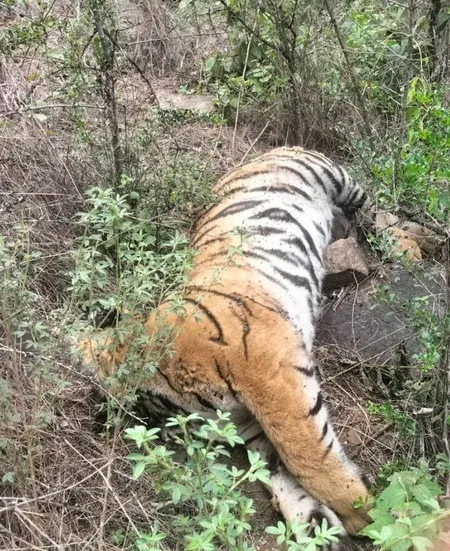
Royal Bengal tigress dies at Jharkhali rescue centre in Sundarbans
Synopsis
A Royal Bengal tigress rescued from the Sundarbans in critical condition in December 2024, treated for four months at Alipore Zoo, and returned to the Jharkhali rescue centre in March 2025, has died after a sudden relapse — with the autopsy report still awaited. Her death raises questions about long-term rehabilitation outcomes for big cats rescued from India's most ecologically sensitive tiger reserve.
Key Takeaways
A 13-year-old Royal Bengal tigress died at the Jharkhali Tiger Rescue Centre , Sundarbans , on 11 August .
She was originally rescued from the Chulkati forest in December 2024 in a critically ill condition.
She received approximately four months of specialised treatment at Alipore Zoo , Kolkata, before being returned to Jharkhali in March 2025 .
Her condition deteriorated suddenly on Monday morning ; she developed fever and did not respond to emergency treatment.
An autopsy has been conducted; the South 24 Parganas Forest Division is awaiting the report to determine the exact cause of death.
A Royal Bengal tigress, approximately 13 years old, died at the Jharkhali Tiger Rescue Centre in the Sundarbans, South 24 Parganas district of West Bengal, forest department officials confirmed on Tuesday, 11 August. The tigress had been under monitored care since her rescue from the wild in December 2024, and her condition deteriorated suddenly on Monday morning before she succumbed despite emergency treatment.
Background: A Long Road from Rescue to Recovery
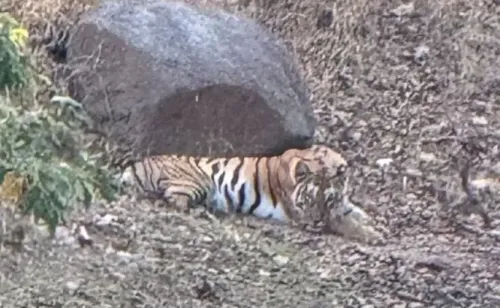
The tigress was first spotted roaming the Chulkati forest of the Sundarbans in a visibly distressed state, struggling to walk normally over several days. Forest workers mobilised a rescue operation and eventually secured her using a cage. At the time of rescue, her physical condition was described as critically poor.
Given the severity of her condition, she was transported to the Alipore Zoo in Kolkata for specialised treatment rather than receiving local care. She remained under the supervision of veterinary doctors and wildlife specialists at the zoo for approximately four months. By March 2025, her health had improved sufficiently for her to be transferred back to the Jharkhali Tiger Rescue Centre.
Sudden Deterioration and Death
According to forest department officials, the tigress appeared to be faring reasonably well after returning to Jharkhali, though her overall constitution had remained weak since the time of her initial rescue. Staff continued to monitor her condition regularly as a precaution.
On Monday morning, forest workers observed that she was lethargic and not moving normally. She was subsequently diagnosed with fever, and emergency treatment along with necessary medicines was arranged without delay. However, the tigress did not respond to treatment and died while still under care.
What the Forest Department Said
Nisha Goswami, Divisional Forest Officer (DFO) of the South 24 Parganas Forest Division, told reporters: 'The tigress was rescued from the forest of Chulkati in a very sick condition in December 2024. After treatment, she was doing well at the Jharkhali Tiger Rescue Centre. She fell ill on Monday morning. Despite treatment, she could not be saved. An autopsy has been conducted to find out the exact cause of death.'
Autopsy and Next Steps
A post-mortem examination has already been carried out on the tigress to determine the precise cause of death. The forest department is currently awaiting the autopsy report. The findings are expected to shed light on whether the death was linked to her prolonged illness, age-related complications, or another underlying condition.
The loss of the tigress is a setback for conservation efforts in the Sundarbans, one of the world's largest mangrove ecosystems and a critical habitat for the endangered Royal Bengal tiger. Wildlife authorities are likely to face renewed scrutiny over long-term care protocols at rescue facilities as the autopsy results come in.
Point of View
Despite months of intensive rehabilitation at one of Kolkata's premier zoological facilities, raises uncomfortable questions about the long-term viability of rescue-and-return protocols for critically ill big cats. The Sundarbans tiger population is already under pressure from habitat fragmentation and human-wildlife conflict, making every individual loss significant. What is missing from the official account is any discussion of whether reintroduction to a rescue centre — rather than continued zoo care — was the right call given her persistently weak constitution. The autopsy report will be telling, but the deeper audit needed is of the decision-making framework that governs when a rescued animal is deemed 'well enough' to be moved.
NationPress
26 Sept 2026
Frequently Asked Questions
Where did the Royal Bengal tigress die?
The tigress died at the Jharkhali Tiger Rescue Centre in the Sundarbans, South 24 Parganas district, West Bengal, on 11 August. She was undergoing treatment after a sudden deterioration in her health on Monday morning.
When and where was the tigress originally rescued?
She was rescued from the Chulkati forest in the Sundarbans in December 2024, after being spotted roaming in a visibly ill condition for several days and struggling to walk normally. Forest workers used a cage to secure her after a sustained effort.
What treatment did the tigress receive before her death?
Following her rescue, she was taken to Alipore Zoo in Kolkata for advanced veterinary care, where she was treated for approximately four months under specialist supervision. Her condition improved and she was transferred back to the Jharkhali Tiger Rescue Centre by March 2025.
What is the cause of the tigress's death?
The exact cause of death has not yet been confirmed. An autopsy has been conducted, and the South 24 Parganas Forest Division is awaiting the post-mortem report. She developed fever on Monday and did not respond to emergency treatment.
What did the Divisional Forest Officer say about the tigress's death?
DFO Nisha Goswami stated that the tigress had been doing well at Jharkhali after her treatment but fell ill on Monday morning and could not be saved despite medical intervention. She confirmed that an autopsy has been conducted to determine the exact cause of death.