Bangladesh lawyers arrested under Anti-Terrorism Act for Mujibur Rahman prayer gathering
Synopsis
Fifteen lawyers in Chattogram were arrested under Bangladesh's Anti-Terrorism Act simply for attending a private prayer marking Bangabandhu Sheikh Mujibur Rahman's death anniversary — a move an international rights group says is part of a widening crackdown on opposition voices that has persisted from the Yunus-led interim government into the new BNP administration.
Key Takeaways
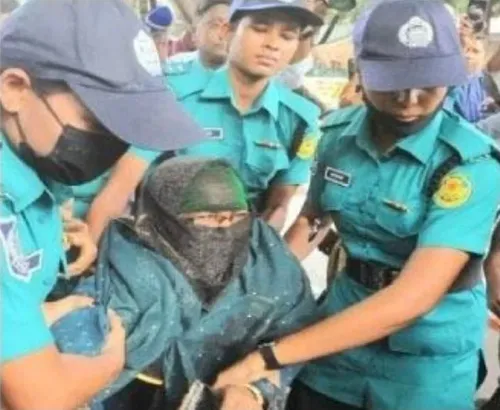
15 lawyers , including 5 women , were arrested in Chattogram's Double Mooring area on Saturday night under Bangladesh's Anti-Terrorism Act .
The lawyers had gathered for a private prayer marking the death anniversary of Bangabandhu Sheikh Mujibur Rahman , assassinated on 15 August 1975 .
A court granted bail to the 5 women lawyers on Sunday; the remaining 10 were denied bail and sent to jail.
JMBF condemned the arrests as arbitrary and warned of misuse of counter-terrorism legislation against peaceful civic activity.
JMBF Founder President Shahanur Islam described the incident as part of a broader pattern of repression continuing under the new BNP government.
JMBF has called on the UN , EU , and international bodies to monitor the case and press for the lawyers' release.
An international human rights organisation has strongly condemned Bangladeshi authorities for the arrest of 15 lawyers — including five women from the Chattogram District Bar Association — under the country's Anti-Terrorism Act, following their participation in a private prayer and commemorative gathering marking the death anniversary of Bangabandhu Sheikh Mujibur Rahman on 15 August. The arrests, carried out on Saturday night in the Double Mooring area of Chattogram, have drawn sharp international criticism over the alleged misuse of counter-terrorism legislation against peaceful civic activity.
The Arrests
Chattogram police detained the 15 lawyers from a private residence in the Double Mooring neighbourhood late on Saturday, acting on what authorities described as secret intelligence. The lawyers, identified as activists and supporters of the Awami League, had gathered to observe the death anniversary of Sheikh Mujibur Rahman, widely regarded as Bangladesh's 'Father of the Nation', who was assassinated on 15 August 1975 along with several members of his family. Double Mooring Police Station OC Shaheen Alam confirmed to Bangladeshi daily Prothom Alo that the arrested individuals were charged under the Anti-Terrorism Act before being produced in court.
Court Proceedings and Bail
On Sunday afternoon, a court granted bail to the five women lawyers among the detained. The remaining 10 lawyers were denied bail and remanded to judicial custody. The use of anti-terrorism charges in connection with what the rights group described as a peaceful and private gathering has alarmed legal observers both within Bangladesh and internationally.
Rights Group Condemns the Detentions
The JMBF (Justice Makers Bangladesh Foundation) described the application of anti-terrorism legislation to a peaceful commemorative event as 'alarming'. In a statement, the organisation said: 'In the absence of any evidence linking the detained lawyers to violence or genuine terrorist activity, their detention raises serious concerns regarding arbitrary arrest, due process, freedom of expression, peaceful assembly and association, political participation, and the potential misuse of counter-terrorism legislation.'
JMBF stressed that peaceful commemoration, prayer, expression of condolences, association, or political opinion cannot, in themselves, legitimately be equated with terrorism. The group warned that applying extraordinary criminal law to such conduct risks undermining fundamental freedoms, the independence of the legal profession, and the rule of law.
A Broader Pattern of Repression, Critics Say
JMBF Founder President and human rights lawyer Shahanur Islam placed the incident within a wider context, stating: 'The arrest of 15 lawyers in Chattogram is not an isolated incident; rather, it forms part of a broader pattern of alleged human rights violations and repression in Bangladesh targeting lawyers, journalists, human rights defenders, cultural activists, and leaders, activists, and supporters of opposition political parties.' Islam noted that this pattern intensified during the former Interim Government led by Muhammad Yunus and, he argued, appears to be continuing under the newly formed Bangladesh Nationalist Party (BNP) government.
Islam further said: 'Peaceful remembrance, prayer, expression of political opinion, or association with a political party must never, in themselves, be treated as terrorism. Using the Anti-Terrorism Act against peaceful activities undermines the rule of law, shrinks democratic and civic space, and creates an atmosphere of fear.'
International Calls for Action
JMBF has urged the United Nations, the European Union, diplomatic missions based in Bangladesh, international bar associations, and global human rights organisations to closely monitor the case. The group has called on Bangladeshi authorities to immediately release the arrested lawyers and to safeguard the rights, liberty, dignity, and professional independence of all lawyers in the country. Bangladesh observes 15 August as National Mourning Day in commemoration of the 1975 assassination of Sheikh Mujibur Rahman. How the BNP-led government responds to this international pressure is expected to be closely watched in the coming days.
Point of View
Which came to power partly on a reform mandate, now faces the same accountability questions it once directed at its predecessors. If the pattern JMBF describes is accurate — crackdowns running unbroken from the Yunus interim period into the BNP era — it suggests institutional entrenchment of repressive practices rather than partisan excess. The legal profession's independence is a bellwether: when lawyers face terrorism charges for commemorating a historical figure, the space for all other dissent contracts accordingly.
NationPress
1 Oct 2026
Frequently Asked Questions
Why were the 15 lawyers arrested in Chattogram, Bangladesh?
The 15 lawyers were arrested on Saturday night in Chattogram's Double Mooring area for attending a private prayer and commemorative gathering marking the death anniversary of Bangabandhu Sheikh Mujibur Rahman. Police charged them under Bangladesh's Anti-Terrorism Act, citing secret intelligence about the gathering.
What is the JMBF and what has it said about the arrests?
JMBF (Justice Makers Bangladesh Foundation) is an international human rights organisation. It condemned the arrests as arbitrary, stating that in the absence of any evidence linking the lawyers to violence or genuine terrorist activity, the detentions raise serious concerns about due process, freedom of expression, and the misuse of counter-terrorism legislation.
What happened to the lawyers in court?
On Sunday afternoon, a court granted bail to the five women lawyers among those detained. The remaining 10 lawyers were denied bail and remanded to judicial custody.
Who is Bangabandhu Sheikh Mujibur Rahman and why is 15 August significant in Bangladesh?
Sheikh Mujibur Rahman, known as Bangabandhu, is widely regarded as Bangladesh's 'Father of the Nation'. He was assassinated on 15 August 1975 along with several family members. Bangladesh observes 15 August as National Mourning Day in his commemoration.
What action has JMBF called for internationally?
JMBF has urged the United Nations, the European Union, diplomatic missions in Bangladesh, international bar associations, and global human rights organisations to monitor the case and press Bangladeshi authorities to release the arrested lawyers and protect the professional independence of all lawyers in the country.