43 million Americans owe $1.7 trillion: McMahon presses Congress on student debt
Synopsis
Education Secretary Linda McMahon put a stark number on America's student debt crisis — 43 million borrowers, $1.7 trillion owed — and used it to defend the Trump administration's new graduate loan caps. The hearing exposed a sharp fault line: Republicans say unchecked federal lending inflated tuition; Democrats warn the caps will worsen nursing and teaching shortages and push students into costlier private debt.
Key Takeaways
43 million Americans carry a combined $1.7 trillion in student debt, according to Education Secretary Linda McMahon .
The Trump administration has introduced new caps on federal graduate borrowing for programmes including nursing , teaching , and social work .
The redesigned FAFSA application now takes approximately 35 minutes to complete, down from several days in previous cycles.
The administration says it has blocked more than $1 billion in fraudulent student aid, including 'ghost student' and AI-generated application schemes.
Democrats, including Rep.
Joe Courtney , warned the loan caps risk deepening healthcare and education workforce shortages.
The policy shift is being closely tracked by Indian students , one of the largest international student groups in the US .
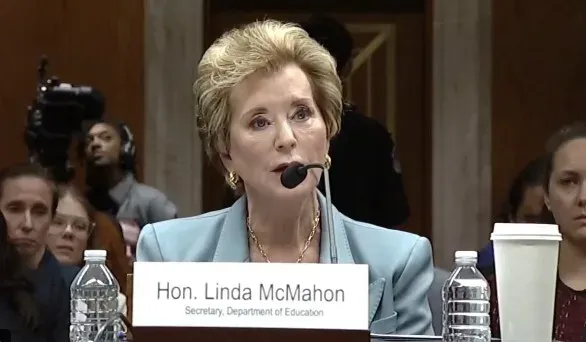
Education Secretary Linda McMahon told the House Education and Workforce Committee on 15 May 2025 that 43 million Americans are collectively carrying $1.7 trillion in student debt, as the Trump administration escalated its campaign to curb runaway college tuition costs. McMahon defended a sweeping package of student loan reforms, arguing that decades of uncapped federal lending had enabled universities to raise fees without restraint.
The Core Argument: Federal Lending Fuelled Tuition Inflation
McMahon told lawmakers that the federal government's open-ended lending model had allowed institutions to charge whatever they wished. 'Universities have been allowed to charge whatever they wanted,' she said, framing the administration's reforms as a structural correction rather than a rollback of access. Her central position: limiting how much the government will lend forces universities to compete on price.
The administration has introduced new caps on graduate student borrowing, particularly for programmes in nursing, teaching, and social work. McMahon cited early signs of impact, saying some universities had already begun reducing graduate tuition after the caps were announced.
Democratic Pushback: Workforce Shortages and Private Loan Risk
The hearing grew contentious as Democratic members warned the borrowing caps could deepen existing workforce shortages in critical sectors. Representative Joe Courtney of Connecticut argued that some graduate nursing programmes already cost more than the new federal loan limits allow, effectively pricing out prospective nurses at a time when the country faces acute healthcare worker shortages.
Representative Ilhan Omar of Minnesota was more direct, telling McMahon: 'You are failing at your job,' during a sharp exchange over the nursing shortfall and graduate borrowing restrictions. Omar and other Democrats contended the caps would push students toward expensive private loans rather than making education more affordable.
FAFSA Overhaul and Fraud Prevention
McMahon also highlighted changes to the federal student aid infrastructure. The redesigned FAFSA application, she said, launched earlier than in any previous cycle and now takes approximately 35 minutes to complete — down from what had previously taken several days. The administration also reported blocking more than $1 billion in fraudulent aid payments, including schemes involving so-called 'ghost students' and AI-generated applications. Officials identified suspicious submissions through duplicate photo IDs and anomalous IP address patterns.
Republican Support and the Biden-Era Contrast
Committee Chairman Tim Walberg backed the reforms, saying the administration had simplified repayment structures and restored borrower accountability after what he characterised as failed loan forgiveness efforts under the previous administration. The Biden administration had pursued broad student debt cancellation programmes, several of which were blocked in court or faced sustained Republican opposition.
What This Means for Indian Students
The debate carries particular relevance for Indian students, who constitute one of the largest international student communities in the United States. Shifts in federal loan eligibility, graduate programme affordability, and workforce-linked education policy could affect long-term access to specialised professional degrees for foreign nationals studying in America. Any further tightening of graduate borrowing rules or changes to visa-linked work pathways would be closely watched by prospective students from India.
With student debt remaining one of the most contested economic and political issues in the US, the committee hearing signals that the administration's higher education overhaul is far from over — and that the sharpest battles lie ahead over graduate access, workforce readiness, and who ultimately bears the cost of college.
Point of View
But the administration has yet to show how borrowing caps alone translate into lower university prices rather than simply lower enrolment in high-cost professional programmes. The nursing shortage is not a hypothetical: the US Bureau of Labor Statistics projects demand for registered nurses to grow well into the next decade. Capping loans for nursing graduate students in that context is a gamble. What is missing from this debate is a mechanism that directly ties institutional behaviour to pricing outcomes — caps on borrowers without caps on institutions may simply shift the burden, not reduce it.
NationPress
24 Sept 2026
Frequently Asked Questions
How much student debt do Americans currently owe?
According to Education Secretary Linda McMahon, 43 million Americans collectively owe $1.7 trillion in student debt as of May 2025. McMahon cited the figure before the House Education and Workforce Committee to underscore the urgency of the Trump administration's higher education reforms.
What are the new graduate loan caps introduced by the Trump administration?
The administration has introduced limits on how much graduate students can borrow through federal loan programmes, specifically targeting fields such as nursing, teaching, and social work. The caps are designed to pressure universities into reducing tuition, though critics warn some graduate nursing programmes already exceed the new limits.
What changes have been made to the FAFSA application?
The redesigned FAFSA launched earlier than in previous years and now takes approximately 35 minutes to complete, compared to what previously took several days. The administration also says it has used the overhaul to block more than $1 billion in fraudulent aid payments.
Why are Democrats opposing the student loan reforms?
Democratic lawmakers, including Representatives Joe Courtney and Ilhan Omar, argue the graduate borrowing caps will worsen workforce shortages in nursing, teaching, and social work, and push students toward more expensive private loans. They contend the reforms reduce access to higher education for low-income Americans rather than making it more affordable.
How do these US student loan changes affect Indian students?
Indian students form one of the largest international student communities in the United States and could be affected by shifts in federal loan eligibility, graduate programme costs, and workforce-linked education policies. Any further restrictions on graduate borrowing or changes to post-study work pathways would have direct implications for Indian nationals pursuing professional degrees in America.