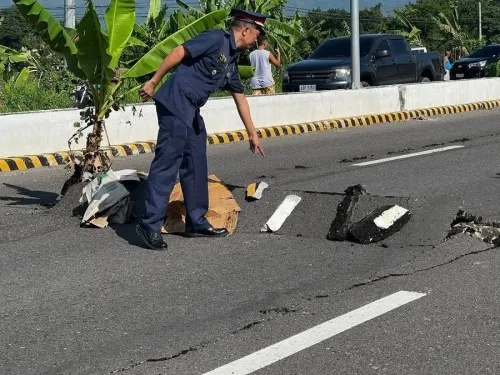
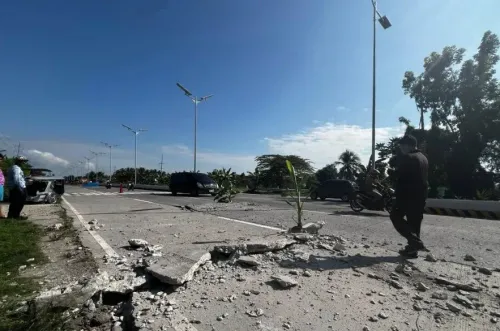
Did a 6.7 Magnitude Earthquake Just Hit Off Mindanao Island in the Philippines?
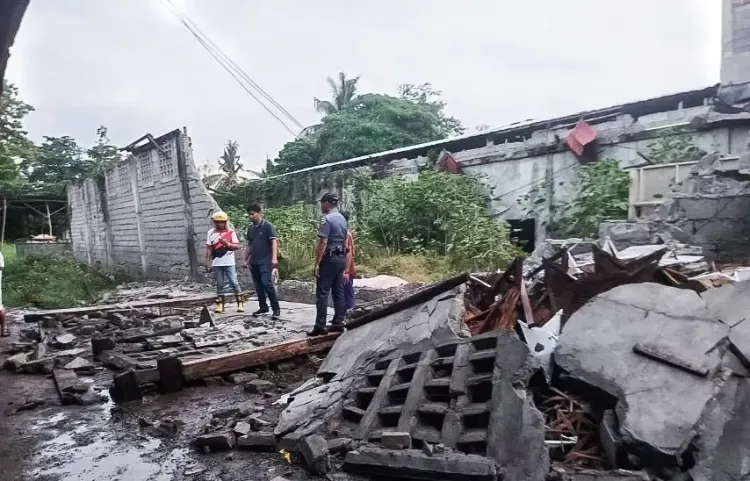
Synopsis
A powerful earthquake struck off the coast of Mindanao Island in the Philippines. This seismic event, registering a magnitude of 6.7, has sparked concerns about potential aftershocks and damage in nearby areas. Read on to learn more about the impact and the geological factors behind this earthquake.
Key Takeaways
Magnitude 6.7 earthquake off Davao Oriental.
Tremors felt across Mindanao Island.
Potential for aftershocks and localized damage.
Philippines' position in the Pacific Ring of Fire makes it seismically active.
Authorities reported no immediate injuries or damage.
Manila, Jan 7 (NationPress) The Philippine Institute of Volcanology and Seismology reported that a powerful magnitude 6.7 earthquake struck off the province of Davao Oriental in the southern Philippines on Wednesday morning.
The quake was recorded at 11:02 a.m. local time and occurred at a depth of 42 kilometers, with its epicenter situated approximately 47 kilometers from the coastal town of Manay.
Residents across the island experienced noticeable tremors.
The institute indicated that the earthquake is likely to produce aftershocks and may lead to damage, particularly in regions close to the epicenter, according to reports from the Xinhua news agency.
Local police and disaster response teams near the epicenter reported no immediate incidents of damage or injuries following the earthquake.
On December 22, 2025, a magnitude 5.7 quake had previously shaken waters near the Philippines, as stated by the GFZ German Research Centre for Geosciences.
This earlier quake had an epicenter depth of 10 kilometers, pinpointed at 8.32 degrees north latitude and 127.57 degrees east longitude.
In October 2025, a severe 6.9-magnitude earthquake hit the central Philippines, causing significant damage, numerous casualties, and widespread panic. The tremor damaged many structures and caused power outages in multiple areas, exacerbating the distress among the populace.
This quake was centered about 19 kilometers northeast of Bogo, a coastal city in Cebu province, and struck with a shallow depth of approximately five kilometers. Following the tremor, the Philippine Institute of Volcanology and Seismology issued a tsunami warning as a precaution, which was later retracted after confirming the absence of dangerous sea waves.
The Philippines is prone to frequent and often severe earthquakes due to its presence in one of the world's most geologically active regions—the Pacific Ring of Fire. This extensive belt is characterized by ongoing tectonic plate movements, leading to intense seismic and volcanic activity.
In the central Philippines, seismic activities are primarily influenced by the interactions between the Philippine Sea Plate and the Eurasian Plate. To the east, the Philippine Sea Plate is being forced underneath the Philippine Microplate along the Philippine Trench. Conversely, on the western side, the Eurasian or Sunda Plate subducts beneath the islands along the Manila and Negros Trenches.
This unique 'double subduction' scenario generates immense underground pressure. Although Tuesday’s earthquake was triggered by a shallow local fault, the accumulated stress from these converging plates significantly contributes to the country’s vulnerability to seismic events.
Point of View
I emphasize that the safety of our citizens is paramount. The Philippine Institute of Volcanology and Seismology's timely updates are crucial in mitigating risks associated with such natural disasters. We will continue to monitor the situation closely and provide accurate information to the public.
NationPress
20 Sept 2026
Frequently Asked Questions
What was the magnitude of the earthquake?
The earthquake was recorded at a magnitude of 6.7.
Where did the earthquake occur?
The earthquake struck off the coast of Davao Oriental province in the southern Philippines.
When did the earthquake happen?
The earthquake occurred on Wednesday morning at 11:02 a.m. local time.
Are there any reports of damage?
Local authorities have reported no immediate damage or injuries at this time.
What geological factors contribute to earthquakes in the Philippines?
The Philippines is located in the Pacific Ring of Fire, where tectonic plate movements cause frequent seismic activity.