800 historic Nepali documents returned from Germany, some from 13th century
Synopsis
Over 800 Nepali documents — some dating to the 13th century — have come home after decades in a private German collection. The tranche includes royal decrees, palm-leaf manuscripts and legal texts spanning the Malla, Shah and Rana eras, handed over in Kathmandu through a friendship-driven collaboration with Heidelberg University. It is a rare, clean repatriation story with no legal dispute — and a potential template for South Asia's broader push to reclaim its scattered heritage.
Key Takeaways
800+ historical documents from Nepal, some dating to the 13th century , were formally returned at a ceremony in Kathmandu .
The collection includes 465 Malla-period palm-leaf manuscripts , 312 Shah and Rana-era royal decrees , and 18 Rana prime ministerial manuscripts .
Documents were part of the private holdings of the late Joseph Peter Rindfleisch and had been gathered from Nepal between the 1780s and the 1990s .
Professor Axel Michaels of Heidelberg University facilitated the repatriation in collaboration with Nepal's National Archives and the Saraf Foundation .
Foreign Minister Shishir Khanal described the handover as restoring Nepal's 'sovereign ownership over its civilisational heritage.' Both Nepal and Germany are signatories to the 1970 UNESCO Convention on cultural property, which framed the legal and diplomatic context for the return.
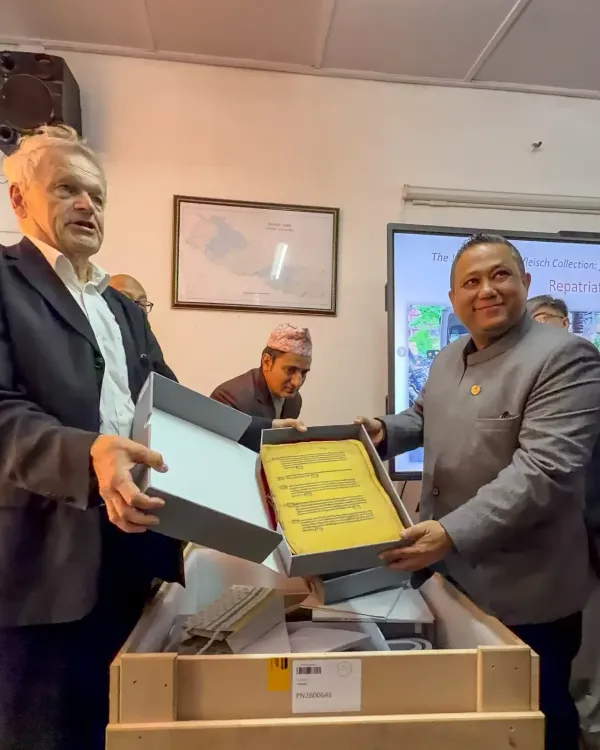
More than 800 historical documents spanning Nepal's political, legal, intellectual and cultural heritage have been formally repatriated to the Himalayan nation from Germany, with some artefacts dating as far back as the 13th century. The documents were handed over to the National Archives of Nepal on Friday, 3 October 2025, at a ceremony in Kathmandu, according to a statement from Nepal's Ministry of Foreign Affairs.
What Was Returned
The repatriated collection is remarkable in its breadth. It includes 465 palm-leaf manuscripts from the Malla period — among the oldest surviving documents from Nepal — along with 312 legal decrees and royal documents from the Shah and Rana periods, bearing clay seals. Additionally, 18 manuscripts and travel diaries from the offices of Rana prime ministers and 11 manuscripts covering diverse subjects were included in the tranche.
Among the most significant items are rukkas (official orders) and lal mohars (royal decrees bearing a red seal), alongside ancient Sanskrit texts and historical travel accounts. The collection was originally gathered from Nepal between the 1780s and the 1990s and had been part of the private holdings of the late Joseph Peter Rindfleisch.
How the Return Was Facilitated
The repatriation was set in motion by Walter Rindfleisch, son of the late collector, who transferred the documents to Professor Axel Michaels of the Heidelberg Academy of Sciences and Humanities under Heidelberg University. Walter Rindfleisch and Michaels were friends, a personal connection that proved pivotal in the handover process.
Michaels, along with team members Dr. Manik Bajracharya and Rajan Khatiwada, subsequently presented the documents to Nepal's Foreign Minister Shishir Khanal at the Kathmandu ceremony. The collection had been preserved and catalogued by the Heidelberg University Library and the Heidelberg Academy of Sciences and Humanities before its repatriation.
The broader effort involved collaboration among the Embassy of Nepal in Germany, Heidelberg University, the Heidelberg Academy of Sciences and Humanities, the Saraf Foundation and Nepal's National Archives.
What Nepal's Foreign Minister Said
At the handover ceremony, Foreign Minister Khanal described the return as a restoration of Nepal's cultural rights and sovereign ownership over its civilisational heritage. 'Our art, literature, traditions and sacred scriptures are not merely physical remnants; they are the living soul of our civilisation. They carry centuries of philosophical thought, political governance, legal knowledge and spiritual life,' he said.
Khanal praised the late Rindfleisch for his expressed wish to return the documents, and commended Professor Michaels and his research team for their 'academic integrity, research and sustained efforts' that made the repatriation possible.
The International Framework
Khanal also noted that both Nepal and Germany are signatories to the 1970 UNESCO Convention on the Means of Prohibiting and Preventing the Illicit Import, Export and Transfer of Ownership of Cultural Property. He said the handover demonstrated the shared commitment of both nations to the principles of that convention.
'Today's handover is an important example of our shared international commitment. We highly appreciate the active support extended by the German government, the German Embassy in Kathmandu and Heidelberg University in facilitating the smooth return of these documents,' Khanal said.
The repatriation is widely seen as a model for future collaborations between South Asian nations and European institutions holding cultural artefacts collected during the colonial and early modern eras. Nepal's National Archives is now expected to digitise and make the collection accessible to researchers worldwide.
Point of View
No public campaign, just a private friendship and academic goodwill. That makes it exceptional, and also exposes how much of South Asia's scattered heritage depends on the conscience of individual collectors rather than enforceable international law. The 1970 UNESCO Convention is cited approvingly here, but it has no retroactive force, meaning thousands of pre-1970 artefacts in European institutions remain in a legal grey zone. Nepal's National Archives receiving 800 documents is a genuine win; the deeper question is what framework emerges to address the far larger volume of material that no heir is volunteering to return.
NationPress
2 Oct 2026
Frequently Asked Questions
What historical documents were returned to Nepal from Germany?
More than 800 documents spanning Nepal's political, legal and cultural history were returned, including 465 Malla-period palm-leaf manuscripts, 312 Shah and Rana-era royal decrees bearing clay seals, 18 Rana prime ministerial manuscripts, and 11 general-subject manuscripts. Some of the palm-leaf manuscripts are among the oldest surviving documents from Nepal, dating back to the 13th century.
Where had the Nepali documents been kept in Germany?
The documents were part of the private collection of the late Joseph Peter Rindfleisch and had been housed in Germany. His son Walter Rindfleisch transferred them to Professor Axel Michaels of Heidelberg University, where they were preserved and catalogued by the Heidelberg University Library and the Heidelberg Academy of Sciences and Humanities before repatriation.
Why is this repatriation significant for Nepal?
The collection covers over two centuries of Nepali governance, law, religion and culture, gathered between the 1780s and the 1990s. Foreign Minister Shishir Khanal called it a restoration of Nepal's 'sovereign ownership over its civilisational heritage,' and it is one of the largest single-batch repatriations of Nepali documents from a foreign private collection.
What is the 1970 UNESCO Convention cited in the handover?
The 1970 UNESCO Convention on the Means of Prohibiting and Preventing the Illicit Import, Export and Transfer of Ownership of Cultural Property is an international treaty that obliges signatory states to prevent illegal movement of cultural artefacts. Both Nepal and Germany are parties to the convention, and the handover was framed as an expression of their shared commitment to its principles.
Who organised the repatriation of the Nepali documents?
The repatriation was coordinated through collaboration among the Embassy of Nepal in Germany, Heidelberg University, the Heidelberg Academy of Sciences and Humanities, the Saraf Foundation and Nepal's National Archives. Professor Axel Michaels, along with Dr. Manik Bajracharya and Rajan Khatiwada, led the academic side of the effort after Walter Rindfleisch entrusted the collection to Michaels.