World Bank: AI saves Indian farmers $560, but threatens BPO jobs
Synopsis
The World Bank's first-ever AI report for developing economies uses India as its centrepiece — from a Telangana weather tool saving farmers $560 to a cough-based TB screener catching 9 in 10 cases. The catch: the same AI wave threatening white-collar jobs in rich nations is already lapping at India's vast BPO sector.
Key Takeaways
The World Bank's World Development Report 2026 flags India as a leading testing ground for practical, low-cost AI.
An AI weather tool in Telangana generated net savings of up to $560 per farmer ; Krushi Samruddhi in Odisha now serves over 7 million farmers with benefit-cost ratios of 9:1 to 15:1 .
Kisan e-Mitra resolved 2.7 million agricultural queries in 186 days — 7x manual capacity — across 11 Indic languages .
Cough Against TB by Wadhwani AI correctly flagged 9 in 10 patients needing confirmatory testing.
Fewer than 1 in 10 jobs in developing economies face AI automation risk, versus more than 1 in 3 in high-income nations — but India's BPO sector remains a specific vulnerability.
Under the IndiaAI Mission , Sarvam AI is building models of 30 billion and 105 billion parameters trained entirely in India.
Artificial intelligence is already delivering measurable gains for Indian farmers, tuberculosis patients, and agricultural advisory services — but the same technology risks eliminating call-centre and entry-level software jobs, the World Bank warned in its World Development Report 2026, released on 10 August. The report positions India as one of the most consequential testing grounds for practical, low-cost AI deployment in the developing world.
Gains on the Farm
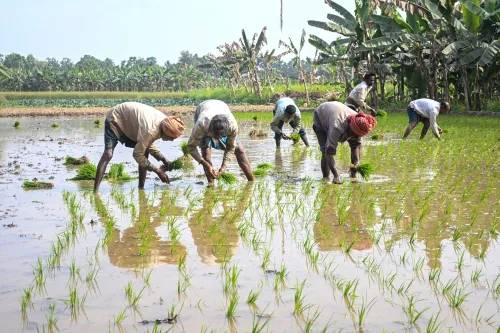
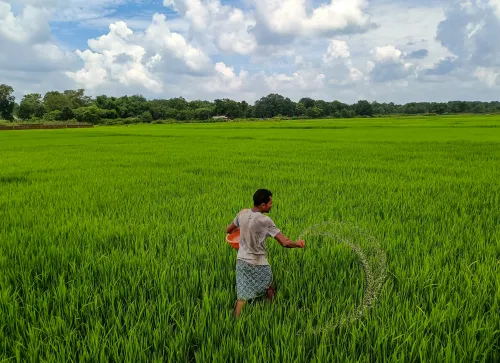
India's agricultural sector features prominently among the report's most striking case studies. In Telangana, an AI-powered weather forecasting system enabled small and marginal farmers to adjust their practices in response to specific risk signals. Some increased farm spending by as much as one-third, while others recorded net savings of up to $560 per farmer, according to the report.
Ama Krushi, launched in Odisha in 2018 and now operating as Krushi Samruddhi, incorporated AI-driven advisory services after moving into government ownership in 2022. Its farmer base grew from roughly three million to more than seven million. A 2025 evaluation found that the service improved farming practices, increased harvests, and reduced severe crop losses — producing benefit-cost ratios ranging from 9:1 to 15:1.
Kisan e-Mitra, an agricultural grievance-redress chatbot operating in 11 Indic languages, handled approximately 2.7 million queries within 186 days of adding advanced AI capabilities — nearly seven times the volume that traditional manual processing could have managed.
AI in Healthcare: TB and Blindness Screening
The report also highlighted AI's potential to address India's chronic shortage of medical specialists. Cough Against TB, developed by Wadhwani AI in collaboration with India's Central Tuberculosis Division, correctly identified nine out of ten individuals who required a confirmatory test, based solely on the sound of their cough.
A Government of India assessment in Maharashtra found that computer-aided detection was both more accurate and less expensive than radiologist readings when screening X-ray images for tuberculosis. Tamil Nadu has separately introduced large-scale AI screening for diabetic retinopathy, a leading cause of preventable blindness.
The BPO Risk: Jobs Under Pressure
The World Bank's optimism is tempered by a pointed warning. AI has already replaced capabilities that customer-service workers at an Indian business-process outsourcing company were performing, the report noted — illustrating how the same technology can complement workers in one context while displacing them in another.
The report cautioned that AI could foreclose an important pathway to middle-class employment by threatening call-centre positions and entry-level roles in software, finance, and business services. Countries heavily dependent on business-process outsourcing face particular pressure as the technology automates back-office work.
That said, the Bank's broader finding is that developing economies have more to gain and less to fear than wealthier nations. Fewer than one in ten jobs in developing economies are susceptible to AI automation, compared with more than one-third in high-income countries. Conversely, roughly one in six jobs — about 16.2% — in developing economies could be enhanced rather than replaced. 'Developing economies should tune out much of this noise,' the report said, referring to anxieties in richer countries about AI displacing white-collar workers.
India's Domestic AI Push
The report identified India as one of the developing economies actively building AI systems adapted to local languages and conditions. Under the government's IndiaAI Mission, Sarvam AI was selected to develop domestic large language models. The company plans models with 30 billion and 105 billion parameters, to be trained entirely within India, according to the report.
India's Unified Payments Interface (UPI) was cited as a model of digital public infrastructure — one that allows banks, financial-technology firms, and payment applications to share a common underlying system, promoting competition and reducing lock-in.
What the World Bank Recommends
The report urged developing nations to focus on adopting existing AI tools, adapting them to local conditions, and building domestic capabilities where resources allow. It noted that small AI systems can operate offline on phones and laptops, or be accessed via voice calls and text messages in areas where electricity and internet access remain unreliable.
The World Development Report 2026 is the World Bank's first comprehensive assessment of AI's implications for developing economies. The Bank concluded that AI could enable developing countries to achieve in a decade progress that might otherwise take a century — but only if accompanied by reliable electricity, affordable internet, local-language data, skilled workers, and safeguards against bias, misinformation, and excessive dependence on foreign technology.
Point of View
But it papers over a structural tension specific to India. India's BPO and IT-services sectors are precisely the middle-rung employment ladders that have historically moved workers from informal to formal, low-skill to mid-skill. If AI compresses that ladder before the broader workforce has upskilled, the gains in agriculture and health could be offset by urban employment shocks. The report's own evidence — that AI has already displaced workers at an Indian BPO — suggests this is not a distant risk. The IndiaAI Mission and Sarvam AI are encouraging signals, but domestic model-building at scale requires sustained policy commitment and compute access that India has not yet fully demonstrated.
NationPress
10 Aug 2026
Frequently Asked Questions
What does the World Bank's World Development Report 2026 say about India and AI?
The report positions India as one of the most important testing grounds for practical, low-cost AI in the developing world, citing gains in agriculture, tuberculosis screening, and healthcare access. It also warns that India's BPO and entry-level technology sectors face displacement risk as AI automates back-office and customer-service functions.
How is AI helping Indian farmers?
An AI weather forecasting system in Telangana helped small farmers manage risk, with some recording net savings of up to $560 per farmer. The Krushi Samruddhi programme in Odisha, using AI advisory services, grew from 3 million to over 7 million farmers and achieved benefit-cost ratios of 9:1 to 15:1 in a 2025 evaluation.
How is AI being used in India's healthcare sector?
Cough Against TB, developed by Wadhwani AI with India's Central Tuberculosis Division, correctly identified 9 out of 10 patients requiring a confirmatory TB test using cough-sound analysis. Maharashtra has also adopted computer-aided X-ray detection for TB, found to be more accurate and cheaper than radiologist readings, while Tamil Nadu has introduced AI screening for diabetic retinopathy.
Which Indian jobs are most at risk from AI automation?
Call-centre workers and entry-level employees in software, finance, and business services are most exposed, according to the World Bank. The report notes that AI has already replaced capabilities performed by customer-service workers at an Indian BPO company, illustrating a real and present displacement risk — not merely a future one.
What is India doing to build its own AI capabilities?
Under the government's IndiaAI Mission, Sarvam AI has been selected to develop domestic large language models with 30 billion and 105 billion parameters, to be trained entirely within India. The report also cites UPI as a model of interoperable digital public infrastructure that other developing economies could emulate.