Can Agri-AI Generate Rs 70,000 Crore Annually for Farmers?
Synopsis
The future of agriculture in India hinges on AI technology, with Dr. Jitendra Singh highlighting its potential to generate significant economic value for farmers. This revolutionary approach aims to tackle longstanding challenges in farming, promoting efficiency and inclusivity across diverse agricultural sectors.
Key Takeaways
AI as a central pillar of India's agricultural policies.
Potential to generate Rs 70,000 crore in annual value for farmers.
Focus on multilingual AI tools for inclusive support.
Collaboration among various stakeholders to build a national Agri Data Commons .
Investment in deep-tech and AI research for sustainable agriculture.
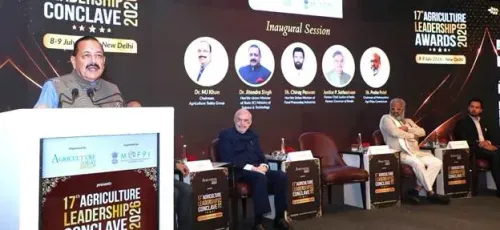
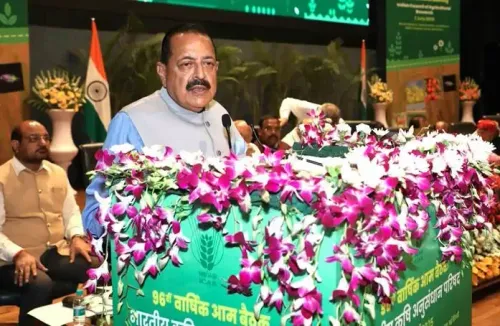
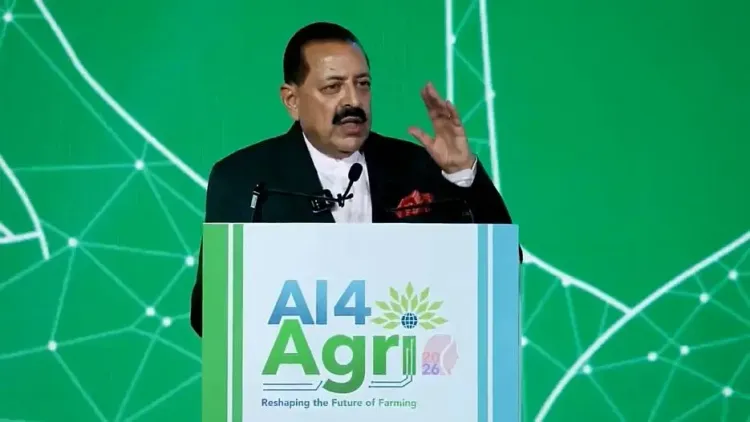
Mumbai, Feb 22 (NationPress) The upcoming agricultural revolution in India is set to be spearheaded by artificial intelligence, according to the Union Minister of State (Independent Charge) for Science and Technology, Dr. Jitendra Singh, who emphasized its role as a fundamental element of agricultural policy, research, and investment frameworks.
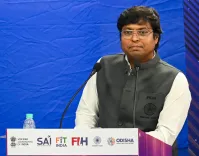
Speaking at the opening of the "Global Conference on AI in Agriculture and Investor Summit 2026" in Mumbai, he stated that AI presents scalable solutions to long-standing structural issues that hinder farm productivity—such as unpredictable weather, information gaps, and fragmented markets.
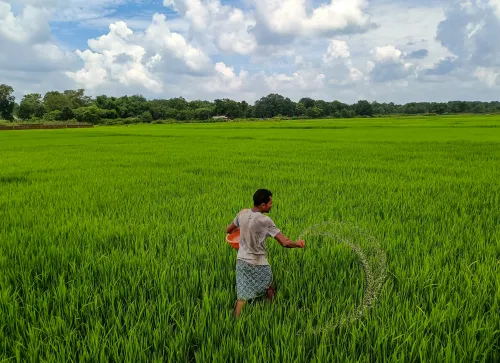
Dr. Singh underscored the potential of India's 140 million farm holdings, predominantly small and marginal, to create an estimated Rs 70,000 crore in annual value if AI-driven advisories assist farmers in saving even Rs 5,000 annually through improved input timing, pest forecasting, and market connections. He referenced Maharashtra's Rs 500-crore MahaAgri-AI Policy 2025–29 as a successful example, noting that the central government will support and enhance such state-level initiatives.
The Union Budget for 2026–27 has introduced ‘Bharat-VISTAAR’—a multilingual AI tool that integrates AgriStack portals with ICAR's agricultural practices, designed to offer tailored advisory support and mitigate farming risks. He noted that the emphasis is on small, specialized AI models trained on India's diverse soil types, climate conditions, and crop varieties, which can function even in low-connectivity rural settings via mobile devices and agricultural machinery.
"AI does not merely provide a new diagnosis; it delivers a scalable remedy," he articulated, adding that a mere 10% increase in productivity for the 600 million farmers in the Global South could present the single largest opportunity for poverty alleviation of this century.
Positioning agriculture as a strategic sector rather than a traditional one, Dr. Singh connected the AI initiative to the Rs 10,372-crore India AI Mission, which aims to establish sovereign computing capabilities, datasets, and infrastructure for startups at scale. He brought attention to BharatGen, India's government-backed large language model network that has introduced "Agri Param," a specialized agriculture model available in 22 Indian languages, allowing farmers to receive advisory services in their native languages. "This is AI that communicates with farmers in Marathi, Bhojpuri, or Kannada," he said, highlighting the significance of linguistic inclusivity.
The minister mentioned that the Department of Science and Technology (DST) is fostering an open, interoperable India AI Open Stack to ensure that agri-AI innovations can integrate into a national framework. The Anusandhan National Research Foundation is financing advanced technology and AI research in collaboration with IITs, IISc, and ICAR, focusing on agricultural applications.
Dr. Singh noted the advancements in drone and satellite mapping that are enhancing soil health assessments and the Swamitva Mission by providing verified land and soil data, along with investments in climate intelligence that merge Earth Sciences and AI into early warning systems to assist farmers in "planning, not panicking." He stressed that biotechnology will be essential in developing resilient and disease-resistant crops, including early detection of pests and plant diseases, and in promoting a circular crop economy.
He advocated for a federated national framework, suggesting that agri-digital public infrastructures like MahaAgriX evolve into a national Agri Data Commons. He called upon stakeholders to engage in a proposed National Agri-AI Research Network—a collaboration among DST, state governments, ICRISAT, ICAR, and international organizations—to create India-specific foundational datasets related to crops, soil, and climate.
The minister made a direct appeal to investors, labeling agri-AI as "the largest untapped productivity market globally," and encouraged long-term investment to support scalable platforms rather than isolated initiatives. He stated that the success of the conference would not be gauged by presentations but by the number of pilots transformed into platforms and the improved decision-making of farmers a year from now due to the commitments made here.
"Farmers do not require AI just for its own sake. They need it to be beneficial. Let that guide our efforts," he concluded, reiterating India's commitment to being a co-architect of global agri-AI frameworks rather than merely a recipient.
Point of View
I firmly believe that the integration of AI in agriculture signals a paradigm shift in how we approach farming in India. This move not only aims to enhance productivity but also empowers our farmers by providing them with the tools they need to thrive in a rapidly changing environment. It is crucial to foster innovations that are inclusive and tailored to local conditions.
NationPress
3 Oct 2026
Frequently Asked Questions
How does AI benefit farmers?
AI provides customized advisory support, helping farmers optimize input timing, predict pest infestations, and connect with markets, ultimately increasing productivity and profitability.
What is the significance of the Rs 70,000 crore figure?
This figure represents the potential annual economic value that could be generated for farmers if AI technologies are effectively implemented.
What initiatives are being taken to integrate AI in agriculture?
The Indian government is launching multilingual AI tools and funding research initiatives to develop AI models tailored to Indian agricultural conditions.