How has AI Transformed Agriculture in India?
Synopsis
Explore how India is revolutionizing agriculture through technology! With the Digital Agriculture Mission, over 7.63 crore farmer IDs and 23.5 crore crop plots have been surveyed, laying the groundwork for a more efficient farming sector. This digital transformation not only aids farmers but also enhances pest management and crop insurance.
Key Takeaways
Over 7.63 crore farmer IDs created.
23.5 crore crop plots surveyed under Digital Agriculture Mission.
AI tools enhance crop insurance processes.
Real-time pest surveillance supports farmers.
Mobile-based Digital Crop Survey captures vital data.
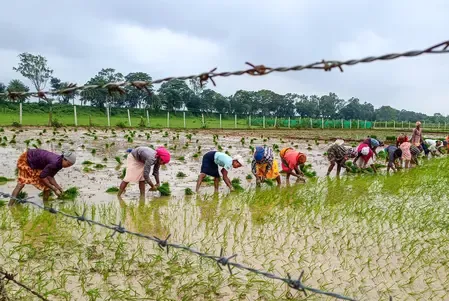
New Delhi, Feb 14 (NationPress) India has established a comprehensive digital framework for agriculture, having generated over 7.63 crore farmer IDs and surveyed 23.5 crore crop plots under the Digital Agriculture Mission, as per an official report released on Saturday.
The report indicated that the National Pest Surveillance System covers 66 crops and over 432 pest variations, offering real-time guidance to more than 10,000 extension workers for timely pest identification.
“By December 2025, the Kisan e-Mitra chatbot had addressed over 93 lakh queries, managing upwards of 8,000 farmer inquiries each day in 11 regional languages,” the government stated.
An AI-driven pilot project aimed at predicting local monsoon onset for Kharif 2025 reached 3.88 crore farmers across 13 states via SMS, with 31–52 percent of responding farmers modifying their sowing and land preparation based on the forecasts.
Additionally, YES-TECH, CROPIC, and the PMFBY WhatsApp Chatbot are utilizing AI tools to enhance the PMFBY crop insurance process, making it more innovative, quick, and transparent for farmers.
Significantly, the Union Budget 2026-27 introduced Bharat-VISTAAR, a multilingual AI resource designed to integrate AgriStack portals with the ICAR package using AI technology.
The announcement also noted that the India-AI Impact Summit 2026 emphasizes India's strategy of using Artificial Intelligence as a means for inclusive growth.
The AgriStack initiative is a foundational element of the Digital Agriculture Mission, offering farmers a unique digital identity (Farmer ID) connected to land ownership, livestock, cultivated crops, and benefits received, facilitating secure identification and access to agricultural services.
To expedite the creation and validation of Farmer IDs, Rs 10 per ID has been allocated from the PM-KISAN administrative budget. AgriStack also features a mobile-friendly Digital Crop Survey, which gathers real-time, plot-level data regarding crop types and cultivation areas.
The Pradhan Mantri Fasal Bima Yojana (PMFBY) was initiated to protect farmers from crop losses due to unforeseen circumstances by providing affordable crop insurance with low, fixed premium rates.
Farmers only pay 2% for Kharif food and oilseed crops, 1.5% for Rabi food and oilseed crops, and 5% for commercial and horticultural crops, with the remainder of the premium subsidized by the government.
Point of View
I believe that India's commitment to integrating technology into agriculture showcases a forward-thinking approach that can potentially elevate the livelihoods of millions. This initiative is not just about numbers; it's about empowering farmers with tools that can lead to sustainable growth and development in the agricultural sector.
NationPress
7 Oct 2026
Frequently Asked Questions
What is the Digital Agriculture Mission?
The Digital Agriculture Mission is an initiative by the Indian government aimed at modernizing the agricultural sector through technology, including the creation of farmer IDs and crop surveys.
How many farmer IDs have been created?
Over 7.63 crore farmer IDs have been created under the Digital Agriculture Mission.
What is the purpose of the Kisan e-Mitra chatbot?
The Kisan e-Mitra chatbot is designed to assist farmers by answering their queries in multiple languages, facilitating access to agricultural information.
How does AgriStack benefit farmers?
AgriStack provides farmers with a unique digital identity linked to their land records and crops, enabling secure access to agricultural services.
What is the Pradhan Mantri Fasal Bima Yojana?
The Pradhan Mantri Fasal Bima Yojana is a crop insurance scheme that protects farmers against losses due to unforeseen events, offering affordable insurance solutions.