How is the Government Utilizing AI to Boost Crop Yields and Farmer Incomes?
Synopsis
Discover how the Indian government is leveraging AI to transform agriculture by enhancing crop yields and supporting farmers' livelihoods. This innovative approach addresses critical agricultural challenges through advanced forecasting and AI technologies, ensuring a sustainable future for farming in India.
Key Takeaways
AI enhances crop productivity and farmer livelihoods.
Local monsoon onset forecasts are critical for sowing decisions.
Over 38 million farmers are benefiting from AI-driven information.
Kisan e-Mitra assists with over 8,000 queries daily.
The National Pest Surveillance System leverages AI for pest detection.
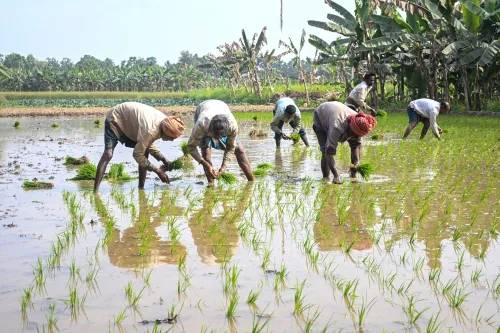
New Delhi, Dec 6 (NationPress) The government has adopted Artificial Intelligence (AI) technologies to enhance crop productivity, promote sustainability, and improve farmer livelihoods, while tackling numerous challenges within the agriculture sector.
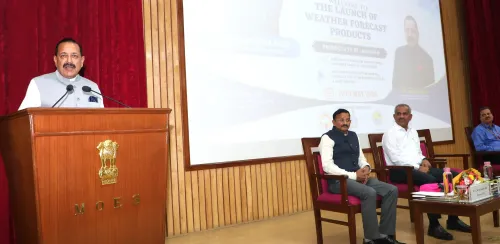
As part of this initiative, an AI-driven pilot project was carried out in collaboration with the Development Innovation Lab-India, focusing on locally relevant forecasts for monsoon onset across 13 states for the Kharif 2025 season.
According to Ramnath Thakur, the Minister of State for Agriculture and Farmers Welfare, an open-source blended model was utilized, incorporating NeuralGCM, the European Centre for Medium-Range Weather Forecasts’ (ECMWF) Artificial Intelligence Forecasting System (AIFS), alongside historical rainfall data spanning 125 years from the India Meteorological Department (IMD).
The probabilistic forecasts specifically addressed the local onset of the monsoon, a critical factor in determining sowing dates, as mentioned by the minister in a written response to the Rajya Sabha.
Local forecasts were disseminated through SMS via the M-Kisan portal to 38,845,214 farmers in 13 states, available in five regional languages: Hindi, Odia, Marathi, Bangla, and Punjabi.
Telephonic feedback surveys were conducted in Madhya Pradesh and Bihar through Kisan Call Centres following the forecasts.
The results indicated that 31–52% of farmers modified their planting strategies, primarily adjusting land preparation and sowing schedules, which included decisions on crop types and inputs.
Additionally, the Kisan e-Mitra is a voice-activated AI chatbot designed to assist farmers with inquiries regarding the PM Kisan Samman Nidhi scheme, PM Fasal Bima Yojna, and Kisan Credit Card.
This tool supports 11 regional languages and is continually evolving to provide assistance with various government initiatives.
Currently, it addresses over 8,000 farmer inquiries daily, having responded to more than 9.3 million queries to date, according to the minister.
Furthermore, the National Pest Surveillance System employs AI and Machine Learning technologies to identify pest infestations, allowing for timely interventions that promote healthier crops.
This AI tool is presently utilized by more than 10,000 extension workers, enabling farmers to capture images of pests, thereby helping them to avert pest damage and mitigate crop losses.
It supports 66 different crops and over 432 pest types. AI-driven analytics, utilizing field images for satellite-based crop mapping, is being integrated into crop-weather matching for monitoring sown crops.
Point of View
The government's initiative to integrate AI into agriculture represents a significant step towards modernizing the sector. While challenges remain, these advancements could provide farmers with the tools necessary to thrive in a changing climate. This strategy aligns with the nation's commitment to enhancing agricultural productivity and ensuring food security.
NationPress
30 Sept 2026
Frequently Asked Questions
How is AI being used in agriculture in India?
AI is being utilized to improve crop forecasts, enhance pest detection, and provide farmers with timely information, thereby increasing productivity.
What technologies are being implemented?
Technologies such as NeuralGCM and ECMWF's AIFS, along with machine learning for pest surveillance, are being implemented.
How are farmers receiving this information?
Farmers receive updates via SMS through the M-Kisan portal in multiple regional languages.
What impact has this initiative had on farmers?
Surveys indicate that a significant percentage of farmers have adjusted their planting decisions based on the forecasts provided.
What is the Kisan e-Mitra?
Kisan e-Mitra is an AI-powered chatbot designed to assist farmers with queries related to various government schemes.