How is the India AI Impact Summit Showcasing Applied AI Success in Defence and Agriculture?
Synopsis
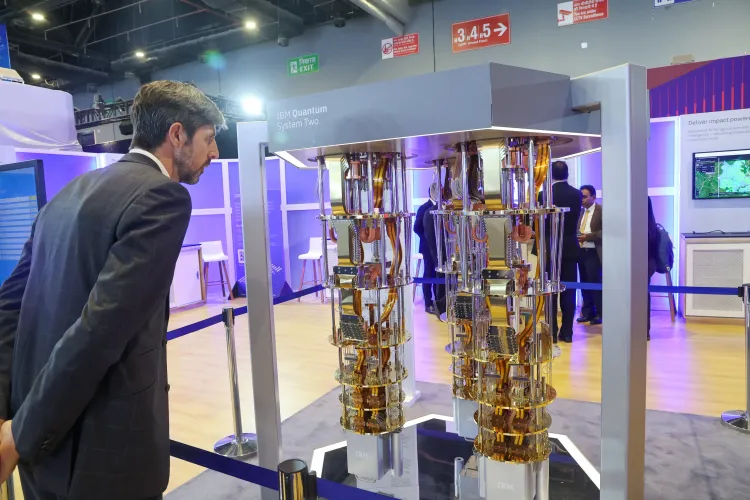
The India AI Impact Summit 2026 has revealed a transformative vision for applied AI, showcasing cutting-edge technologies in defence and agriculture. This event not only emphasizes innovation but also highlights the crucial role of education and local solutions in addressing real-world challenges.
Key Takeaways
Transformational AI Ecosystem: The event showcased advancements in applied AI across multiple sectors.
Practical Solutions: Emphasis on local engineering solutions to address real-world challenges.
Role of Education: Academic institutions play a crucial role in developing AI technologies.
Hands-On Learning: Grassroots initiatives introduce students to coding and robotics.
Innovative Technologies: Hybrid drones and inspection robotics were highlighted as key innovations.
New Delhi, Feb 20 (NationPress) The ‘India AI Impact Summit 2026’ has highlighted a growing applied AI ecosystem that aims to transform research into practical applications capable of functioning outside laboratory settings, according to a recent report.
The report from Khalsa Vox emphasized that the focus on applied AI, educational integration, and industry-ready robotics indicates a developing ecosystem dedicated to creating tools beneficial for the fields of defence, agriculture, education, and industry.
In addition to futuristic concepts, numerous exhibitors showcased practical, locally developed solutions aimed at tackling real-world issues.
Demonstrations included a hybrid vertical take-off-and-landing unmanned aerial vehicle, which merges the flexibility of multi-rotor flight with the endurance of fixed-wing aircraft.
This system is designed for extended aerial monitoring and emergency assistance, incorporating artificial intelligence for navigation and real-time data analysis.
Another drone solution employed AI-based imaging for agriculture, capable of early detection of crop diseases and facilitating targeted spraying, thereby reducing chemical fertilizer usage.
Researchers showcased a range of drone technologies tailored for surveillance, disaster response, and logistics, highlighting closer collaboration between engineers and operational agencies.
Project leaders noted a shift towards adaptable designs suitable for specific terrains and mission profiles.
The report acknowledged the increasing involvement of academic institutions in developing mission-ready unmanned platforms.
Several organizations exhibited AI-focused learning models that blend academic coursework with hands-on development.
Grassroots STEM initiatives were particularly praised for modular robotics kits aimed at school students, allowing them to assemble and program machines using block coding, Python, or C++, thus introducing them to mechanical systems, automation, and artificial intelligence from an early age.
Inspection robotics also garnered attention, featuring a climbing robot designed for wind turbine maintenance that utilizes AI vision and magnetic adhesion to autonomously navigate metal structures and perform routine tasks.
aar/na
Point of View
The India AI Impact Summit 2026 stands as a testament to the potential of applied AI in various sectors. The focus on education and local solutions reflects a commitment to not only technological growth but also to nurturing future innovators. This event underscores the importance of collaboration between academia and industry in addressing pressing challenges.
NationPress
16 Sept 2026
Frequently Asked Questions
What is the India AI Impact Summit 2026?
The India AI Impact Summit 2026 is an event that showcases advancements in applied AI across various sectors, including defence and agriculture.
How does applied AI benefit agriculture?
Applied AI benefits agriculture by enabling early detection of crop diseases and facilitating targeted spraying to reduce chemical fertilizer use.
What role do academic institutions play in AI?
Academic institutions are increasingly involved in developing mission-ready unmanned platforms and AI-focused learning models for students.
What technologies were showcased at the summit?
Technologies showcased included hybrid drones for aerial monitoring and AI-driven solutions for various industrial applications.
How can students get involved in AI?
Students can get involved in AI through grassroots STEM initiatives that offer modular robotics kits for hands-on learning.