Balochistan enforced disappearances reach alarming levels, rights groups warn
Synopsis
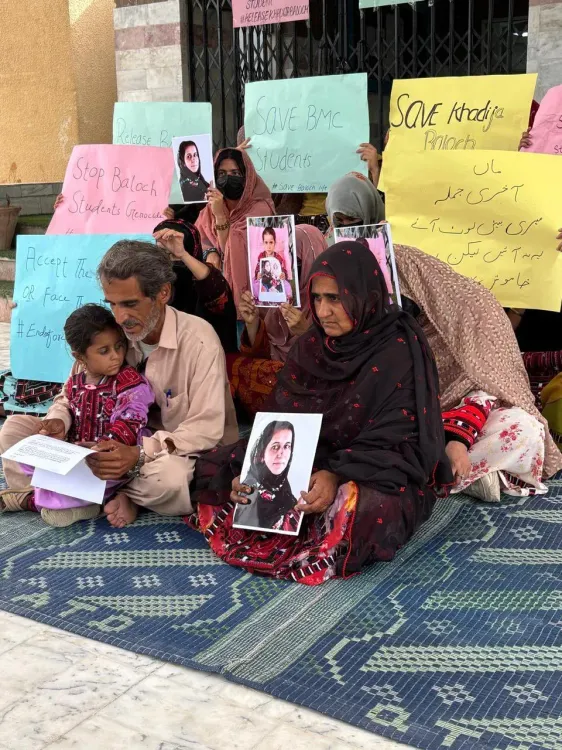
Six family members — including a 3-month-old infant — were allegedly abducted by Pakistani security forces in Mastung, Balochistan on 21 July, prompting the Baloch Women Forum to declare enforced disappearances a crisis of historic proportions. Rights groups say the practice has now reached a scale that places it among the gravest human rights failures of the 21st century.
Key Takeaways
The Baloch Women Forum (BWF) has declared enforced disappearances in Balochistan one of the most alarming human rights issues of the 21st century .
On 21 July , security forces allegedly raided a home in Killi Kongarh, Mastung and abducted six family members , including a 3-month-old infant and two other children.
The victims are identified as Bibi Rafia (33), her three children, her brother Muhammad Arif (40), and her niece Bibi Nida (18).
The Baloch Students Action Committee (BSAC) separately condemned the disappearance of student activist Jeeyand Baloch and youth Asif Baloch .
Rights groups allege detainees are held in undisclosed locations, with some later found dead or bearing signs of torture.
The Baloch Women Forum (BWF) has raised grave alarm over the escalating enforced disappearances of civilians — including women and children — allegedly carried out by Pakistani security forces in Balochistan, calling the practice one of the most serious human rights crises of the 21st century. The warning came in the wake of a 21 July raid in the Killi Kongarh area of Mastung district, in which six members of a single family were reportedly abducted.
The Mastung Incident
According to the BWF, security personnel raided a residence in Killi Kongarh, Mastung, and forcibly took away six family members. Those allegedly detained include Bibi Rafia, 33, her three children aged 3 months, 4 years, and 6 years, her brother Muhammad Arif, 40, and her niece Bibi Nida, 18. The reported abduction of a nursing infant and two toddlers has drawn particular outrage from rights organisations.
What Rights Groups Are Saying
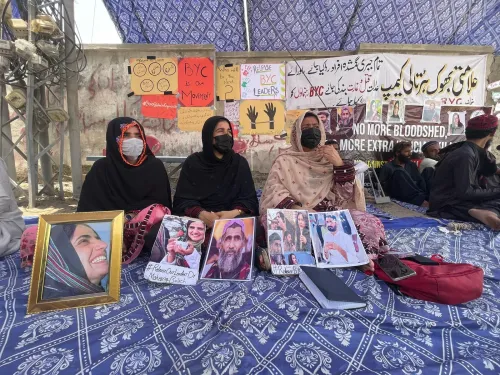
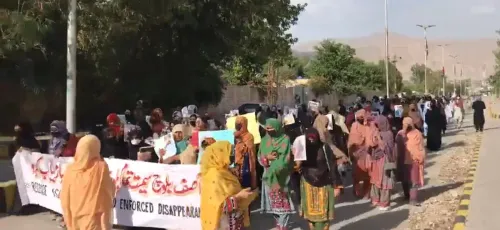
The BWF described the Mastung raid as part of a systematic, province-wide pattern rather than an isolated incident. 'The recent Mastung incident is not just a tragedy for one family but a link in this broader chain of enforced disappearances in Balochistan, about which local human rights activists, affected families, and various organisations have continuously raised their voices,' the forum said in a statement.
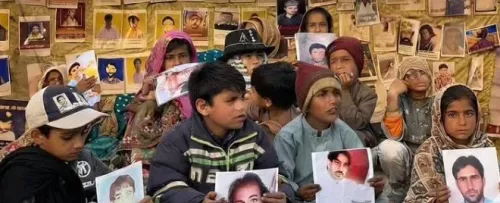
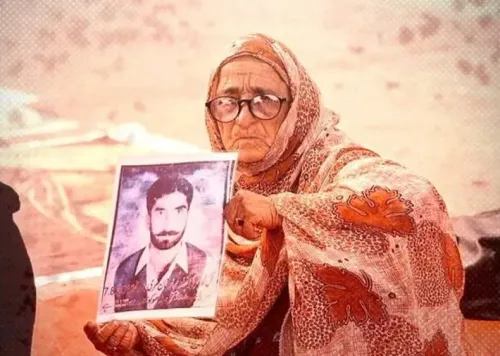
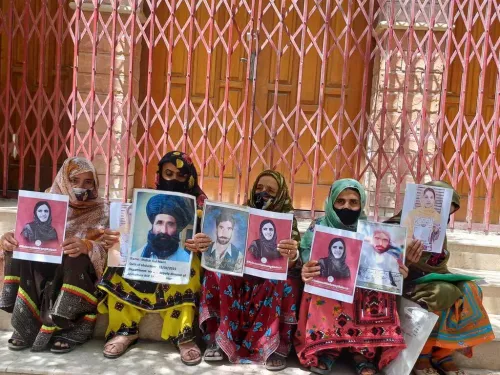
The group further noted that 'numerous families have been waiting for years for the return of their loved ones; numerous victims have passed away while waiting for their loved ones; yet this policy of coercion shows no signs of ending.' The BWF stressed that international law explicitly recognises women and children as categories warranting special protection, and argued that the disappearance of a mother carries compounding consequences — plunging entire families, particularly minor children, into 'severe psychological, economic, and social crises.'
On conditions of detention, the forum alleged that 'people are kept confined in anonymous torture cells for years; then, in some cases, mutilated bodies are recovered, in others, they are buried in unmarked graves; some emerge completely mentally paralyzed.' It called on human rights organisations globally to raise the issue 'on every forum.'
Student Activist Disappearances Draw Fresh Condemnation
Separately, the Baloch Students Action Committee (BSAC) condemned the alleged enforced disappearance of student political activist Jeeyand Baloch and another youth, Asif Baloch, along with his associates. The BSAC said the incidents underscore 'the growing threats faced by Baloch students' and warned that the pattern 'creates an atmosphere of fear among Baloch society, which is a clear violation of democratic practice.'
'This deliberate act of illegal acts and intimidation, marked by unstoppable numbers of enforced disappearances, is not only condemnable but highly concerning,' the committee stated, adding that it has 'always deemed such acts as unlawful and inhumane in nature.'
Broader Context and What Comes Next
Enforced disappearances in Balochistan have been documented by international bodies including the United Nations for well over a decade. Pakistani authorities have consistently denied systematic abductions, attributing security operations to counter-insurgency requirements. Rights groups, however, argue that the absence of due process, judicial oversight, and accountability mechanisms has allowed the practice to persist and expand. The BWF's latest statement signals that civil society pressure is intensifying, even as affected families report little movement on outstanding cases. How Pakistani authorities respond — and whether international bodies escalate scrutiny — will shape the trajectory of the crisis in the months ahead.
Point of View
Her infant, and two toddlers — represent a documented escalation that is difficult to frame as incidental to any counter-insurgency rationale. What is striking is not just the alleged act but the impunity: rights groups have raised these concerns for over a decade with minimal accountability. The international community's muted response has arguably emboldened the cycle. With civil society now explicitly naming the crisis as a 21st-century landmark in human rights violations, the question is whether global institutions will move from documentation to consequence — or whether Balochistan remains a crisis that the world watches but does not act on.
NationPress
24 Oct 2026
Frequently Asked Questions
What happened in Mastung, Balochistan on 21 July 2025?
Pakistani security forces allegedly raided a home in the Killi Kongarh area of Mastung district and abducted six family members, including a 3-month-old infant, two other young children, a 33-year-old mother, her 40-year-old brother, and her 18-year-old niece. The incident has been condemned by the Baloch Women Forum as part of a broader, systematic pattern of enforced disappearances across the province.
What is the Baloch Women Forum and why is it raising the alarm?
The Baloch Women Forum (BWF) is a civil society rights organisation that advocates for communities affected by enforced disappearances in Balochistan. It has raised the alarm because the alleged abduction of women, infants, and children in the Mastung incident reflects what it describes as an escalating province-wide pattern that violates international protections for vulnerable groups.
How widespread are enforced disappearances in Balochistan?
Rights groups and the BWF say thousands of individuals have been held in undisclosed locations over the years, with some later found dead, others in unmarked graves, and many still unaccounted for. The United Nations and multiple international human rights bodies have documented the issue for over a decade, though Pakistani authorities have denied systematic abductions.
Who is Jeeyand Baloch and why does his case matter?
Jeeyand Baloch is a student political activist whose alleged enforced disappearance was condemned by the Baloch Students Action Committee (BSAC). His case, alongside that of youth Asif Baloch, highlights what the BSAC describes as a deliberate targeting of student voices and a growing climate of fear within Baloch society.
What does international law say about enforced disappearances of women and children?
International law — including the UN Declaration on the Protection of All Persons from Enforced Disappearance — explicitly recognises women and children as categories warranting heightened protection. The BWF has invoked these provisions to argue that the alleged abductions in Balochistan constitute grave violations of binding international human rights norms.