Bangladesh cybercrime surge: Women, children make up 97% of victims

Synopsis
In Bangladesh, cybercrime has crossed an alarming threshold — and its victims are overwhelmingly women and children, who account for 97% of cyber violence cases. With 89% of survivors too afraid to report abuse and nearly three in four filed cases going unresolved, the country's digital safety net has all but collapsed. The police chief has called it one of Bangladesh's most pressing law enforcement crises.
Key Takeaways
Women and children account for nearly 97 per cent of cyber violence victims in Bangladesh , according to a Cyber Support for Women and Children Platform report covering January 2025 onwards.
Three out of every five girls and young women in the country have reportedly experienced cyberbullying .
Nearly 89 per cent of victims do not report abuse due to fear of social stigma.
Around 72 per cent of cases that are filed remain unresolved or are dismissed for lack of evidence.
A total of 4,794 cases have been registered under Bangladesh's cybercrime laws over the past five years.
IGP Ali Hossain Fakir has called cybercrime one of Bangladesh's most pressing law enforcement challenges, citing online gambling, phishing, and social media misinformation.
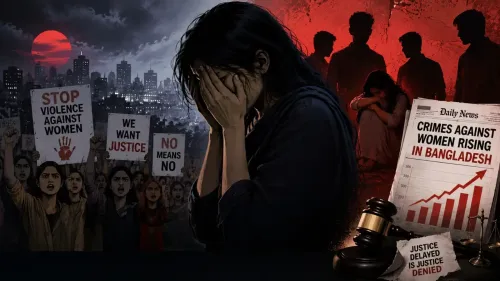
Bangladesh is grappling with a sharp escalation in cybercrime, with women and children accounting for nearly 97 per cent of all cyber violence victims, according to a report by a Bangladesh-based Cyber Support for Women and Children Platform. The findings, drawn from an analysis of 29 cases documented since January 2025, underscore a deepening crisis that law enforcement agencies describe as one of the country's most pressing security challenges.
Scale of the Crisis
Online fraud networks are rapidly widening their reach across Bangladesh, with teenagers emerging as the primary targets. According to police headquarters and intelligence sources cited in local media, three out of every five girls and young women in the country have experienced cyberbullying at some point.
Cybercriminals are increasingly stealing banking and financial credentials, raising the risk of large-scale financial fraud. Separately, significant sums of money are reportedly being routed through Mobile Financial Services (MFS) accounts linked to online gambling platforms, complicating the financial trail for investigators.
Why Victims Stay Silent
Despite the scale of the problem, reporting rates remain critically low. Nearly 89 per cent of victims refrain from filing complaints, citing fear of social stigma. Even among those who do come forward, approximately 72 per cent of cases remain unresolved or are dismissed by authorities for lack of evidence, according to Daily Sun, Bangladesh's leading Bengali-language newspaper.
This combination of under-reporting and low case resolution rates has created a cycle that critics argue effectively shields perpetrators from accountability.
Legal Framework and Institutional Gaps
Police data covering the last five years shows that a total of 4,794 cases have been registered under three laws: the Information and Pornography Control Act-2012, the Information and Communication Technology Act-2006, and the Digital Security Act-2018. However, the absence of a dedicated cybercrime investigation unit has been identified as a major structural obstacle to resolving these cases effectively.
Notably, the volume of registered cases represents only a fraction of the actual incidence, given the high rate of non-reporting documented by civil society organisations.
What the Police Chief Said
Inspector General of Police (IGP) Ali Hossain Fakir has publicly acknowledged the severity of the situation, describing cybercrime and the spread of online rumours as among Bangladesh's most urgent law enforcement challenges. Speaking at the graduation parade of the 42nd batch of Cadet Sub-Inspectors at the Sharda Police Academy in Rajshahi, he warned that offences including online gambling, phishing, and social media misinformation have become increasingly widespread across the country.
What Comes Next
Law enforcement investigations indicate that the indiscriminate exploitation of digital technology for criminal activity has reached an alarming threshold. Advocates and civil society groups are calling for a dedicated cybercrime unit, stronger victim-support mechanisms, and awareness campaigns to reduce the stigma that prevents survivors from seeking justice. Without structural reform, experts warn, the gap between actual victimisation and reported cases will continue to widen.
Point of View
But the more damning number is 89 per cent — the share of survivors who never report their ordeal. A legal framework that spans three separate acts yet lacks a dedicated cybercrime unit is structurally designed to fail victims. Bangladesh's digital safety architecture has not kept pace with the speed of criminal exploitation, and the social stigma that silences survivors functions as a second layer of impunity for perpetrators. Until victim-support infrastructure and institutional capacity are built in parallel, legislative reform alone will not move the needle.
NationPress
20 Oct 2026
Frequently Asked Questions
What percentage of cybercrime victims in Bangladesh are women and children?
According to a report by a Bangladesh-based Cyber Support for Women and Children Platform, women and children account for nearly 97 per cent of cyber violence victims. The finding is based on an analysis of 29 documented cases since January 2025.
Why do most cybercrime victims in Bangladesh not report the abuse?
Nearly 89 per cent of victims refrain from reporting cybercrime due to fear of social stigma, according to police data cited in local media. Even among those who do file complaints, around 72 per cent of cases remain unresolved or are dismissed for lack of evidence.
How many cybercrime cases have been registered in Bangladesh in the last five years?
A total of 4,794 cases have been registered under three laws — the Information and Pornography Control Act-2012, the Information and Communication Technology Act-2006, and the Digital Security Act-2018 — over the past five years, according to police data.
What has Bangladesh's Inspector General of Police said about cybercrime?
IGP Ali Hossain Fakir has described cybercrime and the spread of online rumours as one of Bangladesh's most pressing law enforcement challenges. Speaking at the Sharda Police Academy in Rajshahi, he specifically flagged online gambling, phishing, and social media misinformation as increasingly widespread offences.
What is the key institutional gap in tackling cybercrime in Bangladesh?
The absence of a dedicated cybercrime investigation unit has been identified as a major structural obstacle. Despite three separate laws covering digital offences, there is no specialised unit to ensure proper investigation and case disposal, leaving a large proportion of registered cases unresolved.