Jamaat-e-Islami tightens grip on Bangladesh university campuses, pushes pro-Pakistan agenda
Synopsis
Jamaat-e-Islami has moved from street politics to campus control — and the implications run deep. Its student wing displayed Jinnah's 1948 Urdu-only speech at the Dhaka University museum, a calculated provocation in a country whose independence was partly born in resistance to that very declaration. With the BNP-Jamaat alliance now fracturing over constitutional reforms, Bangladesh's secular foundations face their most serious institutional stress test in decades.
Key Takeaways
Jamaat-e-Islami has expanded its presence at Dhaka University and Chittagong University through its student wing, Islamic Chhatra Shibir .
The Dhaka University Central Students Union , now affiliated with Islamic Chhatra Shibir , displayed photographs and speeches of Muhammad Ali Jinnah — including his 1948 'Urdu alone' declaration — in the university museum.
Jatiyatabadi Chhatra Dal (BNP's student wing) called the display a 'disgraceful act'; Dhaka University has formed a committee to investigate.
Jamaat-e-Islami reportedly strengthened its network under the Muhammad Yunus -led interim government following the July 2024 uprising that ousted Sheikh Hasina .
A constitutional reforms dispute has sharpened the rift between the ruling BNP and the Jamaat -led 11-party alliance, with both sides refusing to join the other's proposed reform body.
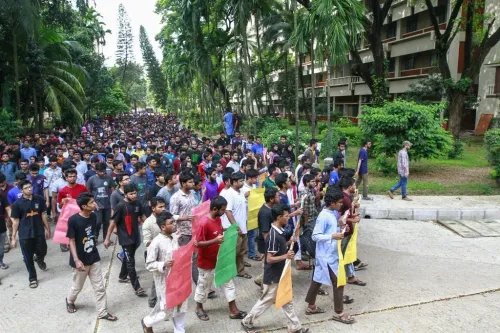
Bangladesh's radical Islamist party Jamaat-e-Islami has reportedly leveraged political patronage gained under the former Muhammad Yunus-led interim government to deepen its foothold across major universities, including Dhaka University and Chittagong University, through its student wing, Islamic Chhatra Shibir. A report by the British publication Asian Lite has detailed how the party is now using campus networks to actively promote pro-Pakistan sentiments among students.
Jinnah Photographs at Dhaka University Museum
According to the Asian Lite report, the Dhaka University Central Students Union — now affiliated with Islamic Chhatra Shibir — recently displayed photographs and speeches of Pakistan's founder Muhammad Ali Jinnah inside the university museum. The display included a speech Jinnah delivered at Race Course Maidan in Dhaka in 1948, in which he declared that 'Urdu and Urdu alone' would be the state language of Pakistan — a position that directly dismissed the linguistic and cultural identity of East Pakistan's Bengali-speaking population. He reportedly reiterated this stance in a separate address at Dhaka University three days later.
The display drew sharp criticism from multiple quarters. The Jatiyatabadi Chhatra Dal, the student wing of the ruling Bangladesh Nationalist Party (BNP), condemned it as a 'disgraceful act' that tarnished the university's reputation. Dhaka University authorities have since formed a committee to investigate how the photographs came to be exhibited. This comes amid growing concern among secular and nationalist groups over attempts to rehabilitate Pakistan-era symbols on Bangladeshi campuses.
Jamaat's Rise Under the Yunus Interim Government
The report identifies Jamaat-e-Islami as a major force behind the 'so-called' July Uprising of 2024 that ousted the Awami League government led by former Prime Minister Sheikh Hasina. Following the political transition, the party is said to have significantly strengthened its organisational network during the period the interim government, headed by Muhammad Yunus, was in power. Critics argue that this patronage — whether formal or tacit — has allowed Islamic Chhatra Shibir to consolidate control over key student bodies that had previously been dominated by secular and left-leaning groups.
Constitutional Reforms: The New Flashpoint
A deepening rift has emerged between the ruling BNP and an 11-party opposition alliance led by Jamaat-e-Islami over proposed constitutional reforms drawn up under the former interim government. According to observers cited in the report, the proposed changes are aimed at weakening the secular character of Bangladesh's Constitution and shifting the balance of power — curbing the Prime Minister's authority while expanding that of the President, a move critics warn could plunge the country into prolonged political instability.
BNP members of parliament declined to join a constitutional reforms council, arguing that Bangladesh's constitution makes no provision for such a body. The party instead proposed a parliamentary committee to examine the reforms. However, parliamentarians from Jamaat-e-Islami and its allies have refused to participate in any such parliamentary committee, effectively gridlocking the reform process and sharpening tensions between the two political blocs.
What This Means for Bangladesh's Secular Identity
The developments are being closely watched by political analysts and civil society groups who see the resurgence of Jamaat-e-Islami on campuses — and in constitutional politics — as a direct challenge to the foundational secular and nationalist principles of Bangladesh, a country whose 1971 Liberation War was fought partly in resistance to Pakistani cultural and linguistic imposition. Notably, Jinnah's 1948 Dhaka speech on Urdu is widely regarded as a catalyst for the Bengali language movement that ultimately fed into the independence struggle. The reappearance of these symbols on university campuses is therefore considered particularly provocative in the Bangladeshi historical context.
How the BNP-led government navigates its uneasy relationship with Jamaat-e-Islami in the months ahead is likely to shape not only university politics but the broader constitutional trajectory of Bangladesh.
Point of View
The consequences rarely stay academic.
NationPress
10 Oct 2026
Frequently Asked Questions
What is Jamaat-e-Islami doing on Bangladesh university campuses?
Jamaat-e-Islami has been expanding its influence at Dhaka University and Chittagong University through its student wing, Islamic Chhatra Shibir, which now controls the Dhaka University Central Students Union. The wing recently displayed photographs and speeches of Pakistan's founder Muhammad Ali Jinnah — including his 1948 declaration that Urdu alone would be Pakistan's state language — inside the Dhaka University museum.
Why is the display of Jinnah's photographs at Dhaka University controversial?
Jinnah's 1948 speech in Dhaka, in which he insisted Urdu would be the sole state language of Pakistan, directly dismissed the Bengali linguistic identity of East Pakistan's population. It is widely seen as a key catalyst for the Bengali language movement and, ultimately, Bangladesh's 1971 independence struggle. Displaying the speech in a university museum is therefore considered a deeply provocative act in the Bangladeshi historical context.
How did Jamaat-e-Islami gain influence in Bangladesh after 2024?
According to reports, Jamaat-e-Islami played a significant role in the July 2024 uprising that ousted the Awami League government of former Prime Minister Sheikh Hasina. The party subsequently strengthened its organisational network during the interim government led by Muhammad Yunus, which critics say gave it the political space to consolidate its presence in universities and public institutions.
What is the constitutional dispute between BNP and Jamaat-e-Islami?
A proposed set of constitutional reforms drawn up under the former interim government has become a major flashpoint. BNP parliamentarians rejected a constitutional reforms council as unconstitutional and called for a parliamentary committee instead; Jamaat and its allies refused to join that committee. Observers warn the proposed reforms could weaken Bangladesh's secular constitutional character and destabilise the balance of power between the Prime Minister and President.
Who condemned the Jinnah display at Dhaka University?
The Jatiyatabadi Chhatra Dal — the student wing of the ruling Bangladesh Nationalist Party (BNP) — condemned the display as a 'disgraceful act' that tarnished the university's image. Dhaka University authorities subsequently formed a committee to investigate how the photographs were put on display.