Is Pakistan's ISI and Islamists Taking Advantage of the Power Vacuum in Bangladesh?
Synopsis
Bangladesh's political landscape is shifting dramatically, creating opportunities for extremist forces to exploit the situation. As the nation grapples with violence against its Hindu minority, the role of Pakistan's ISI in destabilizing the region comes into focus. This report delves into the alarming implications of these developments.
Key Takeaways
Bangladesh is in a state of political transition.
Islamist extremists are exploiting the power vacuum.
The ISI is using religious identity as a destabilizing tool.
Targeted violence against Hindus indicates a dangerous trend.
Historical tensions continue to influence current events.
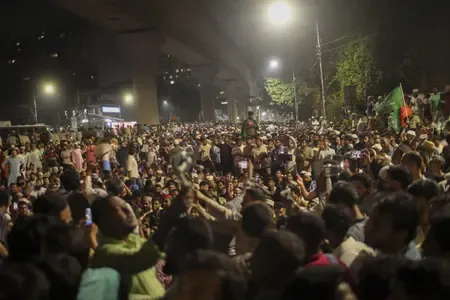
Dhaka, Jan 8 (NationPress) Bangladesh is currently experiencing a volatile transition after the removal of the Sheikh Hasina-led Awami League government, creating opportunities for Islamist extremists and Pakistan’s Inter-Services Intelligence (ISI) to manipulate the power void. With extensive experience, the ISI is utilizing religious identity as a weapon to create instability in the region, according to a report released on Thursday.
A report from the Bangladeshi weekly 'Blitz' highlights that while political unrest is commonplace in Bangladesh, the recent series of murders targeting Hindu citizens across several districts signifies a concerning trend. It emphasizes that these violent incidents are not just failures of law enforcement but are direct assaults on the country’s ethical principles and the pluralism established during the 1971 Liberation War against Pakistan.
“The murder of six Hindu men within approximately 18 days is not mere coincidence. This is not random crime masquerading as communal strife. The pattern is evident, the methods are too conspicuous, and the timing is strikingly convenient. From lynchings based on fabricated blasphemy accusations to targeted shootings and arson, these acts bear the clear hallmark of orchestrated terror. Behind such terror, we see familiar figures: Pakistan’s ISI, their local allies in Bangladesh, and a network of political Islamist factions and militant groups that have never accepted Bangladesh’s secular heritage,” the report elaborates.
It emphasizes that Bangladesh’s foundation is rooted not in a Muslim theocracy but in a cultural, linguistic, and political uprising against Pakistani authoritarianism and religious majoritarianism.
“During the Liberation War, Hindus and Muslims fought and died together, dreaming of a shared future. Hindu villages were destroyed not because they were outsiders but because they represented a pluralistic Bengal that Pakistan’s authorities could not tolerate. Thus, targeting Hindus today is akin to pursuing an unfinished war from 1971—one that Pakistan lost on the battlefield but continues to pursue in its imagination,” the report observes.
“The recent murders highlight this continuity. Although geographically scattered, they are ideologically connected. A Hindu man was lynched over false blasphemy claims. Another was killed following alleged extortion conflicts. Others were shot at their workplaces, hacked in shops, or stabbed and burned after closing their businesses. These are not spontaneous acts of rage; they are deliberate acts of intimidation. They convey a clear message to one community: you are in danger, you are being surveilled, and you can be eliminated,” it underscores.
The report asserts that Pakistan's antagonism towards Bangladesh did not cease in 1971; rather, it has transformed into new manifestations.
“Faced with the inability to regain influence through diplomacy or development, factions within Pakistan’s security apparatus have long invested in proxy networks: radical madrasas, militant organizations, disinformation channels, and sympathetic Islamist parties. Their aim is straightforward—destabilize Bangladesh’s internal unity, poison Hindu-Muslim relations, and undermine Dhaka’s strategic independence by maintaining a state of perpetual insecurity,” it concludes.
Point of View
It is crucial to recognize the historical complexities surrounding Bangladesh's independence and the ongoing threats to its secular and pluralistic society. The rise of extremist violence not only undermines social cohesion but also poses a direct challenge to the democratic values that Bangladesh was founded upon. We stand firm in supporting a narrative that fosters unity, peace, and respect for all communities.
NationPress
24 Sept 2026
Frequently Asked Questions
What triggered the current instability in Bangladesh?
The instability follows the removal of the Sheikh Hasina-led Awami League government, creating a power vacuum that extremist groups are exploiting.
What role does Pakistan's ISI play in this situation?
The ISI has been reported to exploit religious identities to destabilize Bangladesh, leveraging existing tensions to further their agenda.
How are religious minorities affected by this unrest?
Recent violence against Hindu citizens indicates a worrying trend of targeted attacks, suggesting an orchestrated effort to intimidate and marginalize minority communities.
What historical context is essential to understand this issue?
Bangladesh's independence was rooted in a struggle against Pakistani authoritarianism. The ongoing violence reflects unresolved historical tensions.
What can be done to address these challenges?
Strengthening democratic institutions, promoting inter-community dialogue, and ensuring justice for victims of violence are essential steps to mitigate these challenges.