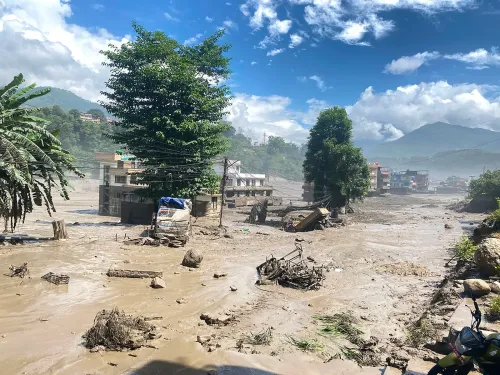
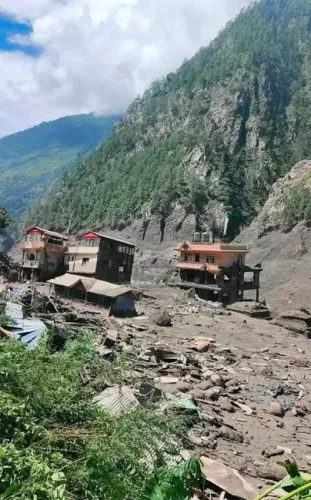
Bhote Koshi flash flood: 4 Nepal police missing at China border, 15 hydro projects hit
Synopsis
A suspected glacial lake outburst from Tibet has sent the Bhote Koshi River surging through Nepal's border districts, leaving four armed police personnel missing, 15 hydropower projects damaged, and five districts on high alert — exposing just how exposed Nepal's critical infrastructure remains to trans-boundary Himalayan flood events.
Key Takeaways
A flash flood struck the Bhote Koshi River at around 9 am on 26 August , hitting the Nepal-China border region in Rasuwa district .
Four APF personnel at a border outpost are missing and out of contact; 14 Rasuwa customs staff are also reportedly unaccounted for, per unconfirmed local media reports.
The Nepal Electricity Authority confirmed damage to multiple power projects including Rasuwagadhi , Chilime , and Trishuli-3B ; 15 hydropower projects in total are affected.
Hydrological experts suspect a Glacial Lake Outburst Flood (GLOF) in Tibet as the trigger; satellite analysis is ongoing with Chinese authorities.
High-alert warnings issued for Rasuwa, Nuwakot, Dhading, Gorkha , and Chitwan districts; residents urged to evacuate low-lying areas immediately.
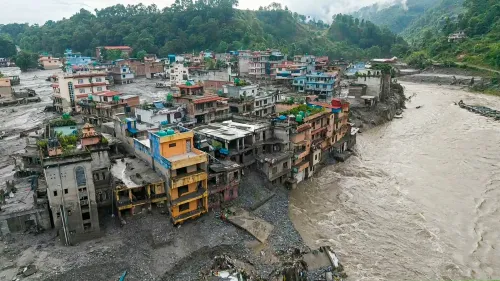
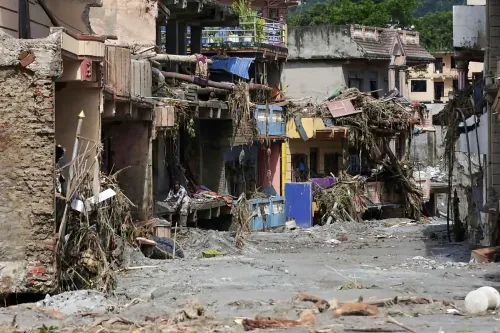
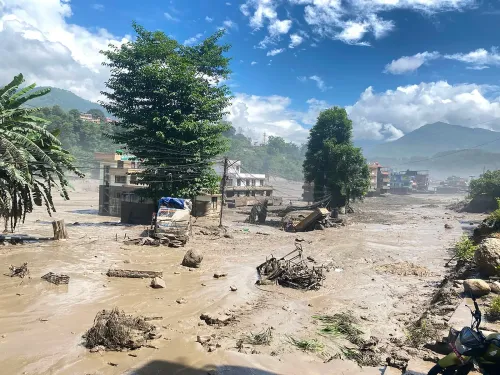
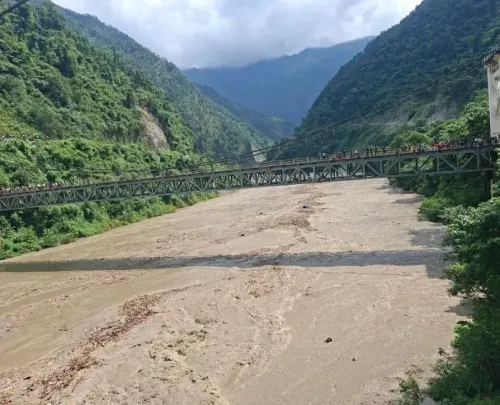
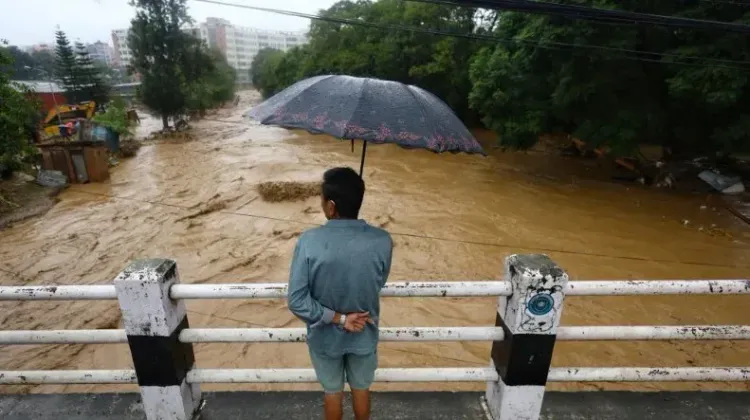
A sudden flash flood swept through the Bhote Koshi River on Wednesday, 26 August, causing widespread destruction across the Nepal-China border region, with four Armed Police Force (APF) personnel reported missing and at least 15 hydropower projects damaged. The surge, which began at around 9 am, has triggered high-alert warnings across five districts in central Nepal.
Personnel Missing, Contact Lost
APF Deputy Inspector General Netra Bahadur Karki confirmed that the four missing personnel were deployed at a border outpost in northern Rasuwa district and have been out of contact since the flood struck. 'The border post itself has not been damaged,' Karki said, adding that authorities have yet to determine whether the missing personnel were directly affected by the floodwaters.
Additionally, unconfirmed reports in local media indicate that 14 Rasuwa customs office staff are also out of contact, though this has not been officially verified.
Infrastructure Damage Across Rasuwa
The Timure market area, Timure Customs Office, and parts of Syabrubesi near the Nepal-China border are among the localities reported to have suffered major damage. Roads, hydropower facilities, electricity transmission lines, and substations have all reportedly been affected, according to officials.
The Nepal Electricity Authority (NEA) said the floods damaged the Rasuwagadhi, Chilime, Trishuli-3A, and Trishuli-3B power projects, the 220 kV Trishuli-3B Hub substation, as well as the Trishuli and Devighat hydropower plants and several distribution structures. Power supply has been disrupted across affected areas, with the NEA stating that all necessary efforts are underway to restore electricity as soon as possible.
According to Nepal's Independent Power Producers' Association, preliminary data indicates that 15 hydropower projects — 10 operational and five under construction — have been affected by the flood.
GLOF in Tibet the Likely Trigger
Hydrological experts have raised the possibility that the flooding was caused by a Glacial Lake Outburst Flood (GLOF) originating in Tibet, rather than heavy rainfall within Nepal. The sudden rise in the Bhote Koshi is believed to have originated in the Tibet region, officials said.
The Department of Hydrology and Meteorology, in coordination with Chinese counterparts, is analysing satellite imagery to establish the precise source of the surge. This comes amid growing scientific concern over accelerating glacial melt in the Himalayan region, which has increased the frequency and severity of GLOF events in Nepal over recent years.
Downstream Threat and Evacuation Orders
Officials have warned that floodwaters could pose a serious threat to downstream communities as the Bhote Koshi flows into the Trishuli River, moving toward Nuwakot and other central Nepal districts. High-alert warnings have been issued for riverbank settlements in Rasuwa, Nuwakot, Dhading, Gorkha, and Chitwan districts.
Residents in low-lying and riverside areas have been advised to relocate immediately to higher ground. Authorities have also urged the public to avoid unnecessary travel along the Prithvi Highway and other riverside routes. District-level disaster management authorities are coordinating rescue operations and mobilising emergency resources across the affected zones.
Point of View
If confirmed, means the surge was generated outside Nepal's monitoring perimeter, leaving communities with almost no lead time. Nepal has faced this vulnerability repeatedly, yet the Bhote Koshi corridor — home to some of the country's most critical hydropower assets — remains acutely exposed. The damage to 15 projects in a single event underscores the systemic risk that climate-driven glacial instability poses to Nepal's energy security, and raises hard questions about whether infrastructure siting and design standards have kept pace with accelerating Himalayan melt.
NationPress
10 Oct 2026
Frequently Asked Questions
What caused the Bhote Koshi flash flood on 26 August?
The flash flood struck the Bhote Koshi River at around 9 am on 26 August, with hydrological experts suspecting a Glacial Lake Outburst Flood (GLOF) originating in Tibet as the likely cause. The Department of Hydrology and Meteorology is analysing satellite data in coordination with Chinese authorities to confirm the source.
How many Nepal police personnel are missing after the flood?
Four Armed Police Force (APF) personnel deployed at a border outpost in northern Rasuwa district are missing and out of contact since the flood struck. APF spokesperson Deputy Inspector General Netra Bahadur Karki confirmed the situation, noting that the border post itself was not damaged.
Which hydropower projects were damaged by the Bhote Koshi flood?
According to the Nepal Electricity Authority, the Rasuwagadhi, Chilime, Trishuli-3A, Trishuli-3B, Trishuli, and Devighat hydropower plants were among those damaged, along with the 220 kV Trishuli-3B Hub substation. Nepal's Independent Power Producers' Association reported that 15 projects in total — 10 operational and 5 under construction — were affected.
Which districts are on high alert after the Bhote Koshi flood?
High-alert warnings have been issued for riverbank communities in Rasuwa, Nuwakot, Dhading, Gorkha, and Chitwan districts. Authorities have advised residents in low-lying areas to move to higher ground immediately and urged the public to avoid travel on the Prithvi Highway and other riverside routes.
What is a Glacial Lake Outburst Flood (GLOF) and why is it relevant here?
A GLOF occurs when a glacial lake — formed by meltwater dammed by ice or moraine — suddenly breaches, releasing a massive surge of water downstream. Experts suspect a GLOF in Tibet triggered the Bhote Koshi surge, a scenario consistent with the river's rapid rise without significant rainfall in Nepal, and a growing hazard as Himalayan glaciers accelerate their retreat.