Is Blue Origin Pausing Space Tourism to Focus on Lunar Missions?
Synopsis
Blue Origin, founded by Jeff Bezos, is shifting its focus from suborbital space tourism to lunar missions aimed at landing humans on the Moon. With the retirement of its New Shepard spacecraft for at least two years, the company is committed to enhancing its lunar capabilities, backed by a significant NASA contract.
Key Takeaways
Blue Origin pauses space tourism to focus on lunar missions.
Retirement of New Shepard for at least two years.
The company aims to enhance its lunar capabilities.
NASA contract worth $3.4 billion for the Blue Moon lander.
Deployment of the TeraWave communication network planned for 2027.
New Delhi, Jan 31 (NationPress) Jeff Bezos’ Blue Origin has revealed its intention to halt space tourism activities as it pivots towards the ambitious goal of landing humans on the Moon.
According to a recent blog post, Blue Origin will be retiring its New Shepard — the pioneering reusable spaceflight system capable of vertical landing — for a minimum of two years.
The company stated it will reallocate resources to expedite the development of its human lunar capabilities.
“This decision underscores Blue Origin's dedication to the nation's mission of returning to the Moon and establishing a lasting lunar presence,” the post further elaborated.
Since its inception in 2021, New Shepard has successfully conducted flights to suborbital space, with each journey lasting approximately 11 minutes above the Karman line, which is recognized internationally as the boundary of space.
To date, the US-based company has completed 38 flights, carrying 98 individuals above the Kármán line, with the most recent mission occurring just a week ago.
The suborbital vehicle has also facilitated the launch of over 200 scientific and research payloads from various entities, including students, academic institutions, research organizations, and NASA.
“This consistent and dependable performance, combined with an outstanding customer experience, has resulted in a backlog of customers for multiple years,” the company noted.
In addition, Blue Origin currently holds a $3.4 billion contract with NASA for the development of its Blue Moon lander, designed to transport NASA astronauts to and from the lunar surface.
The Blue Moon is anticipated to be part of the Artemis 5 mission, which is slated for launch in 2029.
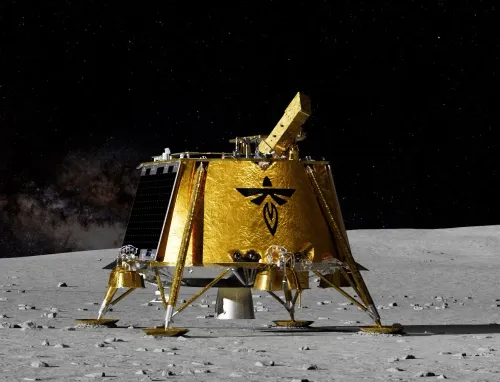
Moreover, the company intends to deploy a pathfinder version of Blue Moon, named Blue Moon Mark 1 (MK1-SN001), on a robotic demonstration mission to the Moon later this year.
The Blue Moon Mark 1 (MK1) is a lunar cargo lander meant for single-launch operations, staying on the lunar surface to ensure safe, reliable, and cost-effective access to the lunar environment. MK1 will facilitate cargo transportation by utilizing the 7-meter fairing of the New Glenn launch vehicle, capable of delivering up to three metric tons anywhere on the lunar surface.
Earlier this month, the company also disclosed plans to construct a satellite communication network called TeraWave, aimed at providing connectivity to data centers, governments, and businesses.
Blue Origin announced it would commence the deployment of this network in the fourth quarter of 2027.
Point of View
It's essential to recognize the importance of Blue Origin's shift from tourism to lunar missions. This strategic pivot not only aligns with national objectives but also underscores the growing significance of sustainable lunar presence in space exploration.
NationPress
14 Oct 2026
Frequently Asked Questions
Why is Blue Origin pausing space tourism?
Blue Origin is pausing space tourism to prioritize the development of its lunar human flight program.
How long will New Shepard be retired?
The New Shepard spacecraft will be retired for at least two years.
What is the Blue Moon lander?
The Blue Moon lander is designed to transport NASA astronauts to and from the Moon as part of a $3.4 billion contract.
When is the Artemis 5 mission expected to launch?
The Artemis 5 mission is targeted for launch in 2029.