Why is the Nervous CCP's 'Religious Management' on Display Again with the Demolition of Guangxi Temple?
Synopsis
The recent demolition of Longfu Temple in Guangxi by the CCP raises critical questions about the party's interpretation of religious management. Discover how this incident reflects larger tensions between the government and local communities. Dive into the resilience of villagers as they confront authoritarian actions.
Key Takeaways
The CCP continues to enforce strict regulations on religious sites.
Local communities are often powerless against state authority.
Demolitions can lead to significant public outcry and resistance.
The ideology behind such actions is rooted in controlling faith and community.
Longfu Temple symbolizes a broader struggle for cultural identity.
Beijing, Jan 8 (NationPress) The human rights publication Bitter Winter has drawn attention to the demolition of the reconstructed Longfu Temple in Guangxi, illustrating how the Chinese Communist Party (CCP) continues to apply its distinct version of religious management.
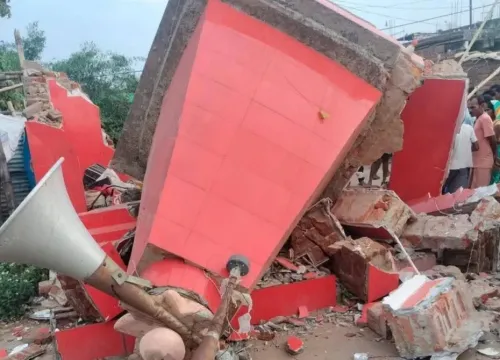
According to testimonies from local villagers, the Italian-based Bitter Winter reported that the local government deployed over 100 personnel, including police, firefighters, and medical staff, to execute a “forced demolition operation” at Longfu Temple, a humble folk-religion shrine that had been rebuilt by the villagers using their own funds and has existed in the area for generations, to the point that local residents cannot even remember its original establishment.
“On December 23, in Xinglongzhai Village, Zhongshan County, Hezhou City, Guangxi, the CCP once again displayed its unique approach to religious management: if it exists, demolish it; if villagers resist, gas them; if anyone films it, arrest them,” wrote Liang Changpu, who uses a pseudonym for security reasons, in Bitter Winter.
The Longfu Temple had previously collapsed. However, villagers combined their savings in 2024 to rebuild the temple and completed the construction in April 2025. At that time, the government raised no objections, issued no warnings, or provided any notices. Suddenly, officials declared that the temple was an “illegal construction” and claimed it was “too close to the ring road.” Ironically, the same ring road that had seemingly posed no risk during the temple’s reconstruction.
“Villagers were astounded. One elderly resident remarked online: 'It was here when I was a child. Now I am old, and only last year did we finally rebuild it. We all donated what we could.' But in China, nostalgia offers no protection against a demolition order. When the demolition team arrived, villagers rallied with tactical precision reminiscent of military parades. Men formed the frontline outside the temple, while women barricaded themselves inside, guarding the entrance. It was a scene straight out of a folk epic—except the heroes were unarmed villagers, and the villains carried riot shields,” reported Bitter Winter.
Violence broke out as police, armed with batons and shields, advanced, resulting in villagers being knocked to the ground. At least four villagers were arrested, and videos showed individuals collapsing under police assaults, illustrating that “maintaining stability” in China often entails destabilizing the lives of ordinary citizens.
“Inside the temple, women braced the doors against repeated attempts by police to force them open. When brute strength proved inadequate, officers resorted to a tactic typically used in hostage scenarios: they unleashed an unidentified irritant gas into the temple. White smoke engulfed the hall. Women gasped for breath and stumbled back. The door collapsed. The temple fell. And with it, another fragment of China’s folk heritage was obliterated,” Liang Changpu wrote.
“Within hours, Longfu Temple lay in ruins. A villager observing the destruction lamented: “When we built it, everything was fine. Now they say it’s illegal. The temple we worked so hard to rebuild is gone in an instant.” The official rationale—proximity to a ring road—would be humorous if it weren’t so tragic. China is filled with structures much closer to roads than Longfu Temple ever was. Yet, those structures belong to developers, not deities,” the writer explained.
“The true motive behind the authorities' actions is ideological, as China is facing widespread resistance incidents, with over 30 major clashes reported last December. The CCP is anxious as its economic model falters, unemployment rises, and public dissent escalates. In such a context, the construction of even a small temple by villagers becomes a threat, not due to road obstruction, but because it symbolizes something the party cannot govern—faith, community, and memory,” it concluded.
Point of View
It is imperative to recognize the ongoing struggles between local communities and the state. The demolition of Longfu Temple in Guangxi is not just a local issue; it highlights a broader conflict over cultural identity and religious expression in China. This incident deserves international attention and empathy.
NationPress
20 Sept 2026
Frequently Asked Questions
What happened to Longfu Temple?
Longfu Temple was demolished by the CCP despite being rebuilt by villagers who pooled their savings.
Why was the temple demolished?
The authorities claimed it was an 'illegal construction' and too close to the ring road.
What was the villagers' reaction?
Villagers resisted the demolition, showcasing their determination to protect their heritage.
How did the authorities respond?
They deployed over 100 personnel, including police, to forcibly demolish the temple.
What does this incident signify?
It reflects the CCP's ongoing tension with local communities regarding religious and cultural expressions.