China enabling Israel's adversaries Iran and Pakistan: Report
Synopsis
A Times of Israel report by Sergio Restelli makes a pointed case: China hasn't fired a shot in the Middle East, yet its arms transfers, dual-use technology, and the 2021 Iran cooperation pact have quietly armed Israel's most consequential adversaries. The analysis places Beijing at the centre of an Iran-Pakistan strategic triangle — and warns the West has not paid enough attention.
Key Takeaways
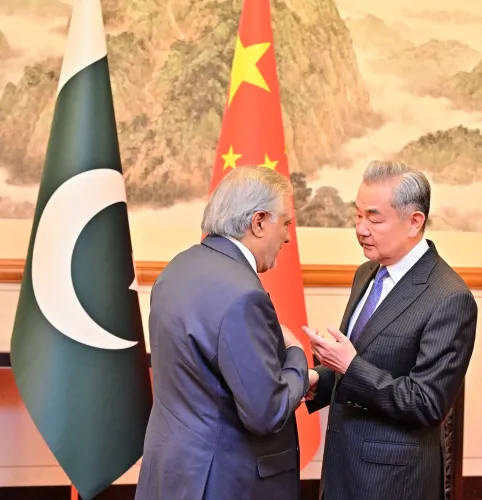
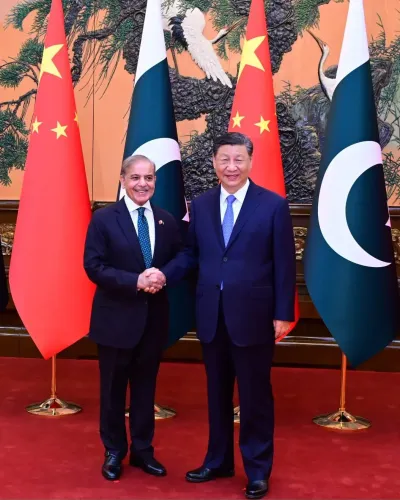
A report in the Times of Israel by analyst Sergio Restelli identifies China as a principal enabler of Iran and Pakistan , two of Israel's most consequential adversaries.
The Pakistan Air Force relies on Chinese-built JF-17 and J-10CE aircraft; the Pakistan Navy is acquiring Chinese submarines and frigates.
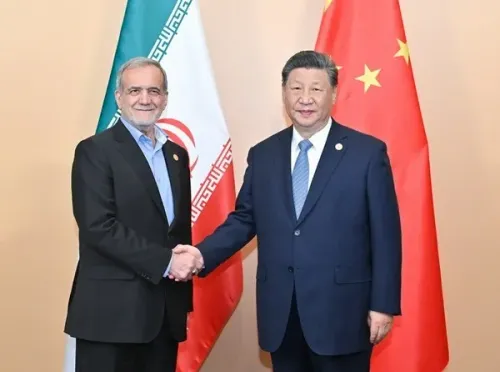
China and Iran deepened ties through a 25-year strategic cooperation agreement signed in 2021 , covering energy, infrastructure, technology, and security.
The report says China sits at the centre of an Iran-Pakistan-China strategic triangle, with no public evidence of a formal trilateral arrangement but significant information-flow channels.
The report notes it is "assumed and possibly a reality" that Iran's nuclear technology has Pakistani origins, with tacit Chinese support — though no concrete evidence is cited.
Iran's proxy network spans Lebanon, Syria, Iraq, and Yemen , giving the axis a broad regional footprint that directly concerns Israel.
A new analytical report has identified China as one of the principal enablers of Iran and Pakistan — two of Israel's most consequential adversaries — arguing that Beijing has systematically strengthened both states through arms transfers, dual-use technology, and diplomatic cover, without deploying a single soldier. The findings, published in the Times of Israel, carry fresh relevance in the aftermath of the conflict involving Iran.
China's Strategy: Influence Without Alliances
According to analyst Sergio Restelli, China's approach differs fundamentally from that of the United States or Russia. Rather than formal alliances or expeditionary military deployments, Beijing relies on a quieter toolkit.
"Unlike the United States or Russia, China has built its influence without alliances or expeditionary deployments, relying instead on arms transfers, dual-use technology, industrial cooperation, economic investment and diplomatic cover," Restelli wrote. "The effect has been the steady strengthening of states that often share an interest in limiting Israeli and American reach across the region and actively empowering terrorists against Israel."
Pakistan: China's Closest Military Partner
The report describes Pakistan as the clearest illustration of China's strategy, noting that over more than three decades, Beijing has transformed Islamabad into its closest military partner. The Pakistan Air Force now operates Chinese-built aircraft including the JF-17 and the J-10CE, while the Pakistan Navy is acquiring Chinese submarines and frigates. Pakistan's missile and air defence systems have also benefited from extensive Chinese cooperation, according to the report.
Pakistan fields the largest armed forces in the Islamic world and remains a nuclear power — making this partnership, the report argues, far from an abstract concern for Israel.
Iran: Strategic Partnership Under Sanctions
Despite years of international sanctions that have constrained conventional arms transfers, China remains one of Iran's principal strategic partners, the report states. Chinese firms have reportedly supplied dual-use technologies, industrial equipment, and components that support Iran's military-industrial base.
The relationship was deepened further by the 25-year strategic cooperation agreement signed in 2021, which expanded bilateral cooperation across energy, infrastructure, technology, and security domains. The report notes that while concrete evidence is lacking, it is "assumed and possibly a reality" that a significant portion of Iran's nuclear technology traces back to Pakistan — with what the report describes as tacit Chinese support.
The China-Iran-Pakistan Triangle
Restelli argues that China sits at the centre of a strategic triangle, maintaining deep military ties with Pakistan while cultivating a broad partnership with Iran. Iran and Pakistan have, for their part, steadily expanded their own security cooperation along their shared border, building military coordination mechanisms following repeated border crises and establishing routine intelligence exchanges on opposition groups.
"China sits at the centre of this triangle, maintaining deep military ties with Pakistan while cultivating a broad strategic partnership with Iran. There is little public evidence of a formal trilateral intelligence arrangement aimed at Israel, but China is well positioned to benefit from information generated through its ties to both countries," Restelli noted. He pointed to military exercises, defence dialogues, technology cooperation, and security consultations as channels through which information flows that "would not otherwise exist."
Why This Matters for Israel and the Region
The report underscores that Iran's proxy network extends across Lebanon, Syria, Iraq, and Yemen — giving the China-Iran-Pakistan axis a wide regional footprint. Critics argue this network actively works against Israeli and American interests in the Middle East.
"China rarely appears on the battlefield, but its influence is visible in the weapons systems, industrial capacity and strategic resilience of states whose interests often run counter to Israel's own, and it deserves more attention than it has so far received," Restelli concluded. The report suggests that Beijing's below-the-radar strategy of arming and enabling adversaries may warrant far greater scrutiny from Western and Israeli policymakers going forward.
Point of View
Deniable arming of states and networks that keep the US and Israel strategically stretched. The 2021 Iran pact and three decades of Pakistan military build-up are not isolated transactions; they form a coherent pattern of influence-without-accountability. What the report stops short of addressing is the limits of this strategy — China also has deep economic interests in Gulf Arab states that are themselves wary of Iran, creating a structural tension Beijing has so far managed through deliberate ambiguity. The harder question for Western policymakers is not whether China is doing this, but whether existing sanctions and export-control frameworks are remotely calibrated to stop it.
NationPress
17 Sept 2026
Frequently Asked Questions
What does the report say about China's role in arming Israel's adversaries?
The report, authored by Sergio Restelli and published in the Times of Israel, argues that China has become a principal enabler of Iran and Pakistan — Israel's two most consequential adversaries — through arms transfers, dual-use technology, industrial cooperation, and diplomatic cover. It contends that Beijing has achieved this influence without formal alliances or military deployments.
How has China strengthened Pakistan's military?
Over more than three decades, China has supplied Pakistan with Chinese-built aircraft including the JF-17 and J-10CE, submarines, frigates, and missile and air defence systems. The report describes Pakistan as China's closest military partner, noting it fields the largest armed forces in the Islamic world and is a nuclear power.
What is the China-Iran 25-year strategic cooperation agreement?
The agreement, signed in 2021, deepened the China-Iran relationship across energy, infrastructure, technology, and security. The report notes that even before this pact, Chinese firms had reportedly supplied Iran with dual-use technologies and industrial equipment supporting its military-industrial sector despite international sanctions.
Is there evidence of a formal China-Iran-Pakistan trilateral arrangement against Israel?
The report states there is little public evidence of a formal trilateral intelligence arrangement targeting Israel. However, it argues that military exercises, defence dialogues, and technology cooperation between China and each country create information-flow channels that position Beijing to benefit strategically.
Why does the report say this matters for Israel?
The report highlights that Iran's proxy network extends across Lebanon, Syria, Iraq, and Yemen, while Pakistan fields the Islamic world's largest armed forces and holds nuclear weapons. Together, these factors make China's enabling role a direct and non-abstract security concern for Israel, not a theoretical one.