US Coast Guard suspends search for 6 aboard Nantucket medical aircraft crash

Synopsis
After 66 hours and 4,445 square miles of searching, the US Coast Guard has suspended the hunt for six people aboard a medical Gulfstream G100 that vanished from FAA radar near Nantucket. With no black box found and a vast debris field complicating recovery, the cause of the crash remains unknown — and may stay that way for some time.
Key Takeaways
The US Coast Guard suspended its search on 4 October 2026 for six passengers aboard a crashed medical aircraft off Nantucket, Massachusetts .
Search operations covered 4,445 square miles over approximately 66 hours before being called off.
The aircraft was a Gulfstream G100 twinjet on a medical transport flight from Bermuda to Boston Logan International Airport .
The plane vanished from FAA radar shortly before its scheduled 1:25 am landing; debris was found 32 km off Nantucket in waters 24–28 metres deep.
The aircraft’s black box has not been recovered; the extensive debris field has hampered detailed recovery efforts.
Rear Admiral Matthew Lake expressed condolences to families and acknowledged the difficulty of suspending the search.
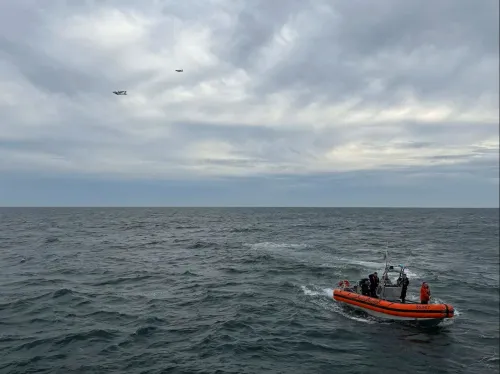
The US Coast Guard officially suspended its search on Sunday, 4 October 2026 for the six passengers aboard a medical transport aircraft that crashed off the coast of Nantucket, Massachusetts, after roughly 66 hours of search operations covering 4,445 square miles. The aircraft, a Gulfstream G100 twinjet, disappeared from Federal Aviation Administration (FAA) radar late Saturday while on a flight from Bermuda's L.F. Wade International Airport to Boston Logan International Airport.
How the Search Unfolded
The plane vanished from FAA radar shortly before its scheduled 1:25 am landing in Boston. Debris from the Gulfstream G100 was first spotted floating in the ocean on Saturday evening, prompting an immediate multi-agency search operation. The wreckage was located approximately 32 kilometres off the Nantucket coastline, in waters between 24 and 28 metres deep.
The Coast Guard and its partner agencies combed an area of 4,445 square miles over approximately 66 hours before the decision to stand down was made. Officials described the debris field as extensive, though they did not disclose its precise dimensions.
The Decision to Suspend Operations
Rear Admiral Matthew Lake, Commander of the Northeast District, announced the suspension and acknowledged its difficulty. “Suspending a search is not an easy decision,” he said. “We express our deepest condolences to the families and loved ones affected by the tragedy and our gratitude for our partner agencies who helped support search efforts.”
The tone of the statement implicitly acknowledged that the prospects of finding survivors had effectively ended, though officials stopped short of formally declaring the six aboard dead.
Black Box Search Complicated by Debris Scale
Alongside the search for survivors, crews had also been attempting to locate the aircraft’s flight data recorder, commonly known as the black box. That effort too yielded no results. “In the debris we’ve identified at this point, there is no indication that we found a black box,” Rear Admiral Lake said.
Kastriot Kastrati, search and rescue mission coordinator for the Coast Guard’s Northeast District, explained that the sheer volume and spread of debris made detailed examination extremely challenging. The size of the debris field made it “very difficult to get into the details of what’s there,” he said. The absence of the black box means investigators may face significant hurdles in reconstructing the final moments of the flight.
The Flight and the Aircraft
The Gulfstream G100 is a twin-engine business jet frequently used for medical air transport. The aircraft was operating as a medical transport flight, carrying six people in total. It was en route from Bermuda to Boston when contact was lost. The sudden disappearance from FAA radar — without any reported distress signal — points to a rapid, catastrophic loss of the aircraft, though investigators have not yet formally attributed a cause.
This is the latest in a series of aviation incidents over US coastal waters, and it comes at a time when regulatory scrutiny of smaller medical and charter aircraft operations remains an ongoing concern in the United States. A full investigation by relevant aviation authorities is expected to follow the recovery of any additional debris or flight data equipment.
Point of View
Catastrophic failure — yet without the black box, investigators are working largely from debris patterns and flight data up to the point of last radar contact. Suspending a search after 66 hours is consistent with Coast Guard protocol when survival probability drops to near zero, but the optics are hard for grieving families. The broader question — whether regulatory oversight of medical charter operations, which often fly demanding routes at odd hours, is adequate — will likely surface again as this investigation proceeds.
NationPress
5 Oct 2026
Frequently Asked Questions
What happened to the medical aircraft that crashed off Nantucket?
A Gulfstream G100 medical transport aircraft carrying six people disappeared from FAA radar late on 4 October 2026 while flying from Bermuda to Boston Logan International Airport. Debris was found roughly 32 kilometres off the coast of Nantucket, Massachusetts, in 24–28 metres of water.
Why did the US Coast Guard suspend the search?
The Coast Guard suspended the search on Sunday, 4 October 2026, after approximately 66 hours of operations covering 4,445 square miles with no survivors or bodies found. Rear Admiral Matthew Lake described the decision as ‘not an easy’ one, but standard protocol when survival probability is effectively nil.
Has the aircraft’s black box been recovered?
No. Officials confirmed there was no indication a black box had been found within the debris field. Search and rescue coordinator Kastriot Kastrati noted the extensive debris made detailed examination very difficult, raising concerns about how long — or whether — flight data will be retrievable.
How many people were on board the crashed aircraft?
Six people were aboard the Gulfstream G100 at the time of the crash. No survivors have been found, and the Coast Guard’s suspension of search operations effectively ends active rescue efforts for those on board.
What was the route of the crashed medical aircraft?
The Gulfstream G100 was flying from Bermuda’s L.F. Wade International Airport to Boston Logan International Airport when it vanished from FAA radar shortly before its scheduled 1:25 am arrival. It crashed roughly 32 kilometres off the coast of Nantucket.