Jaishankar raises India's Russian oil tariff concerns with Rubio at UN
Synopsis
India's top diplomat confronted the US Secretary of State face-to-face over legislation that could slap a 100% tariff on Indian exports for buying Russian oil — a direct threat to both India's energy strategy and an unfinished bilateral trade deal. Rubio's conspicuous silence on SRIA in his own post-meeting statement suggests Washington is not yet ready to offer New Delhi relief on the issue.
Key Takeaways
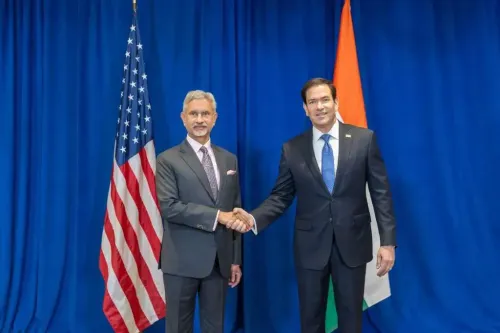
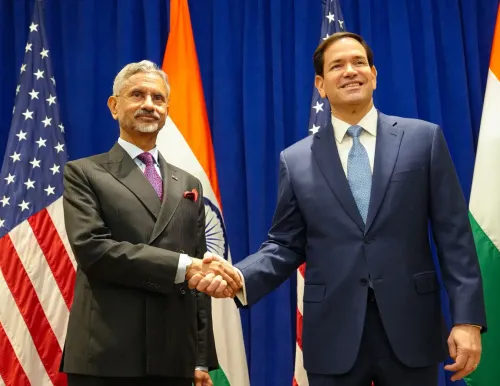
Jaishankar met US Secretary of State Marco Rubio in New York on 23 September on the sidelines of the UNGA high-level week.
Jaishankar formally raised India's objections to the Graham Sanctioning Russia and Iran Act (SRIA) , which proposes a 100% tariff on buyers of Russian oil.
India absorbs an estimated 37% of Russia's total oil exports; enforcement of SRIA would also threaten the ongoing India-US bilateral trade deal .
The MEA has stated India will protect energy security for its 1.4 billion people through 'diversified sourcing.' Rubio's post-meeting statement on X made no mention of SRIA, highlighting the gap between the two sides.
The meeting coincided with a scheduled Trump-Xi summit in Washington, underlining the high-stakes geopolitical backdrop.
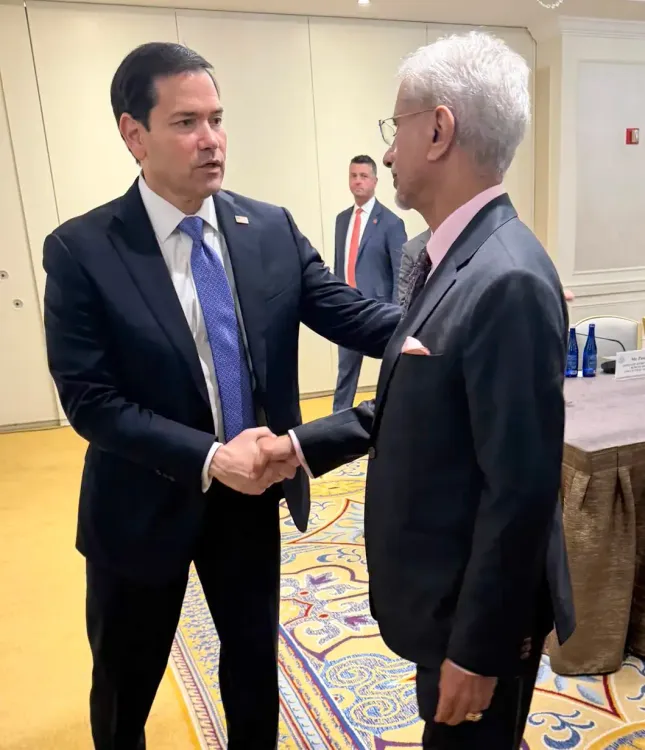
External Affairs Minister S. Jaishankar raised India's concerns over proposed 100% tariffs on buyers of Russian oil directly with US Secretary of State Marco Rubio in New York on Wednesday, 23 September, on the sidelines of the United Nations General Assembly high-level week. The discussions centred on the Graham Sanctioning Russia and Iran Act (SRIA), a piece of US legislation that, if enforced, could significantly disrupt India's energy imports and complicate an ongoing bilateral trade agreement.
What Jaishankar Said
Following the meeting, Jaishankar posted on X that he 'reiterated India's interests and concerns with regard to SRIA.' The minister's public statement signals New Delhi's intent to push back formally against the legislation, which was named after the late hawkish Senator Lindsay Graham. India accounts for an estimated 37% of Russia's total oil exports, making it one of the largest buyers of discounted Russian crude since Western sanctions took hold after the Ukraine war.
India's Energy Security Stance
The Ministry of External Affairs (MEA) had already signalled defiance after the SRIA's passage, stating: 'India remains firmly committed to ensuring energy security for its 1.4 billion people. It will continue to do so through diversified sourcing and on the basis of evolving market dynamics.' The statement underscores that New Delhi views its energy procurement decisions as a sovereign matter tied to the welfare of its population, not as political alignment with Moscow.
Trade Deal and Tariff History in Focus
The SRIA carries particular weight because a punitive 100% tariff on Indian exports to the US — triggered by India's Russian oil purchases — would directly undercut the bilateral trade agreement currently being negotiated. This is not the first time Washington has used this lever: the Trump administration had previously imposed a 25% tariff on India over the same issue before rescinding it in February. The recurrence suggests energy trade remains a structural flashpoint in the relationship despite broader strategic convergence.
Rubio's Response and the Wider Context
Rubio's own post on X after the meeting made no mention of the SRIA, instead highlighting broader partnership goals: 'Together, we are building on the US-India strategic partnership and coordinating on key regional priorities and upcoming multilateral efforts.' The omission was notable. The two ministers also discussed the Gulf and Ukraine situations. The choking of shipping through the Strait of Hormuz — following Israeli and US strikes on Iran — has had a direct economic impact on India as a major Gulf oil importer. Separately, Prime Minister Narendra Modi had last month publicly urged Russian President Vladimir Putin to end the Ukraine conflict on humanitarian grounds.
Quad Cooperation and the Broader Relationship
The Jaishankar-Rubio meeting came on the eve of a scheduled summit between US President Donald Trump and Chinese President Xi Jinping in Washington — a geopolitical backdrop that amplifies the significance of India-US coordination. Despite tensions over SRIA and the stalled trade deal, defence and strategic cooperation remains robust: both nations are members of the Quad, alongside Japan and Australia. At the Quad Foreign Ministers' meeting in New Delhi in May, the four nations reiterated cooperation on maritime security, port infrastructure, and energy — widely seen as a collective response to China's expanding regional influence.
How New Delhi and Washington navigate the SRIA fault line in the weeks ahead will be a critical test of whether the strategic partnership can hold its course even as energy and trade tensions mount.
Point of View
Against China, and as a negotiating chip in trade talks. Rubio's pointed silence on SRIA in his public post signals that the US is not about to blink. India's challenge is to protect its energy interests without fracturing the Quad architecture, which remains its most important structural hedge against China. That balancing act is getting harder.
NationPress
23 Sept 2026
Frequently Asked Questions
What is the Graham Sanctioning Russia and Iran Act (SRIA)?
The SRIA is a US law named after the late Senator Lindsay Graham that would impose a 100% tariff on countries that buy Russian oil, effectively penalising India for its significant purchases of discounted Russian crude. If enforced, it would hit India's exports to the US and threaten the ongoing bilateral trade deal.
Why does India buy so much Russian oil?
India has been purchasing discounted Russian crude since Western sanctions sharply reduced other buyers after Russia's invasion of Ukraine, helping manage domestic energy costs for its 1.4 billion people. An estimated 37% of Russia's oil exports go to India, making it one of Moscow's largest energy customers.
What was the outcome of the Jaishankar-Rubio meeting?
Jaishankar publicly stated he reiterated India's concerns over the SRIA. However, Rubio's own post-meeting statement on X made no mention of the legislation, suggesting no resolution was reached. Both sides said they discussed Gulf and Ukraine situations and reaffirmed the broader US-India strategic partnership.
How does the SRIA affect the India-US trade deal?
A 100% tariff on Indian exports triggered by SRIA would significantly undermine the bilateral trade agreement currently being negotiated between New Delhi and Washington, making it economically unviable for India to comply with US demands while maintaining its current energy sourcing strategy.
What is the Quad and how does it relate to this dispute?
The Quad is a strategic grouping comprising the United States, India, Japan, and Australia, focused on security and stability in the Indo-Pacific, largely seen as a counterweight to China's influence. Despite the SRIA dispute, Quad cooperation on maritime security and energy has continued, including at the Foreign Ministers' meeting in New Delhi in May 2026.