Delhi-born engineer Monica Saigal quit corporate life after friend's death, wrote 14 books
Synopsis
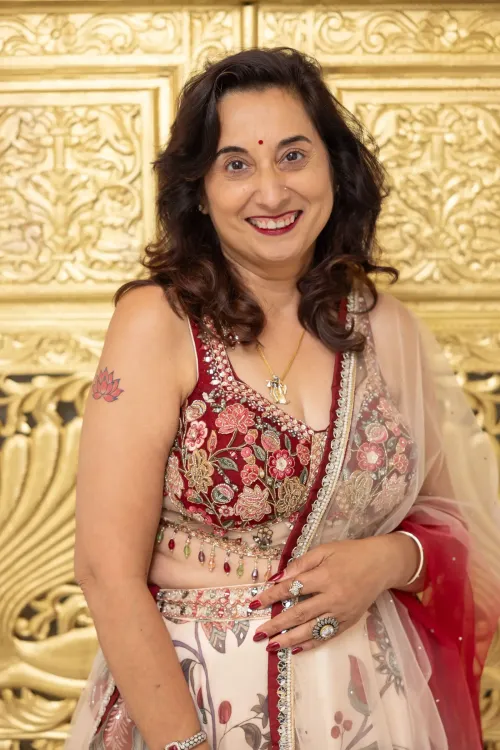
A friend's death at 35 did what years of ambition could not — it pushed Delhi-born engineer Monica Saigal out of a six-figure corporate job and into a writing life that has yielded 14 books, a Simon & Schuster cookbook, a Random House children's book, and now a short story collection about women reinventing themselves after life's labels disappear.
Key Takeaways
Monica Saigal , a Delhi -born engineer now based in Northern Virginia , has written 14 books after quitting her corporate career.
The turning point was the sudden death of a close friend at age 35 , who had repeatedly urged Saigal to start writing.
Her cookbook Modern Spice was published by Simon & Schuster ; her children's book Papa's Butter Chicken was pitched directly to Random House without an agent.
One of her books serves as a caregiver guide for ICU families, with copies reportedly donated to Inova Fairfax Hospital .
Her latest book, The Lotus Blooms Twice , is a short story collection about women navigating identity in later life.
Saigal, 57 , describes writing as 'a calling' and advises aspiring authors: 'Sit and write.
You cannot edit a blank page.'
Delhi-born engineer-turned-author Monica Saigal credits a single devastating phone call for redirecting her life: a close friend died at 35 after hitting her head on a sidewalk, and the question that friend had long asked — 'What makes you think you're going to be old enough to retire?' — would not leave Saigal alone. She quit her full-time corporate job, cut her family's income in half, and began writing. She has since published 14 books and is now based in Northern Virginia, United States.
From Delhi to Northern Virginia: An Unlikely Literary Journey
Saigal grew up in what she describes as 'a very conservative Delhi Punjabi household' where, she said, the acceptable career options were 'doctor, lawyer, engineer, or marry rich.' She went the engineering route, earning two master's degrees — an outcome she jokes made her 'one of the original three idiots.' Born in Delhi, she was six when her family relocated to Bahrain, where they lived for nearly 30 years. The family eventually returned to India, and she completed her engineering degree from BMS College in Bengaluru.
She arrived in the United States in 1991 for graduate studies, first at Lynchburg College in Virginia and later at George Washington University. She recalls landing in a freezing January, having never seen snow, and finding small-town Virginia disorienting after the sensory intensity of life in India. There was no Indian grocery store in Lynchburg; she once borrowed cardamom from the wife of the only Indian professor on campus.
Corporate Career, a Tragedy, and a Turning Point
Saigal went on to work at Ernst & Young and then at Hewitt Associates in Northern Virginia. All through those years, she deferred the writing ambition she had carried since the age of five, telling herself she would pursue it after retirement. A German American friend in Cleveland kept urging her to start earlier. Then came the call from the friend's husband: she had fallen on a sidewalk, struck her head, and died at 35.
'Her question kept ringing in my mind,' Saigal recalled. 'So I quit my full-time job, cutting the family income by half and started to write. And I haven't looked back since.' The early years were financially lean — her first year writing about food earned her $5,000.
From Cookbooks to a Children's Book Written for Her Father
Food writing opened the door to cookbooks, including Modern Spice, published by Simon & Schuster. She later pitched a children's book, Papa's Butter Chicken, directly to Random House without a literary agent — a rare feat — inspired by the experience of cooking with her father. She calls it one of her most precious books. 'He looked so awkward, but he looked so proud,' she said of the moment the book reached him. She noted she recently lost her father, lending the book an added layer of personal weight.
Caregiving, Loss, and a New Short Story Collection
One of her most emotionally demanding books grew out of her experience as a caregiver when her former husband was critically ill. She turned that period — spent largely in an intensive care unit — into a journal-style guide for ICU caregivers, copies of which have reportedly been donated to visitors at Inova Fairfax Hospital in Virginia. 'Caregiving, I think, is one of the hardest acts of love that you can perform for someone,' she said. 'And it's also one of those that's so, so, so exhausting. We don't talk about that.'
Her latest work, The Lotus Blooms Twice, is a short story collection centred on women in later life. The title draws on the lotus flower, which closes at night and reopens with morning sunlight — a metaphor Saigal uses for reinvention after life's defining labels fall away. 'At a certain age in life, the labels start going away,' she said. 'I've lost my parents. I'm no longer married. My children are now independent. So when all the labels go away, who are you?' Several stories deliberately leave their endings unresolved — a choice she says has 'succeeded in annoying the reader,' but also in opening discussions.
Advice to Writers and a Larger Reflection
Saigal, 57, sees Indian writing in English at a strong moment, noting that Indian bookstores now offer readers an abundance of choices. Her advice to aspiring writers is unambiguous: 'Sit and write. You cannot edit a blank page and you cannot sell an idea.' Asked whether she regrets walking away from a six-figure salary, she laughed. 'There are days. Don't get me wrong,' she said. 'I feel very satisfied and I feel very much at peace, and I think that's priceless.' She frames her writing not merely as a profession but as a calling — one that, she says, will not leave you alone until you answer it.
Point of View
000, a detail most inspirational retellings gloss over. The ICU caregiver book, donated to hospital visitors rather than commercially pushed, points to a model of writing-as-public-service that the publishing industry rarely celebrates. And her framing of 'The Lotus Blooms Twice' — rejecting the narrative of female endurance in favour of joy and ease — is a quiet but pointed challenge to how Indian womanhood is typically storied, in both literature and life.
NationPress
20 Oct 2026
Frequently Asked Questions
Who is Monica Saigal and why is she in the news?
Monica Saigal is a Delhi-born, Northern Virginia-based author who has published 14 books after leaving a corporate engineering career. She is in the news following an interview in which she discussed her journey from engineer to writer, prompted by the sudden death of a close friend at 35.
What books has Monica Saigal written?
Saigal's published works include the cookbook Modern Spice (Simon & Schuster), the children's book Papa's Butter Chicken (Random House), a journal-style guide for ICU caregivers, and her latest short story collection The Lotus Blooms Twice. In total she has authored 14 books across multiple genres.
Why did Monica Saigal quit her corporate job?
She quit after a close friend died suddenly at 35 from a head injury sustained in a fall. The friend had long urged Saigal to start writing rather than wait for retirement, and her death made Saigal reconsider deferring the decision further.
What is The Lotus Blooms Twice about?
The Lotus Blooms Twice is a short story collection about women in later life navigating identity once social labels — parent, spouse, child — fall away. Saigal uses the lotus, which closes at night and reopens at dawn, as a metaphor for intentional reinvention. Many stories deliberately leave their endings open.
What advice does Monica Saigal give to aspiring writers?
Saigal's advice is direct: 'Sit and write. You cannot edit a blank page and you cannot sell an idea.' She describes writing not as a profession but as a calling, and says those who have it will find it impossible to ignore indefinitely.