Nirmal Purja killed in Broad Peak avalanche chasing historic double summit
Synopsis
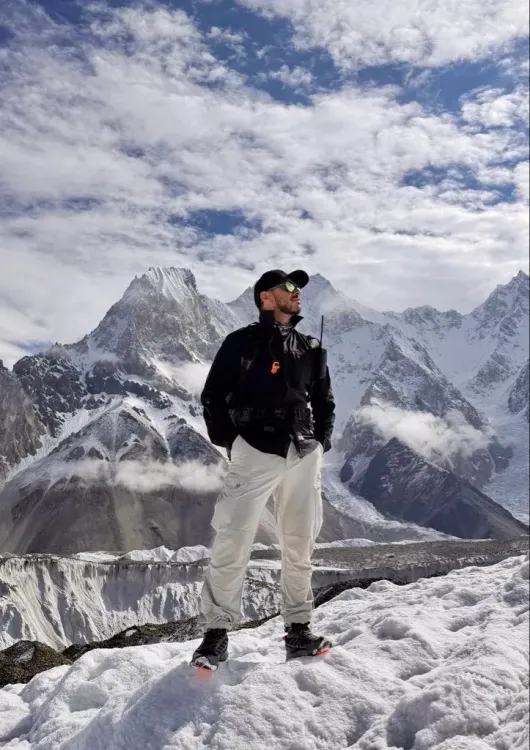
Nirmal Purja — the man who climbed all 14 eight-thousanders in six months — died chasing an even bolder record: doing it twice, without oxygen. Broad Peak was never the plan; a last-minute calculation made it irresistible. The avalanche on 30 July killed him and at least nine others, making it one of the deadliest single incidents on a high-altitude peak in recent memory.
Key Takeaways
Nirmal 'Nimsdai' Purja was killed in an avalanche on Broad Peak ( 8,051 m ), Pakistan , on 30 July 2025 .
His company Elite Exped confirmed the deaths on Saturday, 2 August ; Nepal's Prime Minister Balendra Shah named all six Nepali victims.
At least 10 climbers — six Nepali and four foreign — reportedly died in the disaster.
Purja had added Broad Peak spontaneously, hoping to become the first person to climb all 14 eight-thousanders twice without oxygen .
In 2019 , he set a world record by climbing all 14 peaks above 8,000 m in just over six months under 'Project Possible' .
Purja was also a veteran of the British Special Boat Service (SBS) and the first Gurkha to serve in the unit.
Renowned mountaineer Nirmal 'Nimsdai' Purja died on 30 July 2025 after an avalanche struck his team on Broad Peak, the 8,051-metre giant in Pakistan's Karakoram Range, ending a bid to become the first person in history to summit all 14 eight-thousanders twice without supplemental oxygen. His company, Elite Exped, confirmed the tragedy on Saturday, 2 August, announcing that other expedition members also perished in the disaster.
What Happened on Broad Peak
'Today, it is with profound sadness and immense heartbreak that we confirm that Nirmal 'Nimsdai' Purja tragically lost his life following the avalanche on Broad Peak,' Elite Exped wrote on its Facebook page. The company confirmed that fellow climbers Pur Bahadur Gurung (Yukta) and Nima Sherpa also lost their lives on the mountain.
Nepal's Prime Minister Balendra Shah confirmed that a total of six Nepali climbers perished, naming Pur Bahadur Gurung ('Yukta'), Kili Pemba Sherpa ('Kilu'), Nima Sherpa, Nawang Thindu Sherpa, and Gyalu Sherpa alongside Purja. Four foreign climbers also reportedly did not survive. 'The tragic deaths of six Nepali climbers, including world record-holding mountaineer Nirmal Purja (Nims Dai), along with four foreign climbers on the 8,051-metre Broad Peak — the world's 12th-highest mountain, located in Pakistan's Karakoram Range — have left us deeply shocked and saddened,' Shah wrote.
The Unplanned Attempt That Cost Him His Life
Broad Peak was never on Purja's original itinerary for the Pakistan expedition. In a Facebook post dated 27 July, he revealed that his initial plan had been to summit only Gasherbrum II (G2). A last-minute calculation changed everything. 'This was never the plan. Initially, the plan was to climb just G2. But just before setting off for Pakistan, I ran the numbers on my 8,000m summits. That's when it hit me: if I tick off Broad Peak whilst I'm here, only one remains — Cho Oyu. Then I become the FIRST person in history to climb all 14 eight-thousanders twice. Without oxygen,' he wrote.
Tracking data reviewed by Mingma Gyabu Sherpa, a member of Nepal's House of Representatives and Purja's business partner, showed that Purja's GPS position had shifted after the avalanche — first appearing to have been swept downhill before moving again to the point where the signal eventually stopped.
A Career Built on Breaking Limits
Born in Nepal's Dhaulagiri region and raised in Chitwan, Purja served 16 years in the military — six years with the British Gurkhas and a decade with the United Kingdom's elite Special Boat Service (SBS), becoming the first Gurkha to join the SBS. He took up mountaineering only in 2012 after trekking to Everest Base Camp while on military leave.
In 2018, he set a world record by summiting Mount Everest, Lhotse, and Makalu in just five days. The following year, under his landmark 'Project Possible' campaign, he climbed all 14 of the world's 8,000-metre peaks in just over six months — shattering the previous record of nearly eight years. Known for his exceptional ability to acclimatise rapidly at extreme altitude, Purja also led numerous high-altitude rescue missions across the Himalayas.
Tributes and Reactions
Prime Minister Shah said that while mountains sometimes claim climbers forever, their courage renders them immortal. 'Although the physical journey of Nirmal Purja and all the departed climbers has come to an end, their courage, dedication and contributions will continue to inspire generations and remain forever alive in history,' he wrote.
Elite Exped said the world had lost one of mountaineering's greatest figures. 'More than his extraordinary achievements, he wanted to show the world what was possible when you dared to dream bigger, believed in yourself and refused to accept limitations,' the company said. 'Through his actions, he inspired millions of people to believe that they, too, could achieve more than they ever thought possible.'
The deaths mark one of the deadliest single incidents on an eight-thousander in recent years, and cast a shadow over the high-altitude climbing season in the Karakoram.
Point of View
The SBS career, the rescues — is extraordinary and secure. But the circumstances of his death deserve scrutiny, not just mourning.
NationPress
1 Aug 2026
Frequently Asked Questions
How did Nirmal Purja die?
Nirmal Purja died after an avalanche struck his expedition on Broad Peak, an 8,051-metre mountain in Pakistan's Karakoram Range, on 30 July 2025. His company Elite Exped confirmed his death on 2 August, along with the deaths of other expedition members.
What record was Nirmal Purja chasing on Broad Peak?
Purja was attempting to become the first person in history to summit all 14 of the world's 8,000-metre peaks twice, without supplemental oxygen. Broad Peak was an unplanned addition to his Pakistan trip — had he summited it, only Cho Oyu would have remained.
Who else died in the Broad Peak avalanche?
Nepal's Prime Minister Balendra Shah confirmed that five other Nepali climbers — Pur Bahadur Gurung ('Yukta'), Kili Pemba Sherpa ('Kilu'), Nima Sherpa, Nawang Thindu Sherpa, and Gyalu Sherpa — also perished. Four foreign climbers reportedly did not survive either.
What was Nirmal Purja's most famous achievement?
In 2019, Purja completed all 14 of the world's 8,000-metre peaks in just over six months under his 'Project Possible' campaign, shattering the previous record of nearly eight years. He had also set a record in 2018 by summiting Everest, Lhotse, and Makalu in just five days.
What was Nirmal Purja's background before mountaineering?
Purja served 16 years in the military — six with the British Gurkhas and ten with the UK's elite Special Boat Service (SBS), becoming the first Gurkha to join the SBS. He took up mountaineering only in 2012 after trekking to Everest Base Camp while on military leave.