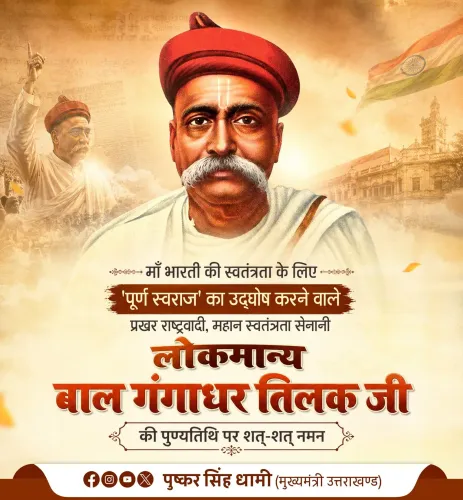
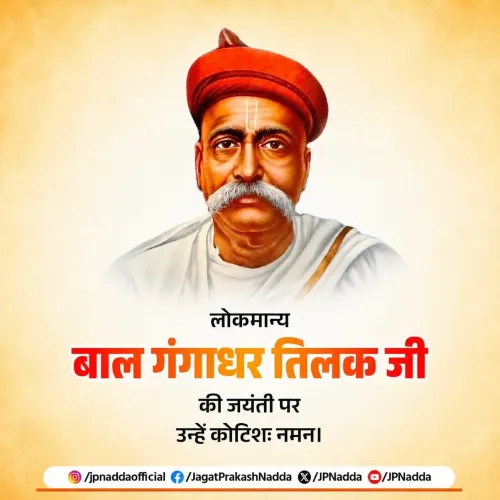
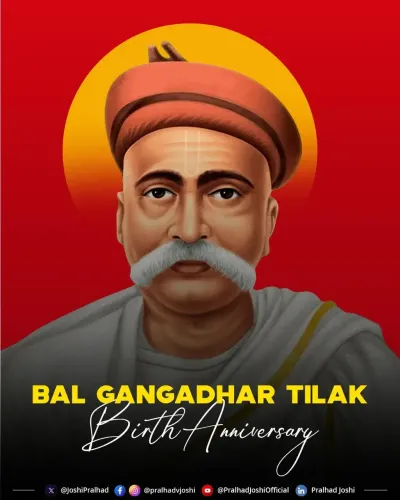
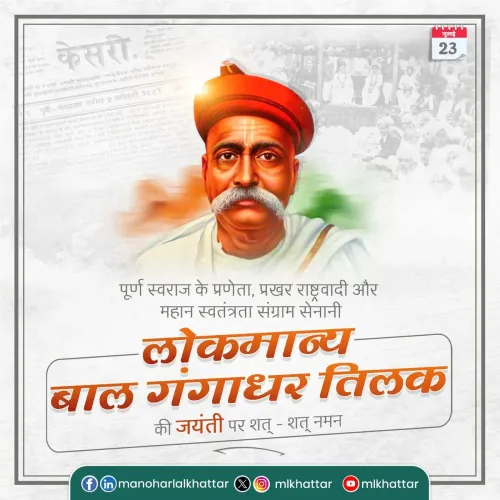
Nadda pays tribute to Lokmanya Tilak on death anniversary
Synopsis
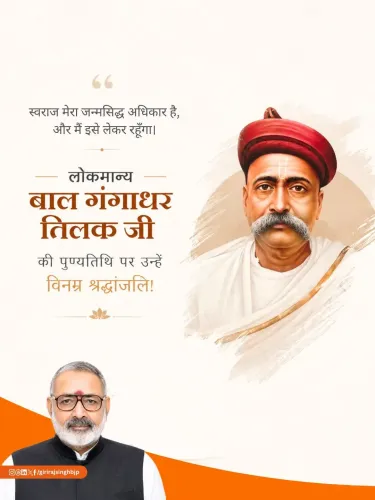
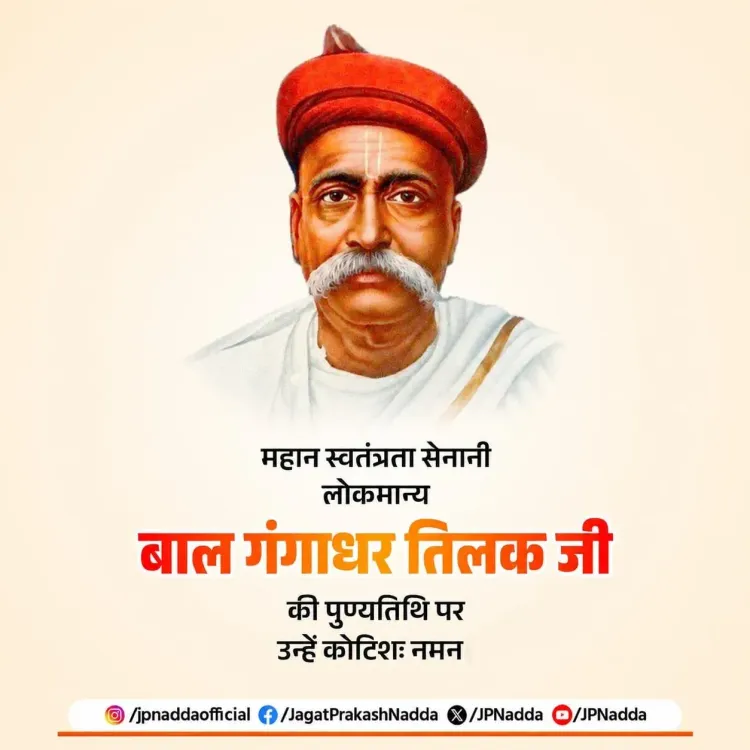
Union Health Minister J. P. Nadda on 1 August 2026 paid tribute to Lokmanya Bal Gangadhar Tilak on his death anniversary, honouring the freedom leader's role in mass mobilisation, nationalist journalism, and the Swadeshi movement that shaped India's independence struggle.
Key Takeaways
Nadda , Union Health Minister, paid tribute to Lokmanya Bal Gangadhar Tilak on his death anniversary, 1 August 2026 .
Nadda described Tilak as the pioneer of Purna Swarajya (complete self-rule) and a key pillar of the Indian independence movement.
Tilak is credited with using nationalist journalism and public festivals such as Ganesh Chaturthi to mobilise millions toward the freedom struggle.
His promotion of the Swadeshi movement and vernacular education gave economic and intellectual force to the resistance against British rule.
Tilak died on 1 August 1920 ; annual tributes from political leaders across parties mark his enduring place in India's national memory.
A freedom fighter who declared 'Swaraj mera janmasiddh adhikar hai' ('Swaraj is my birthright') died on 1 August 1920 — and more than a century later, his legacy still commands the attention of India's top political leadership. Union Health Minister J. P. Nadda marked the death anniversary of Lokmanya Bal Gangadhar Tilak on Saturday, 1 August 2026, paying tribute to the nationalist icon's role in mass-mobilising millions toward independence.
In his post, Nadda described Tilak as the 'purohit' (pioneer) of 'Purna Swarajya' — complete self-rule — and a vital pillar of India's independence movement. 'His fearless personality, nationalist journalism, and efforts at public awakening inspired crores of Indians to participate in the freedom struggle,' Nadda wrote. He specifically highlighted Tilak's contributions to the Swadeshi movement, the spread of education, and the sustained awakening of national consciousness.
The man who gave India a political grammar
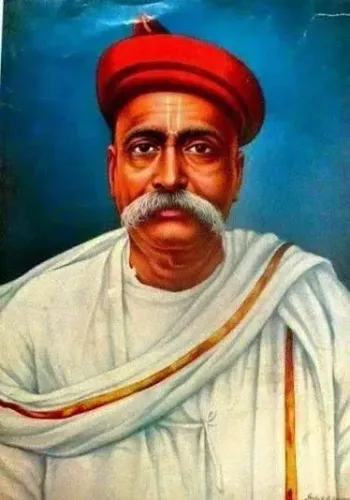
Bal Gangadhar Tilak, born in 1856 in Ratnagiri, Maharashtra, was among the first Indian leaders to argue for complete independence rather than incremental reform under British rule. Titled Lokmanya — meaning 'accepted by the people as their leader' — he wielded journalism as a political weapon through his Marathi and English newspapers, building a mass readership at a time when the printed word was the only broadcast medium available. His organisation of the Ganesh Chaturthi and Shivaji Jayanti festivals as public, communal events was a deliberate strategy to gather people outside the reach of colonial surveillance and build solidarity at scale.Swadeshi, education, and the art of mass mobilisation
Tilak's insistence on the Swadeshi movement — rejecting British goods in favour of Indian-made products — gave economic teeth to political resistance decades before it became mainstream policy. His push for the spread of education, particularly in vernacular languages, was rooted in the conviction that an informed citizenry was the only durable foundation for self-rule. He died on 1 August 1920, before independence arrived, but the organisational and ideological architecture he built became the scaffolding on which later leaders constructed the final push to 1947.A ritual of remembrance across party lines
Senior politicians across India's political spectrum mark Tilak's death anniversary each year, a practice that underscores how thoroughly his legacy has been absorbed into the national mainstream. Nadda's tribute, framed around themes of fearlessness, self-reliance, and national consciousness, reflects the BJP's consistent emphasis on pre-Gandhian nationalist figures as foundational to India's civilisational identity. The story of Tilak's courage, struggle, and dedication, Nadda wrote, 'will always inspire the countrymen.' A man jailed twice by the British for sedition, who turned a courtroom into a platform and a festival into a political rally — Tilak's methods remain a masterclass in building movements without modern tools.Point of View
Simultaneously, signals about which strands of the independence movement a party chooses to amplify. The consistency of such commemorations across party lines also suggests that Tilak's legacy has achieved a rare, largely non-contested status in Indian public life.
NationPress
16 Sept 2026
Frequently Asked Questions
When did Bal Gangadhar Tilak die?
Bal Gangadhar Tilak died on 1 August 1920 . His death anniversary is marked each year by political leaders and institutions across India.
Why is Bal Gangadhar Tilak called Lokmanya?
The title Lokmanya means 'accepted by the people as their leader.' It was conferred on Tilak by the Indian public in recognition of his mass appeal and his role in galvanising ordinary citizens toward the independence movement.
What was Tilak's role in the Swadeshi movement?
Tilak was a strong advocate of the Swadeshi movement , which called on Indians to reject British-manufactured goods and support Indian-made products as a form of economic resistance against colonial rule.
What did JP Nadda say about Lokmanya Tilak?
J. P. Nadda described Tilak as the pioneer of Purna Swarajya and praised his fearless personality, nationalist journalism, and public-awakening efforts for inspiring crores of Indians to join the freedom struggle.
What is Purna Swarajya?
Purna Swarajya means complete self-rule or full independence. Tilak was among the earliest Indian leaders to demand total independence from British rule, rather than limited self-governance within the empire.