Pilot joins Rahul Gandhi's Andaman conservation drive
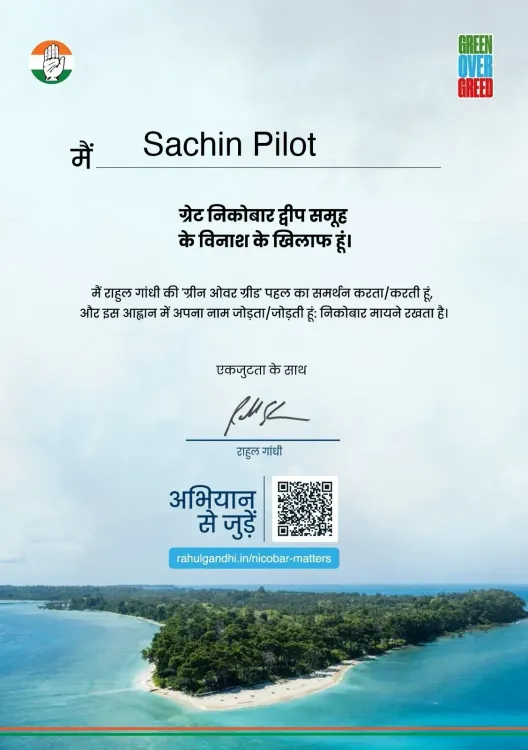
Synopsis
On World Environment Day 2026, Congress leader Sachin Pilot joined Rahul Gandhi's petition to protect the Andaman and Nicobar Islands and the Aravalli range, warning that recent central government policy decisions pose a serious threat to both ecosystems and calling on citizens to sign the conservation campaign.
Key Takeaways
Sachin Pilot publicly joined Rahul Gandhi 's conservation petition on World Environment Day, June 5, 2026 .
Pilot cited both the Aravalli mountain range and the Andaman and Nicobar Islands as ecosystems under threat from recent central government policy decisions.
He called nature 'our lifeline' and framed conservation as an inter-generational responsibility.
The Forest (Conservation) Amendment Act, 2023 and proposed infrastructure projects in the Andaman and Nicobar Islands form the key policy backdrop to the campaign.
Citizens were urged to sign the petition to make their voices heard on ecological protection.
The campaign connects two politically and ecologically significant zones — the Thar-bordering Aravallis and the Bay of Bengal archipelago — under a single conservation narrative.
Congress leader Sachin Pilot, general secretary of the Indian National Congress and party in-charge for Chhattisgarh, on Friday, June 5, 2026 — World Environment Day — publicly joined Leader of Opposition Rahul Gandhi's campaign to protect the Andaman and Nicobar Islands, and called on citizens to sign a petition demanding conservation of the archipelago's natural heritage.
Posting in Hindi on X, Pilot drew a direct parallel between two of India's most ecologically sensitive zones, writing: 'Aravalli parvat shrrinkhala ho ya phir Andaman aur Nicobar dweepsamooh ki prakritik sampada' — 'Whether it is the Aravalli mountain range or the natural wealth of the Andaman and Nicobar archipelago — nature is our lifeline and its protection is our responsibility.'
Context
Pilot's post arrives on World Environment Day, a date that Indian opposition parties have consistently used to spotlight what they describe as the dilution of ecological safeguards under the current central government. His statement specifically links two geographically distant but environmentally critical zones: the Aravallis, which span Rajasthan, Haryana, Gujarat and Delhi, and the Andaman and Nicobar Islands, a Union Territory in the Bay of Bengal.
The Congress leader warned that 'recent policy decisions by the central government are creating a serious threat to the very existence of these regions,' though he did not name specific decisions. He also framed the issue in inter-generational terms: 'Islands and mountains are nature's priceless heritage — if they are not saved, the future of coming generations will also be affected.'
Policy Backdrop
The Forest (Conservation) Amendment Act, 2023 redefined the scope of protected forests and exempted certain categories of land from mandatory prior central clearances — a move that drew criticism from environmentalists and opposition lawmakers. The Aravallis have been the subject of multiple Supreme Court orders since 2002 restricting mining and non-forest activity, following repeated violations of the Forest Conservation Act, 1980.
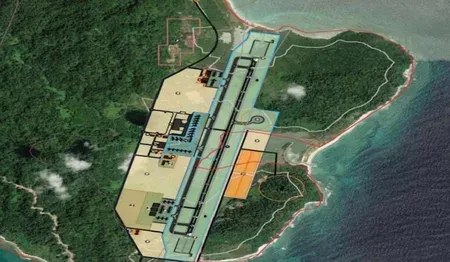
The Andaman and Nicobar Islands host unique coral ecosystems, dense tropical forests and Particularly Vulnerable Tribal Groups (PVTGs). Large-scale infrastructure proposals — including port development and tourism corridors — have periodically triggered environmental-clearance debates. Opposition parties have argued that such projects risk irreversible damage to one of Asia's last intact island ecosystems.
Stakeholders and Impact
The communities most directly affected include tribal groups and fishing populations on the Andaman and Nicobar Islands, as well as residents and farmers in the Aravalli belt who depend on the range for groundwater recharge and as a natural barrier against desert encroachment from the Thar. Environmental groups have long argued that the Aravallis' degradation accelerates dust storms and water scarcity across the National Capital Region.
Pilot urged his followers to join what he called 'this important campaign' and sign the petition initiated by Rahul Gandhi. The appeal to citizen participation signals an effort to convert political messaging into measurable public engagement ahead of any parliamentary or judicial proceedings on pending clearances.
What's Next
The trajectory of the petition — including the number of signatures it attracts — will indicate how much traction the campaign gains beyond party circles. Environmental-clearance decisions for proposed infrastructure projects in the Andaman and Nicobar Islands remain under watch, as does any forthcoming parliamentary debate on the implementation of the Forest (Conservation) Amendment Act, 2023. Judicial scrutiny of Aravalli mining and construction activity, a recurring feature of India's environmental litigation landscape, is also expected to continue.
Point of View
He amplifies the Congress leadership's ecological messaging while simultaneously invoking the Aravallis — a cause with direct resonance in his home state of Rajasthan. The twin-ecosystem framing broadens the campaign's geographic and voter appeal beyond any single state. Opposition parties have consistently used high-visibility environmental dates to press the government on the Forest (Conservation) Amendment Act, 2023, and this post fits squarely into that pattern of sustained legislative and public pressure. Whether the petition translates into parliamentary action or judicial intervention will be the real test of the campaign's staying power.
NationPress
21 Oct 2026
Frequently Asked Questions
Why is Sachin Pilot talking about Andaman and Nicobar Islands?
Pilot joined a conservation petition led by Rahul Gandhi on World Environment Day, June 5, 2026, warning that recent central government policy decisions threaten the islands' unique ecosystems. He linked the issue to the broader pattern of ecological risk he also associates with the Aravalli range.
What is the Rahul Gandhi Andaman and Nicobar petition about?
The petition, initiated by Leader of Opposition Rahul Gandhi, calls for the protection of the Andaman and Nicobar Islands' natural heritage — including its coral ecosystems, tropical forests and tribal communities — from infrastructure and policy decisions that critics argue could cause irreversible environmental damage.
How does the Forest Conservation Amendment Act 2023 affect the Aravallis?
The Forest (Conservation) Amendment Act, 2023 redefined protected-forest categories and exempted certain land from prior central clearances, which environmentalists and opposition leaders argue weakens protections for ecologically sensitive zones like the Aravallis that have been shielded by Supreme Court orders since 2002.
What communities live in the Andaman and Nicobar Islands?
The islands are home to fishing communities, settlers and Particularly Vulnerable Tribal Groups (PVTGs) who depend on the archipelago's forests and marine ecosystems. Conservation advocates argue that large-scale infrastructure projects risk displacing these communities and destroying their livelihoods.
What is World Environment Day and why do Indian politicians mark it?
World Environment Day, observed every year on June 5, is a United Nations platform for global environmental action. Indian political parties — particularly in the opposition — regularly use the date to launch campaigns, petitions and public statements highlighting what they see as inadequate ecological protections under the current government.