US-led global scam crackdown removes 3.7 million fake accounts, 28 arrested

Synopsis
In its first-ever coordinated strike on West African online fraud networks, a US-led coalition spanning eight countries and nine tech giants — including Meta, Google, and OpenAI — wiped out 3.7 million fake accounts, made 28 arrests, and uncovered 117 human trafficking victims in a single week. Officials say it is just the beginning.
Key Takeaways
A US-led Joint Disruption Week operation (6–13 October 2026) dismantled West African online fraud networks, resulting in 28 arrests .
More than 3.7 million fraudulent social media accounts were removed by participating tech companies including Meta , Google , and OpenAI .
117 human trafficking victims were identified in Ghana , awaiting repatriation to Nigeria .
Investigators flagged over $11 million in potentially freezable funds and intelligence on more than 30 scam centres.
89 fraud victims were identified with estimated losses of $8.3 million .
India participated in the operation; its specific role was not detailed by the US Justice Department .
An international law enforcement operation spanning the United States, India, and several other nations has dismantled major online fraud networks operating out of West Africa, resulting in 28 arrests, the removal of more than 3.7 million fraudulent social media accounts, and the identification of 117 human trafficking victims, the US Justice Department announced on Tuesday, 13 October 2026. The week-long operation also flagged more than $11 million in potentially freezable funds and generated intelligence on over 30 suspected scam centres.
How the Operation Unfolded
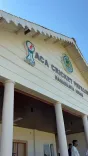
Dubbed Joint Disruption Week, the coordinated crackdown ran from 6 October and was hosted by Britain's National Crime Agency (NCA) in London. It brought together authorities from the United States, United Kingdom, India, Canada, Australia, Nigeria, and Ghana, alongside international police organisations and leading technology companies. According to the Justice Department, it was the first coordinated international operation focused specifically on West African scam networks.
The operation targeted criminal enterprises running cryptocurrency investment fraud, impersonation schemes, digital arrest extortion, and other online scams affecting victims primarily in the United States and Britain.
Arrests and Seizures Across West Africa
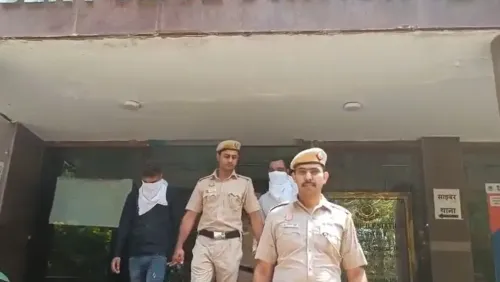
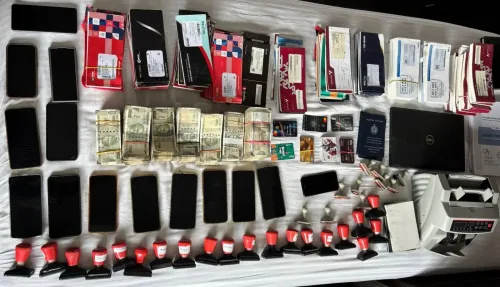
In Ghana, authorities arrested 19 suspects in Sasaabi, near Accra, and seized 303 electronic devices. Investigators also identified 117 suspected human trafficking victims awaiting repatriation to Nigeria, and uncovered another 89 fraud victims who had suffered estimated losses of $8.3 million.
In Nigeria, authorities arrested nine suspects and seized 53 electronic devices during the same enforcement period. Combined, the two countries accounted for all 28 arrests recorded during the operation.
Tech Giants Joined the Takedown
Several major technology and financial companies — including Meta, Google, Microsoft, Adobe, OpenAI, Binance, Coinbase, Chainalysis, and Starlink — participated in the operation. According to the Justice Department, these firms voluntarily removed fraudulent accounts, pages, and groups from their platforms, shared intelligence with law enforcement, helped identify suspected scam centres, and assisted in tracing cryptocurrency linked to criminal enterprises.
What Officials Said
Jeanine Ferris Pirro, US Attorney for the District of Columbia and founder of the Scam Center Strike Force, called the operation a model for cross-border enforcement. 'Transnational fraud demands a transnational response,' she said, adding: 'I have partnered with the NCA and the Crown Prosecutor for England and Wales to push forward cases on both sides of the Atlantic; criminals are not hindered by borders and neither are we.'
FBI Director Kash Patel credited the government-private sector partnership, saying the operation 'truly saved lives.' 'Thanks to brilliant partnership with the Department of Justice and the private sector, across multiple African countries, we arrested dozens of criminal actors, seized hundreds of devices, identified at least $11 million in potentially freezable funds, and truly saved lives,' Patel said.
Assistant Attorney General A. Tysen Duva framed the operation as the opening move in a wider campaign, stating: 'The millions of bogus social media accounts taken down and dozens of arrests that took place as part of Joint Disruption Week are just the beginning.'
India's Role and What Comes Next
India was listed among the participating countries, though the Justice Department did not specify the role played by Indian investigators or confirm whether any arrests were made on Indian soil. This comes amid a broader global push to address online scams that have increasingly targeted Indian citizens through digital arrest and fake investment schemes — a pattern that Indian authorities, including the Ministry of Home Affairs, have flagged repeatedly in recent years.
With officials describing Joint Disruption Week as the beginning of a sustained international effort, further enforcement actions against scam centres operating across West Africa are expected in the months ahead.
Point of View
28 arrests, 117 trafficking victims — are striking, but the structural question is whether a single week of disruption can dent fraud networks that are adaptive, low-cost to rebuild, and largely shielded by weak governance in host countries. The voluntary participation of Meta, Google, and OpenAI is notable, though it also raises the uncomfortable question of why these platforms hosted millions of fraudulent accounts long enough for a joint law enforcement operation to be necessary. For India, which is listed as a participant but whose specific contribution remains publicly undefined, the operation matters domestically: digital arrest scams and fake investment schemes have cost Indian citizens billions of rupees. The real accountability test will come not from this week's arrests but from whether the intelligence generated translates into prosecutions — and whether the scam centres simply relocate.
NationPress
13 Oct 2026
Frequently Asked Questions
What was the US-led scam crackdown operation and what did it achieve?
It was a week-long coordinated international operation called Joint Disruption Week, running from 6 October 2026, hosted by Britain's National Crime Agency in London. The operation resulted in 28 arrests across Ghana and Nigeria, the removal of more than 3.7 million fraudulent social media accounts, identification of 117 human trafficking victims, and the flagging of over $11 million in potentially freezable funds.
Which countries and companies participated in the operation?
Eight countries participated: the United States, United Kingdom, India, Canada, Australia, Nigeria, and Ghana, along with international police organisations. Nine technology and financial companies — Meta, Google, Microsoft, Adobe, OpenAI, Binance, Coinbase, Chainalysis, and Starlink — also took part, voluntarily removing fraudulent accounts and sharing intelligence.
What type of scams did the operation target?
The operation targeted cryptocurrency investment fraud, impersonation schemes, digital arrest extortion, and other online scams, primarily affecting victims in the United States and Britain. Authorities say the criminal enterprises were run out of West Africa.
What was India's role in the Joint Disruption Week operation?
India was listed as a participating country in the operation, but the US Justice Department did not specify the role played by Indian investigators or whether any arrests were made in India. The operation's inclusion of India is significant given the country's ongoing domestic challenge from digital arrest scams and fake investment fraud.
Is this the first time such a coordinated global operation targeted West African scam networks?
Yes, according to the US Justice Department, Joint Disruption Week was the first coordinated international operation focused specifically on West African scam networks. Officials described it as the beginning of a sustained broader effort to dismantle international cybercrime operations.