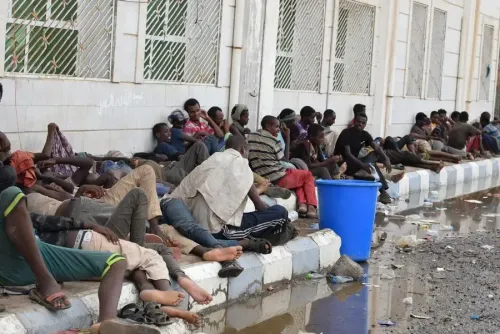
IOM warns of criminal networks trafficking Africans into Asia scam compounds

Synopsis
IOM has flagged a sharp expansion of transnational trafficking networks recruiting East Africans into Asian scam compounds — a forced-criminality model that generates billions annually. Ethiopia's arrest of 17 suspects, including an alleged kingpin who moved 40,000 people and collected over 1 billion birr from victims, puts a rare, concrete face on a crisis that the 30 July global observance is only beginning to spotlight.
Key Takeaways
IOM warned on 28 July 2025 that hundreds of thousands of Africans have been trafficked into online fraud operations generating billions of dollars annually.
Nationals from Kenya , Ethiopia , and neighbouring countries have reportedly been trafficked into scam compounds in Asia .
Ethiopian police arrested 17 suspects allegedly led by Mohamed Tahir Aden , accused of smuggling more than 40,000 Ethiopians to Saudi Arabia.
The network is linked to the deaths of more than 60 people and collected over 1 billion birr (approx. $6.19 million ) from victims.
The World Day Against Trafficking in Persons falls on 30 July 2025 , themed 'Trapped Behind the Scam.'
The International Organisation for Migration (IOM) on Tuesday, 28 July warned that hundreds of thousands of people across Africa have been trafficked by organised criminal networks and coerced into online fraud operations, generating billions of dollars in illicit profits each year. The alert, issued from Nairobi, comes days before the World Day Against Trafficking in Persons on 30 July 2025, observed this year under the theme 'Trapped Behind the Scam.'
Scale of the Threat
IOM said trafficking networks are increasingly preying on job seekers across East, Horn and Southern Africa, luring victims with false promises of overseas employment before forcing them into illegal activities. Nationals from Kenya, Ethiopia, and neighbouring countries have reportedly been trafficked into scam compounds operating in Asia, according to the agency.
Frantz Celestin, IOM Regional Director for East, Horn and Southern Africa, said in a statement: 'The identification of East Africans among victims rescued from scam compounds demonstrates that trafficking for forced criminality is no longer a distant threat. Criminal networks are actively targeting job seekers across our region with false promises of employment abroad.'
Ethiopia Arrests 17 in Major Trafficking Bust
In a significant enforcement action last week, Ethiopian police announced the arrest of 17 suspected members of an organised human trafficking network accused of illegally trafficking tens of thousands of Ethiopians and causing the deaths of more than 60 people. The suspects are allegedly led by a trafficking kingpin named Mohamed Tahir Aden.
According to the Ethiopian Federal Police, the network smuggled more than 40,000 Ethiopian nationals to Saudi Arabia through Djibouti and Yemen. The group is also accused of committing serious crimes including sexual violence against several women, and of collecting more than 1 billion birr (approximately $6.19 million) from victims.
How the Networks Operate
Police said the trafficking group deployed brokers to recruit victims from different parts of Ethiopia, falsely assuring them they could easily enter Saudi Arabia via Yemen and secure a better life. This recruitment model — targeting economically vulnerable individuals through deceptive employment promises — mirrors the broader pattern IOM has flagged across the region.
Notably, the IOM's warning underscores how forced criminality in scam compounds has evolved into a structured, transnational industry. Victims are not merely exploited for labour; they are compelled to operate online fraud schemes, generating revenue for criminal enterprises while remaining trapped abroad.
Regional and Global Context
This comes amid growing international concern over Southeast Asian scam compounds — particularly in Myanmar, Cambodia, and Laos — where trafficked individuals from multiple continents have been documented. The expansion of these networks into East Africa as a recruitment ground marks a significant geographic shift that authorities and aid organisations are only beginning to quantify.
As the 30 July global observance approaches, IOM is calling for coordinated regional action to dismantle trafficking infrastructure and protect job seekers from deceptive recruitment practices. How swiftly governments across the Horn and East Africa respond will determine whether the arrests in Ethiopia signal a turning point or remain an isolated enforcement action.
Point of View
Generating revenue that dwarfs traditional trafficking proceeds. The Ethiopia bust, while notable, involved just 17 arrests against a network that moved 40,000 people; the disparity exposes how enforcement capacity across the region lags the sophistication of these criminal enterprises. Mainstream coverage tends to frame this as a Southeast Asia story, but the recruitment pipeline now runs through Nairobi and Addis Ababa. Without aggressive cross-border intelligence sharing and consular intervention, the 30 July observance risks being a symbolic exercise rather than a policy inflection point.
NationPress
27 Oct 2026
Frequently Asked Questions
What did IOM warn about on 28 July 2025?
IOM warned that hundreds of thousands of people across Africa have been trafficked by criminal networks and forced into online fraud operations that generate billions of dollars in illicit profits annually. The agency specifically flagged that East African nationals from Kenya, Ethiopia, and neighbouring countries are being trafficked into scam compounds in Asia.
Who is Mohamed Tahir Aden?
Mohamed Tahir Aden is the alleged kingpin of a large-scale human trafficking network dismantled by Ethiopian police. He is accused of leading a group that smuggled more than 40,000 Ethiopian nationals to Saudi Arabia via Djibouti and Yemen, causing the deaths of over 60 people and collecting more than 1 billion birr from victims.
How many suspects were arrested in the Ethiopia trafficking bust?
Ethiopian police announced the arrest of 17 suspected members of the organised trafficking network. The suspects are accused of illegally trafficking tens of thousands of Ethiopians and are linked to the deaths of more than 60 people.
What is the World Day Against Trafficking in Persons?
The World Day Against Trafficking in Persons is observed annually on 30 July. The 2025 theme is 'Trapped Behind the Scam,' reflecting the growing use of trafficking victims in online fraud operations. IOM used the occasion to highlight the expanding threat of forced criminality in Asia-based scam compounds.
How are trafficking networks recruiting victims in East Africa?
According to Ethiopian Federal Police and IOM, trafficking networks use brokers to recruit economically vulnerable individuals across East Africa with false promises of legitimate employment abroad. Victims are told they can easily enter Saudi Arabia via Yemen and secure a better life, before being coerced into illegal activities once abroad.