Indian-born GOP challenger backs Microsoft green card freeze, wants tech worker quota
Synopsis
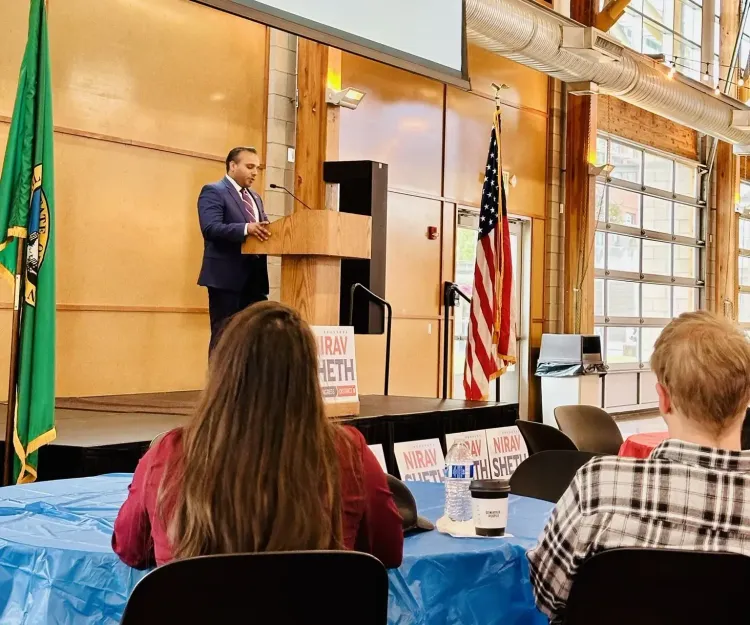
Nirav Sheth, the Ahmedabad-born Marine veteran challenging Congresswoman Pramila Jayapal, backs the Trump-Vance suspension of Microsoft's green card sponsorship — even as Indian-origin tech workers fill his own district. His simultaneous call for a separate quota for direct-hire tech employees reveals a deeply conflicted immigration pitch aimed squarely at Indian American voters ahead of the 3 November midterms.
Key Takeaways
Nirav Sheth , Republican challenger in Washington's 7th Congressional District , backed the suspension of Microsoft 's green card sponsorship programme.
He proposed a dedicated green card quota for high-skilled workers directly employed by large tech firms, bypassing third-party staffing agencies.
Sheth acknowledged he does not expect to win, targeting roughly 20% of the vote after receiving 10.6% in the August primary.
Incumbent Pramila Jayapal won approximately 84% of the primary vote; Sheth declined to call her 'anti-India' but said she was 'anti-American.' Sheth arrived in the US in 2008 , gained citizenship via the US Marine Corps , and owns five businesses in Washington state.
He criticised Washington state's Climate Commitment Act for adding a claimed $1.27 per-gallon tax on fuel.
Nirav Sheth, the Ahmedabad-born Republican candidate challenging Indian American Congresswoman Pramila Jayapal in Washington's 7th Congressional District, has voiced support for the suspension of Microsoft's green card sponsorship — even as thousands of Indian-origin tech workers employed by the company live and work within his own district. The remarks came in an interview eight days before the 3 November midterm elections.
Sheth's Stance on the Microsoft Green Card Freeze
Sheth said he supports the decision by President Donald Trump and Vice President JD Vance to suspend Microsoft's green card sponsorship programme. He argued that third-party recruiting agencies were 'abusing the immigration system', allowing some individuals to exploit 'loopholes' to secure green cards faster than professionals who had waited 10 to 15 years through legitimate channels.
'The immigration fraud is the major concern right now,' Sheth said, describing current policies as 'a tip of the iceberg.' When asked directly whether firms such as Microsoft, Adobe, or Infosys were engaged in fraud, he declined to comment, citing an ongoing investigation. 'I will not give a statement which gonna scrutinize either policy itself or the company,' he said.
The Case for a Separate Tech Worker Quota
Despite backing the freeze, Sheth simultaneously argued that the green card backlog confronting Indian tech professionals demands 'a complete overhaul.' He proposed a dedicated green card quota specifically for high-skilled professionals directly employed by large technology companies — naming Microsoft, Adobe, and Facebook as examples — rather than those placed through third-party staffing agencies.
He suggested that workers who have been in the United States for five to ten years or more deserve priority. If elected, he said he would push for direct dealings between the Department of Homeland Security (DHS) and employers, cutting out intermediaries. On lifting the per-country cap, he said it 'can be doable,' adding: 'We must not punish the hardworking legal professionals who play by every rule.'
Candid About His Chances
Sheth was unusually candid about his electoral prospects. Having secured 10.6% of the vote in the August primary, he set a realistic target of roughly 20% in November and openly acknowledged he does not expect to win this cycle. 'I know I'm not gonna win, I know that,' he said, framing the run as a longer campaign to 'spread the message' ahead of a planned rematch in two years.
Jayapal, who was born in Chennai, captured approximately 84% of the primary vote. Sheth declined to echo some Indian Americans who label her anti-India, but went further in another direction: 'I will not say she's anti-Indian… She's anti-American, and I can confirm that.' He accused her of neglecting local issues — homelessness, drug overdoses, crime, and struggling small businesses in Seattle — in favour of national politics centred on Trump. He noted that he had shut his own Italian restaurant the previous year 'due to the break-ins and other stuff.'
Background: A Veteran, Officer, and Small-Business Owner
Sheth arrived in the United States as a student in 2008, studied in Orlando and at the University of Massachusetts, and joined the US Marine Corps in 2011 — the route through which he obtained citizenship. He subsequently served as a police officer in Washington state before resigning due to hearing loss. He now owns five businesses, including auto repair centres and a credit card processing firm.
Sheth also criticised Washington state's Climate Commitment Act, which he claimed adds '$1.27 extra tax the state charges on each gallon of gas.' On Trump's second term, he said 'the economy is thriving' but flagged fuel prices and the conflict with Iran as concerns. On India-US ties, he said it would be 'interesting to see' how the relationship develops.
Broader Context: Indian Americans and the Immigration Debate
Sheth's candidacy sits at an unusual intersection: an Indian-born immigrant running on a platform that includes restricting the very immigration pathways many of his co-ethnics depend on. This comes amid a wider national debate over H-1B visas, per-country green card caps, and the role of large staffing firms in the US immigration pipeline. Notably, Sheth cited Jayapal's post on X about the H-1B crackdown on Microsoft as the only instance of her engaging with the Indian American community — a characterisation Jayapal's office has not publicly responded to. He also claimed that Indian voters, particularly Punjabi and Gujarati residents in Kent, Washington, are shifting toward Republican voting — a trend that, if real, could have implications well beyond this single race.
Point of View
Combined with support for executive actions — like the Microsoft sponsorship freeze — that directly harm those same workers in the short term. The proposal to carve out a quota for direct-hire tech employees is politically clever but operationally vague; it does nothing for the hundreds of thousands already stuck in the backlog through staffing firms. More revealing is his electoral arithmetic — a candidate who openly says he cannot win this race is essentially auditing the Indian American vote for a future run, and that longer game may matter more than the 3 November result.
NationPress
27 Oct 2026
Frequently Asked Questions
Who is Nirav Sheth and why is he in the news?
Nirav Sheth is an Ahmedabad-born Republican candidate running against incumbent Congresswoman Pramila Jayapal in Washington's 7th Congressional District ahead of the 3 November midterm elections. He has drawn attention for backing the Trump administration's suspension of Microsoft's green card sponsorship while simultaneously calling for a separate immigration quota for direct-hire tech workers.
Why does Sheth support the Microsoft green card suspension?
Sheth argues that third-party recruiting agencies are 'abusing the immigration system,' allowing some applicants to jump ahead of professionals who have waited 10 to 15 years. He called immigration fraud 'the major concern right now' and described existing policies as 'a tip of the iceberg,' though he declined to accuse specific companies of wrongdoing given an ongoing investigation.
What is Sheth's proposed green card quota for tech workers?
Sheth has proposed a dedicated green card quota for high-skilled professionals directly employed by large technology companies such as Microsoft, Adobe, and Facebook, rather than those hired through staffing agencies. He said workers who have been in the US for five to ten years or more should be prioritised, and called for direct DHS-to-employer dealings to cut out intermediaries.
What are Sheth's chances of winning the 7th Congressional District seat?
Sheth himself acknowledged he does not expect to win, setting a target of roughly 20% of the vote after finishing with 10.6% in the August primary. Incumbent Jayapal captured approximately 84% of that primary vote. Sheth indicated he plans to run again in two years.
How does this race connect to the broader Indian American immigration debate?
The contest reflects a wider national debate over H-1B visas, per-country green card caps, and staffing-firm practices that affect hundreds of thousands of Indian-origin tech workers. Sheth's candidacy is notable because he is himself an immigrant who gained citizenship through military service, yet supports restrictions that many in the Indian American community oppose — making his platform a test of whether that community's political priorities are shifting.