Smriti Irani accuses opposition of shielding infiltrators' votes
Synopsis
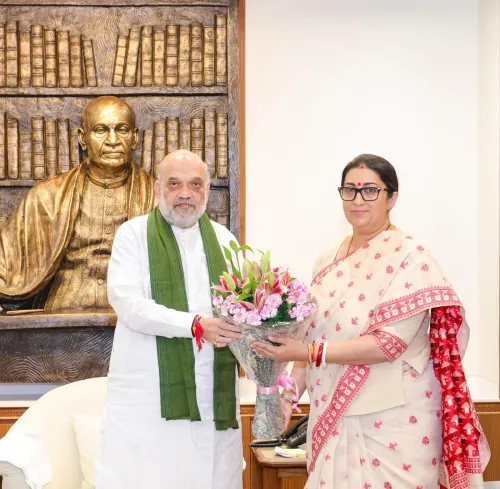
BJP leader Smriti Irani on 22 October 2026 accused the opposition of shielding illegal immigrants' votes under the cover of voter-integrity rhetoric, directly tagging Home Minister Amit Shah in a post that revives the CAA-NRC citizenship debate ahead of elections.
Key Takeaways
Smriti Irani on 22 October 2026 accused the opposition of protecting votes cast by infiltrators, not Indian citizens.
She tagged Amit Shah , Union Home Minister, directly escalating the message to the government's top security and citizenship authority.
The BJP has long argued that undocumented Bangladeshi migrants in Assam and West Bengal distort electoral rolls.
The Citizenship Amendment Act (2019) and the Assam NRC (2019) form the legislative backbone of this BJP policy argument.
The post reframes opposition voter-integrity concerns as cover for shielding non-citizen votes — a narrative the party has deployed repeatedly in election campaigns.
A sharp electoral-integrity broadside landed on Thursday when BJP leader Smriti Irani publicly tagged Union Home Minister Amit Shah in a post accusing the opposition of using the language of 'vote theft' to protect the voting rights of illegal immigrants — not Indian citizens. The post, shared on 22 October 2026, cuts to one of the most combustible fault-lines in Indian electoral politics.
Irani wrote, 'विपक्ष वोट चोरी के नाम पर घुसपैठियों का वोट बचाना चाहता है' — 'The opposition, in the name of stopping vote theft, actually wants to protect the votes of infiltrators.' By looping in Shah, she was clearly pitching the message to the government's top official on internal security and citizenship policy.The infiltrator-voter debate BJP has kept alive
This is not a new argument for the BJP — but its reappearance signals it is being sharpened again for an electoral cycle. The party has for years maintained that undocumented migrants from Bangladesh, concentrated in Assam, West Bengal, and other northeastern border states, have found their way onto electoral rolls, distorting both demographics and democratic outcomes. Every opposition push to challenge voter-list revisions or ID verification drives gets refracted through this lens: that objecting to scrutiny is the same as protecting illegitimate votes.
The Citizenship Amendment Act (CAA), passed in 2019, and the National Register of Citizens (NRC) exercise in Assam — also concluded in 2019 under Supreme Court supervision — are the legislative spine of this policy posture. Both measures were bitterly contested by the opposition, which argued they were discriminatory and designed to disenfranchise Muslims. The BJP's counter has consistently been that the two instruments are about documented citizenship, not religious targeting.
Why tagging Amit Shah matters
Amit Shah, as Union Home Minister, holds direct authority over the Bureau of Immigration, the Border Security Force, and the broader citizenship-documentation architecture. When Irani publicly tags him in a post framing electoral rolls as being corrupted by infiltrators, she is not just scoring a political point — she is nudging the policy conversation toward enforcement action. It is a deliberate signal to the base and, arguably, to border-state BJP governments, that the demand for tighter electoral-roll verification has the party's central leadership behind it.
Assembly elections and parliamentary debates over electoral roll revisions in frontier states will now be watched to see whether this social-media salvo translates into concrete legislative or administrative moves. The question is blunt: will the opposition's voter-integrity concerns be redefined, in the run-up to any election, as cover for non-citizen voting — and will that framing stick?
Irani has proven an effective messenger on exactly these kinds of politically charged, culturally resonant frames. Expect this one to travel.
Point of View
She anchors the rhetoric to the government's enforcement machinery, lending institutional weight to what could otherwise read as a political jab. The timing, directed at an unspecified but clearly live electoral context, suggests the party is stress-testing this narrative for a coming campaign. For the opposition, the challenge is familiar and uncomfortable: any pushback on voter-list scrutiny risks being absorbed into the BJP's 'pro-infiltrator' framing before a counter-argument can land.
NationPress
22 Oct 2026
Frequently Asked Questions
What did Smriti Irani say about the opposition and infiltrators?
Smriti Irani posted on 22 October 2026 that the opposition, under the pretext of opposing vote theft, actually wants to protect the votes of illegal immigrants or infiltrators, tagging Home Minister Amit Shah.
Why did Smriti Irani tag Amit Shah in her post?
Amit Shah is the Union Home Minister who oversees border security and citizenship documentation. Tagging him signals that the demand for electoral-roll verification has the support of the party's top policy authority.
What is the BJP's position on infiltrators and electoral rolls?
The BJP has long argued that undocumented migrants, particularly from Bangladesh, have entered electoral rolls in border states like Assam and West Bengal, affecting election outcomes and demographics.
What are the CAA and NRC, and how do they relate to this debate?
The Citizenship Amendment Act (2019) provides citizenship pathways for persecuted non-Muslim minorities from neighbouring countries, while the Assam NRC (2019) was a Supreme Court-supervised exercise to identify illegal immigrants. Together they form the BJP's legislative framework for citizenship verification.
Which states are most affected by the infiltrator-voter controversy?
Assam, West Bengal, and other northeastern border states are most often cited in this debate, given their proximity to Bangladesh and historical patterns of cross-border migration.