US H-1B restrictions risk India-US strategic partnership: Report
Synopsis
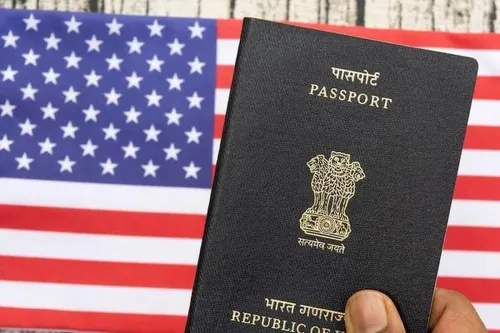
A Khalsa Vox report warns that Washington's increasingly restrictive H-1B posture — including a proposed $100,000 petition fee — threatens to erode the India-US strategic partnership at its foundations. With Indian nationals making up nearly two-thirds of H-1B approvals in 2024, the report argues this is less an immigration debate and more a test of whether America can hold its most important partnerships together under domestic political pressure.
Key Takeaways
A Khalsa Vox report warns that restrictive US H-1B visa policies risk undermining the India-US strategic partnership .
Indian nationals accounted for nearly two-thirds of all H-1B approvals in 2024 .
The Trump administration has proposed a $100,000 fee on certain new H-1B petitions, raising concerns over disproportionate impact on Indian professionals.
The Indian American community , numbering over four million , is described as one of the strongest foundations of India-US relations .
The report stresses that strategic partnerships depend on 'economic interdependence, institutional confidence and the movement of people' — not military ties alone.
Restrictive US H-1B visa policies risk eroding the trust underpinning the India-US strategic partnership, according to a report published in Khalsa Vox, as Indian nationals continue to account for nearly two-thirds of all H-1B approvals. With the Indian American community numbering over four million, the report argues that treating skilled foreign professionals as economic liabilities rather than drivers of innovation could destabilise one of Washington's most consequential bilateral relationships.
The H-1B Tension at the Core
The report draws a sharp distinction between legitimate immigration reform and politically motivated restriction. It acknowledges that the Trump administration's stated goals — protecting American workers, eliminating visa fraud, and curbing misuse of foreign labour — are defensible policy objectives. However, it raises pointed questions about the decision to impose a $100,000 fee on certain new H-1B petitions.
'Is Washington genuinely reforming a flawed immigration system, or is it sacrificing a strategically valuable partnership for domestic political gains?' the report asked. The framing captures a tension that has grown increasingly visible as the 'America First' immigration posture collides with the demands of America's own technology sector.
Why India Bears the Disproportionate Impact
Indian professionals have been among the largest beneficiaries of the US skilled immigration system for decades. In 2024, Indian nationals accounted for approximately two-thirds of all H-1B approvals — a figure that reflects deep integration across technology, engineering, healthcare, and other specialised sectors.
The report warns that any blanket restriction on the programme would hit Indian professionals, companies, and families disproportionately hard. India's information technology industry, it notes, has spent decades building an 'intricate economic relationship' with the United States, with Indian technology firms embedded across American banking, healthcare, telecommunications, manufacturing, and digital infrastructure.
The Strategic Cost Washington Cannot Ignore
Over the past two decades, successive US administrations have made considerable diplomatic investments in the India-US partnership — expanding defence cooperation, deepening technological ties, and aligning on a shared vision for Indo-Pacific stability. Against the backdrop of intensifying competition with China, India has emerged as a key pillar of America's long-term strategic calculations, the report observed.
Yet the report stresses that strategic partnerships are not sustained through military exercises and summit diplomacy alone. 'Their durability depends equally on economic interdependence, institutional confidence and the movement of people,' it stated. This is a point that critics argue Washington has underweighted in its immigration calculus.
What the Larger Trend Signals
Indian students, researchers, entrepreneurs, and professionals have, over generations, built what the report describes as 'enduring links' between the two countries. Disrupting that human capital pipeline — through cost barriers, processing uncertainty, or restrictive caps — risks reversing decades of relationship-building at precisely the moment the two nations need strategic alignment most.
Notably, this report arrives as the broader debate over US immigration policy continues to reshape how skilled-worker source countries, particularly India, assess the long-term reliability of the United States as a partner for talent mobility and economic cooperation. How Washington navigates the tension between domestic political pressures and its global strategic ambitions will be closely watched in New Delhi.
Point of View
Yet stops short of asking why New Delhi has not made this a formal bilateral red line. India's leverage here is real — two-thirds of H-1B approvals is not a statistic Washington can dismiss lightly — but that leverage is only as strong as India's willingness to wield it in diplomatic channels rather than cede the conversation to think-tank commentary. The $100,000 fee is the clearest signal yet that the US immigration system is being reengineered around domestic political theatre rather than strategic interest. If Washington proceeds, it will not just lose Indian talent to other destinations; it will signal to New Delhi that 'America First' has a ceiling on what the partnership can deliver.
NationPress
24 Oct 2026
Frequently Asked Questions
How do US H-1B restrictions affect Indian professionals?
Indian nationals accounted for nearly two-thirds of all H-1B approvals in 2024, making them the single largest group affected by any tightening of the programme. A proposed $100,000 fee on certain new H-1B petitions would raise the cost of hiring Indian professionals significantly, potentially deterring US companies and displacing Indian talent to other countries.
Why does the H-1B debate matter for the India-US strategic relationship?
The India-US partnership rests not just on defence cooperation and diplomatic summits but on decades of people-to-people links built by Indian students, professionals, and entrepreneurs in the United States. Restricting that movement risks eroding the goodwill and economic interdependence that underpin the broader strategic relationship, particularly at a time when both countries are aligned on Indo-Pacific stability.
What is the $100,000 H-1B fee and who does it affect?
According to the report, the Trump administration has proposed imposing a $100,000 fee on certain new H-1B petitions, framed as a measure to curb visa fraud and protect American workers. Critics argue it would disproportionately burden Indian professionals and the companies that employ them, raising questions about whether this is genuine reform or a politically driven barrier.
What role does the Indian American community play in India-US relations?
With a population of over four million, the Indian American community is described in the report as one of the strongest foundations of the India-US bilateral relationship. Indian professionals have built lasting ties across technology, healthcare, and finance, contributing to American innovation while maintaining economic and cultural links with India.
How has the India-US strategic partnership developed over the past two decades?
Over the past two decades, successive US administrations have expanded defence cooperation with India, deepened technological ties, and aligned on maintaining stability in the Indo-Pacific. India has become a central pillar of America's long-term strategic calculations, particularly as competition with China intensifies — making the erosion of people-to-people ties through immigration curbs a significant strategic risk.