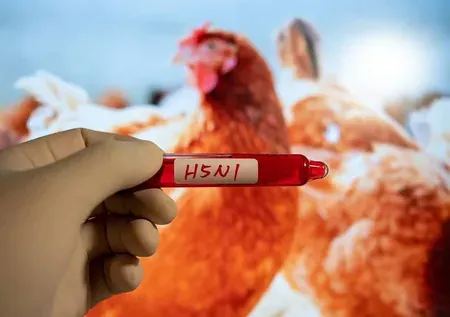
H5N1 bird flu confirmed on Australian mainland for first time in Western Australia
Synopsis
Australia — until now the last inhabited continent untouched by H5N1 — has confirmed its first mainland case after a brown skua died in a Western Australia national park. With a second bird quarantined and AU$113 million already committed for preparedness, the coming days will reveal whether the virus has established itself in local populations.
Key Takeaways
A brown skua found dead on 14 June in a southern Western Australia national park has tested positive for the H5N1 strain of avian influenza — the first confirmed mainland case in Australia.
A second bird, a giant petrel , was found sick nearby and has been quarantined .
Agriculture Minister Julie Collins confirmed the detection on 20 June in Canberra.
The Australian government pre-committed AU$113 million (approx.
US$79.2 million ) for H5N1 outbreak preparedness.
The H5N1 strain has caused millions of animal deaths globally since 2020 ; human cases remain uncommon.
Authorities expect to know within days whether the strain has established itself in any Australian wildlife population.
Australia has recorded its first confirmed case of the H5N1 strain of avian influenza on the mainland, after a migratory brown skua found dead in a southern Western Australia national park tested positive for the highly pathogenic virus. The detection, announced on Saturday, 20 June, ends Australia's status as the last inhabited continent free of the strain.
How the Case Was Confirmed
Agriculture Minister Julie Collins told reporters in Canberra that the Australian Centre for Disease Preparedness confirmed the brown skua — discovered on 14 June — had died from the H5N1 strain. A second bird, a giant petrel, was found sick nearby on Thursday and has since been quarantined pending further testing.
Australia's Chief Veterinary Officer, Beth Cookson, urged the public to avoid contact with sick or dead birds and to report any such sightings to the Emergency Animal Disease hotline. Threatened Species Commissioner Fiona Fraser said authorities expect to know within days whether the strain has established itself in any local wildlife populations.
Australia's Preparedness and Prior Warnings
The Australian government had previously committed AU$113 million (approximately US$79.2 million) to prepare for a potential H5N1 outbreak. Collins noted that the early investment was informed by observing outbreaks overseas. 'We have looked at what has happened overseas and we have learnt from that, which is why we have invested early,' she said.
Notably, the H5N1 strain had already been detected on the remote Australian territories of Heard and McDonald Islands in the southern Indian Ocean in October last year — but Saturday's detection marks the first confirmed case on the Australian mainland itself.
Global Context and Animal Risk
The H5N1 strain has spread across the globe since 2020, causing the deaths of millions of birds and other animals. It spreads rapidly among poultry and wild bird populations. This is the first time the strain has breached the Australian mainland, completing what epidemiologists had long regarded as an inevitable geographic progression.
Human cases tied to H5N1 remain uncommon, according to available data, though health authorities continue to monitor the situation closely given the virus's track record of rapid spread in animal populations.
What Happens Next
Authorities are conducting surveillance across nearby wildlife populations to determine whether the strain has taken hold beyond the two birds identified so far. The quarantine of the giant petrel is a critical early containment measure. Poultry producers and wildlife managers in Western Australia have been placed on heightened alert, and further testing results are expected within days.
Point of View
Not if. The fact that Canberra committed AU$113 million in preparedness funding before this detection suggests the government read the risk correctly. What is less clear is whether that investment translates into on-ground containment capacity fast enough to protect Australia's uniquely vulnerable wildlife, including threatened seabird colonies. The detection in a migratory bird also underscores a structural problem: no border biosecurity regime can stop a flying animal. The next 72 hours of surveillance data will be the real test of whether Australia's early spending buys it a controlled response or a prolonged outbreak.
NationPress
19 Sept 2026
Frequently Asked Questions
What is the H5N1 bird flu strain detected in Australia?
H5N1 is a highly pathogenic strain of avian influenza that has spread globally since 2020, causing the deaths of millions of birds and other animals. It was confirmed on the Australian mainland for the first time after a brown skua found dead in a Western Australia national park tested positive on 14 June.
Where exactly was the H5N1 case found in Australia?
The infected bird — a brown skua — was found in a southern Western Australia national park on 14 June. A second bird, a giant petrel, was discovered sick nearby and has been quarantined.
Has Australia seen H5N1 before this mainland detection?
Yes, the H5N1 strain was previously detected on the remote Australian territories of Heard and McDonald Islands in the southern Indian Ocean in October last year. However, Saturday's case is the first confirmed detection on the Australian mainland.
What is the risk to humans from this H5N1 detection?
Human cases tied to H5N1 remain uncommon, according to available data. Authorities have urged the public to avoid contact with sick or dead birds and to report sightings to the Emergency Animal Disease hotline as a precautionary measure.
How is Australia responding to the H5N1 outbreak?
The Australian government had pre-committed AU$113 million for H5N1 preparedness. Chief Veterinary Officer Beth Cookson has urged public vigilance, and Threatened Species Commissioner Fiona Fraser said authorities expect surveillance results on local population spread within days.