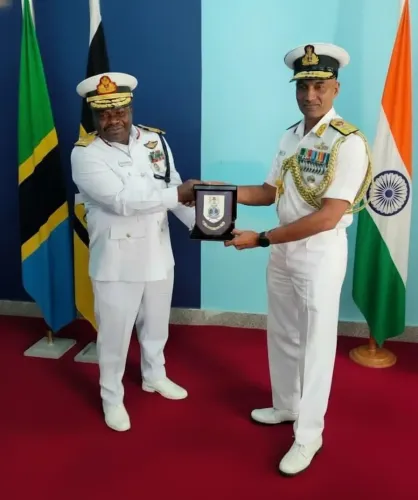
IBSAMAR IX: India, Brazil, South Africa hold 9th naval exercise at Simon's Town
Synopsis
For the ninth time since 2008, India, Brazil and South Africa are exercising their navies together — this time at Simon's Town with INS Tarkash, BNS Barroso and SAS Amatola. IBSAMAR IX is not an alliance in the making; it is something arguably more durable: a non-aligned maritime framework connecting the Indian and South Atlantic Oceans through repeated, practical naval engagement.
Key Takeaways
IBSAMAR IX is under way at Simon's Town, South Africa in 2026 , the ninth edition of the biennial trilateral exercise launched in 2008 .
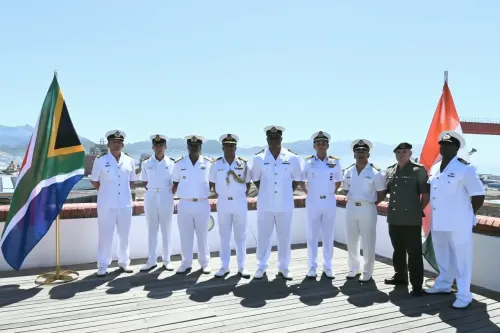
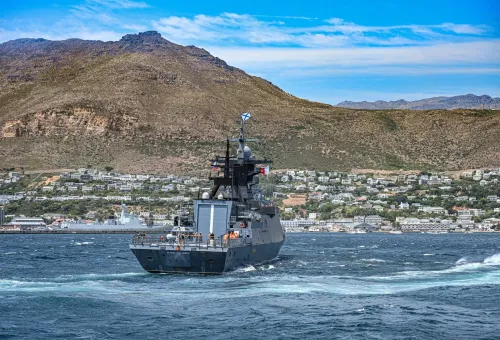
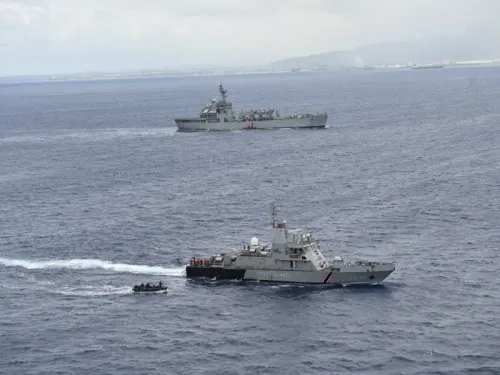
The Indian Navy is represented by INS Tarkash , the Brazilian Navy by BNS Barroso , and the South African Navy by SAS Amatola .
The exercise covers anti-submarine warfare, aviation operations, maritime interdiction, VBSS, replenishment-at-sea and Special Forces cooperation across harbour and sea phases.
India, Brazil and South Africa are not formal military allies; IBSAMAR builds interoperability without a collective-defence commitment.
The three nations' geographic positions — Indian Ocean , Atlantic-Indian junction , and South Atlantic — give the exercise cross-oceanic strategic relevance.
The ninth edition of the India-Brazil-South Africa Maritime Exercise (IBSAMAR IX) is under way at Simon's Town, South Africa, in 2026, bringing together the Indian Navy, Brazilian Navy and South African Navy for trilateral maritime training that spans two oceanic theatres. The exercise, conducted biennially since 2008, represents the naval arm of the IBSA Dialogue Forum and one of the most sustained examples of South-South maritime cooperation in the world today.
Ships and Forces Involved
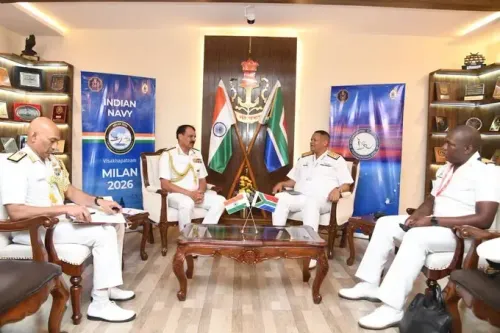
The Indian Navy is represented by INS Tarkash, while the South African Navy has deployed SAS Amatola and the Brazilian Navy is participating with BNS Barroso. The three-warship formation mirrors the structure of IBSAMAR VIII in 2024, which brought together INS Talwar, BNS Defensora and SAS Amatola, supported by naval aviation and Special Forces elements.
Simon's Town — one of South Africa's foremost naval installations — provides direct access to the maritime approaches of the southern African coastline and has hosted multiple previous editions of the exercise, reinforcing its status as the natural base for this trilateral format.
What the Exercise Involves
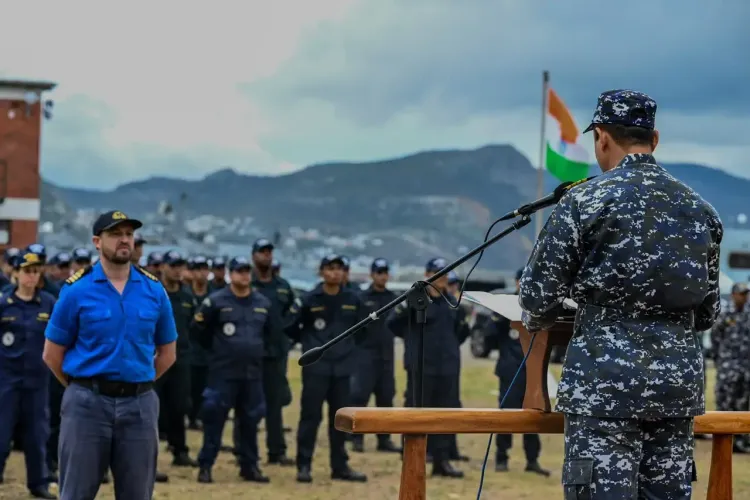
IBSAMAR has matured well beyond basic naval contact drills since its inaugural edition. The exercise now incorporates harbour and sea phases covering navigation, seamanship, tactical manoeuvres, surface warfare, anti-air warfare, anti-submarine warfare, aviation operations, replenishment-at-sea, maritime interdiction, and Visit, Board, Search and Seizure (VBSS) activities. Harbour phases include damage-control and firefighting drills, cross-deck exchanges and Special Forces cooperation.
The Indian Ministry of Defence has consistently described the exercise as a vehicle for collective training, interoperability-building and the sharing of best practices — goals that require repeated engagement because naval forces differ in communication systems, procedures, command structures and operational cultures. Diplomatic agreements alone cannot create the practical familiarity that joint exercises produce.
Strategic Significance for All Three Navies
The geographic spread of the three participant nations gives IBSAMAR a distinctive strategic character. India occupies a commanding position in the Indian Ocean Region; South Africa sits at the junction of the Atlantic and Indian Oceans; and Brazil anchors the South Atlantic. Together, the three navies connect maritime cooperation across a vast arc stretching from the western Indian Ocean to the eastern South Atlantic.
For India, the deployment of INS Tarkash to waters off South Africa demonstrates a blue-water capability — the ability to sustain long-range overseas deployments and engage partner navies far from the domestic coastline. For Brazil, participation deepens engagement with Indian Ocean partners beyond its immediate neighbourhood. For South Africa, hosting the exercise and deploying SAS Amatola reinforces its role as a maritime bridge between two oceanic regions.
Notably, India, Brazil and South Africa are not formal military allies, and IBSAMAR carries no collective-defence commitment. Its value lies precisely in demonstrating that structured naval cooperation can exist — and generate genuine operational benefit — without requiring identical strategic alignments or a treaty framework.
South-South Cooperation and Common Security Interests
IBSAMAR's broader significance is its character as a South-South maritime security mechanism. All three nations share concerns over piracy, trafficking, illegal exploitation of marine resources, maritime terrorism and threats to commercial shipping. As global shipping routes, energy supplies and subsea infrastructure become more interconnected, events in one oceanic theatre increasingly produce consequences in another — making cross-regional naval familiarity more valuable.
This comes amid a period of heightened attention to maritime security globally, with competition over sea lanes intensifying and the vulnerability of undersea infrastructure — highlighted by several high-profile incidents in recent years — drawing fresh scrutiny from naval planners worldwide.
What Comes Next
IBSAMAR IX will build on the operational lessons of the 2024 edition, incorporating increasingly demanding combined serials in its sea phase. Each successful iteration contributes to a larger network of professional relationships and a shared operational vocabulary between the three navies. With the exercise now in its ninth edition and its biennial rhythm well established, the strategic partnership it underpins appears set to deepen further ahead of IBSAMAR X.
Point of View
But its strategic logic is distinct and arguably underappreciated. By sustaining a non-allied maritime framework across the Indian and South Atlantic Oceans, it hedges India's naval diplomacy against over-dependence on any single strategic grouping. The exercise also quietly tests the IBSA Dialogue Forum's practical utility at a time when that forum's political momentum has been uneven. Nine editions in, the fact that all three navies keep showing up — with warships, not just officials — is itself a data point worth noting.
NationPress
14 Oct 2026
Frequently Asked Questions
What is IBSAMAR and when did it start?
IBSAMAR is a biennial trilateral maritime exercise involving the Indian, Brazilian and South African navies, established in 2008 as the naval dimension of the IBSA Dialogue Forum. It is designed to build interoperability, mutual understanding and operational cooperation between the three navies across the Indian and South Atlantic Oceans.
Which ships are participating in IBSAMAR IX in 2026?
India is represented by INS Tarkash, Brazil by BNS Barroso, and South Africa by SAS Amatola. The exercise is being hosted at Simon's Town, South Africa — a venue that has hosted multiple previous editions of the exercise.
What activities are carried out during IBSAMAR?
IBSAMAR combines harbour and sea phases, encompassing tactical manoeuvres, anti-submarine and anti-air warfare, aviation operations, replenishment-at-sea, maritime interdiction, Visit Board Search and Seizure (VBSS) drills, damage control, and Special Forces cooperation. The mix of activities is designed to develop practical interoperability across a broad range of naval tasks.
Does IBSAMAR create a military alliance between India, Brazil and South Africa?
No. IBSAMAR does not constitute a formal military alliance or collective-defence commitment. The exercise is explicitly designed to build operational familiarity and trust while allowing all three countries to retain independent foreign and defence policies.
Why is Simon's Town strategically significant for this exercise?
Simon's Town is South Africa's primary naval base and sits at the maritime junction of the Atlantic and Indian Oceans, giving the exercise direct access to the approaches of southern Africa. Its established naval infrastructure and strategic position make it the natural host for a trilateral exercise whose geographic scope spans two oceanic theatres.