Bangladesh must find room for Awami League voters as it did for Jamaat: Analyst
Synopsis
A political analyst writing in a UK outlet has delivered a sharp rebuke of Bangladesh's Yunus-led interim government, warning that hundreds of Awami League-linked individuals remain jailed without charge while Jamaat-e-Islami — which opposed Bangladesh's own independence — has been welcomed back into electoral politics. The contradiction, he argues, exposes a selective approach to rights that risks turning the language of liberation into a cover for repression.
Key Takeaways
Analyst Chris Blackburn warned that Muhammad Yunus 's interim government, in power since July 2024 , has failed to prevent arbitrary detention of political opponents.
A Human Rights Watch report from August 2026 found hundreds of Awami League -linked individuals held without charge, with concerns over deaths in custody and denial of medical care.
Lawyers reportedly advised some clients against seeking bail, as police allegedly filed fresh cases against those who pursued legal relief.
Jamaat-e-Islami had its electoral registration restored in 2025 , despite its historical opposition to Bangladesh's independence — a precedent Blackburn used to demand inclusion of Awami League voters.
Blackburn urged Britain , Europe , and international partners to press Dhaka for credible trials, an end to arbitrary detention, and protection for journalists and minorities.
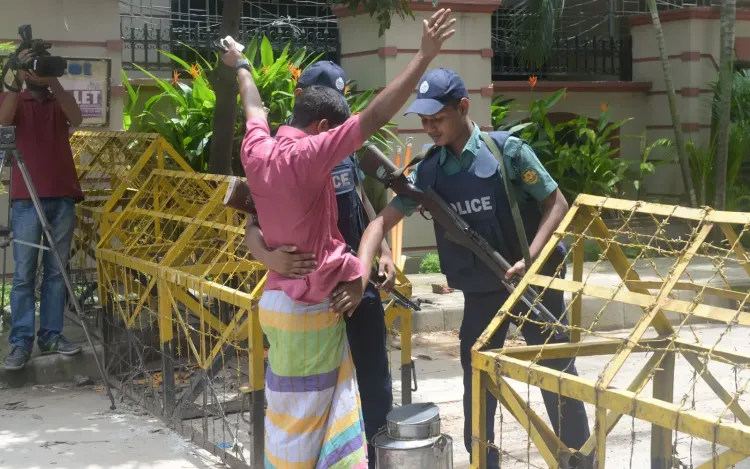
Bangladesh's interim administration faces mounting scrutiny over its human rights record, with a political and security analyst warning that Muhammad Yunus's government risks replacing one form of repression with another — and that democratic obligations do not expire after a revolution.
The Core Argument
Writing in UK-based platform Comment Central, analyst Chris Blackburn argued that the Yunus-led interim government, which assumed power following the July 2024 protests that toppled the previous administration, has failed to protect individuals from arbitrary detention. Critically, he pointed out that those now in power — many of whom once demanded due process for themselves — are presiding over a system that denies those very protections to political opponents.
Blackburn framed the danger starkly: a future where the language of liberation is weaponised to justify repression, and the language of justice is used to mask revenge. In such a scenario, he warned, rights are reduced to favours, and political labels determine whose suffering is acknowledged.
Arbitrary Detention and Rights Concerns
Blackburn cited a Human Rights Watch report from August 2026, which found that hundreds of individuals associated with the former Awami League government remained detained without charge. The rights body also raised concerns about deaths in custody and allegations that detainees were being denied medical treatment — obligations that, Blackburn stressed, do not disappear regardless of the political context.
He further noted that some lawyers reportedly advised clients against seeking bail, as police allegedly responded by filing fresh cases against those who pursued legal remedies. 'What does the right to bail mean if exercising it opens another route back to prison?' Blackburn wrote. 'The people occupying the chairs have changed. The willingness to deny opponents the protections once demanded for oneself remains.'
Jamaat's Return and the Question of Political Inclusion
Blackburn pointed to the restoration of Jamaat-e-Islami's electoral registration in 2025 as evidence that political exclusion can be reversed. Despite the party's historical opposition to Bangladesh's independence from Pakistan, it has been rehabilitated into the political process — a fact the analyst used to press for consistency.
'If Bangladesh can find room for Jamaat, it should be able to find room for Awami League voters,' Blackburn stated, asserting that political inclusion cannot be selective without undermining the very principles a post-revolution government claims to uphold.
On the 1971 Liberation War Trials
The analyst also addressed the enduring legacy of the 1971 Bangladesh Liberation War, arguing that the crimes committed during that conflict could not simply be set aside because prosecution was politically inconvenient. However, he cautioned that the historical importance of that justice never relieves a court of its obligation to conduct a fair trial based on evidence — not political imperatives.
International Community Urged to Act
Blackburn called on Britain, Europe, and other international partners to actively push for credible trials, an end to arbitrary detention, and legal safeguards for journalists and minorities. He also urged these countries to ensure that space exists for peaceful political opposition in Bangladesh, emphasising that such standards must hold regardless of who holds power.
According to Blackburn, Bangladesh can only attract genuine international support through an honest reckoning with its past and a consistent commitment to its stated democratic future.
Point of View
Not rewards for political loyalty. The irony of a movement that demanded due process for itself now presiding over mass detention without charge is not a minor inconsistency — it is an institutional failure. Jamaat's rehabilitation, while contested, does provide a coherent precedent: if a party that opposed Bangladesh's very birth can re-enter the fold, the exclusion of Awami League voters is not principled justice but political convenience dressed in legal language. International partners that stayed silent through earlier crackdowns risk becoming complicit in the new dispensation's excesses.
NationPress
14 Sept 2026
Frequently Asked Questions
What concerns has the analyst raised about Bangladesh's interim government?
Analyst Chris Blackburn argues that the Muhammad Yunus-led interim government, in power since July 2024, has failed to protect individuals from arbitrary detention and is denying political opponents the due-process protections the same leaders once demanded for themselves. He cites a Human Rights Watch report from August 2026 finding hundreds of Awami League-linked individuals jailed without charge.
What did Human Rights Watch say about Bangladesh in August 2026?
According to the August 2026 Human Rights Watch report cited by Blackburn, hundreds of people associated with the former Awami League government remained detained without charge. The report also raised concerns over deaths in custody and allegations that detainees were denied medical treatment.
Why did Blackburn reference Jamaat-e-Islami's restoration in 2025?
Jamaat-e-Islami had its electoral registration restored in 2025 despite historically opposing Bangladesh's independence from Pakistan. Blackburn used this as evidence that political exclusion can be reversed and argued that consistency demands the same openness be extended to Awami League voters.
What did the analyst say about the 1971 Liberation War trials?
Blackburn argued that prosecuting crimes committed during the 1971 Bangladesh Liberation War was both necessary and a right for the nation, but stressed that historical importance never relieves a court of its obligation to conduct fair trials based on evidence rather than political pressure.
What role does Blackburn urge Britain and Europe to play in Bangladesh?
Blackburn called on Britain, Europe, and other international partners to actively push for credible trials, an end to arbitrary detention, and legal safeguards for journalists, minorities, and peaceful political opposition. He emphasised that these standards must be upheld regardless of who holds power in Dhaka.