Is the EU–India FTA a Positive Development According to IMF?
Synopsis
The IMF has hailed the EU–India Free Trade Agreement as a promising step towards economic integration during turbulent trade times. With insights on trade dynamics and policy implications, this development is poised to reshape economic landscapes for multiple nations. Discover how this agreement reflects broader trends in global trade.
Key Takeaways
The IMF views the EU–India FTA as a significant advancement.
Trade agreements are essential for deepening economic integration.
There are both benefits and challenges associated with trade liberalization.
Policy certainty from trade deals can bolster economic stability.
Historical trade integration has driven growth in emerging economies.
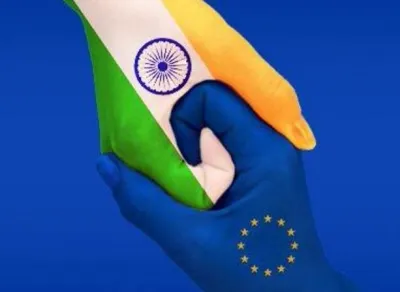
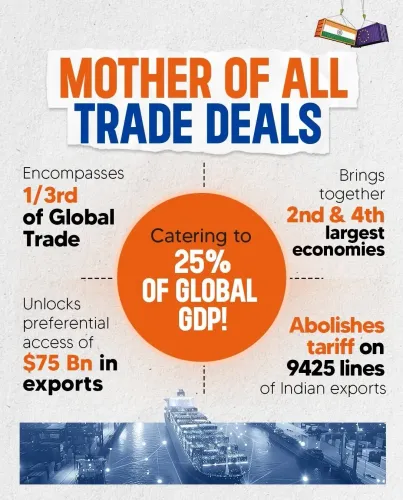
Washington, Jan 29, (NationPress) The International Monetary Fund (IMF) has recently characterized the India–European Union (EU) Free Trade Agreement (FTA) as a significant advancement. This development highlights the countries' commitment to enhancing economic integration in the context of escalating global trade tensions and uncertainty.
During a briefing concerning emerging market economies, IMF Economic Counsellor and Director of Research Pierre-Olivier Gourinchas remarked that the recent trade agreements underscore governments' efforts to find practical methods to strengthen trade relationships, despite a challenging year for global trade.
“We have seen two crucial agreements announced at various phases of their progression,” Gourinchas noted, referencing the newly signed EU–Mercosur deal alongside the EU–India FTA.
“I view both of these developments as beneficial,” Gourinchas stated. “They are advantageous for the EU, the Mercosur nations, and for India.”
He emphasized that these agreements reflect “the determination of several nations to transcend the trade tensions experienced in 2025” and to explore avenues for deeper economic integration that can uplift various regions.
Gourinchas pointed out the historical significance of trade integration as a catalyst for growth in emerging and developing nations. “Over the last 50 to 70 years, trade integration, especially for emerging markets and developing countries, has served as a key driver of development,” he explained.
“It has lifted hundreds of millions out of poverty, facilitated rapid growth, and improved living standards,” he added, noting the “well-documented evidence” supporting the benefits of trade openness.
In today’s global landscape, Gourinchas remarked that it is crucial for some nations to continue pursuing enhanced trade relationships where opportunities exist. “The fact that certain countries are actively seeking to deepen their trade ties where feasible is a positive sign,” he stated.
However, he also warned against viewing trade liberalization as without costs. “We must not be overly optimistic about trade,” Gourinchas cautioned, acknowledging that trade integration can result in both beneficiaries and those adversely affected by increased competition and job displacement.
“There are winners, but other sectors of the economy may suffer due to heightened competition, resulting in job losses,” he noted, adding that these adjustment costs should be recognized and managed through appropriate policy measures.
“Nonetheless, the overall net benefits are favorable,” Gourinchas concluded.
He highlighted that trade agreements can provide policy stability in times of global volatility. “These trade deals offer a degree of policy certainty,” he said, explaining that such predictability enables businesses to operate within a clearer framework, allowing for informed investment decisions and resource allocation.
“They are empowered to determine their investment strategies,” he noted, adding that this certainty can bolster investment flows and enhance economic stability.
This discussion occurred ahead of an IMF conference on emerging market economies, organized in collaboration with Saudi Arabia’s Ministry of Finance in AlUla, where policymakers will deliberate on resilience, trade integration, and economic transitions amidst heightened global uncertainty.
Point of View
I believe that the IMF's recognition of the EU–India FTA as a positive development underscores a critical move towards economic integration during challenging global conditions. This agreement signals opportunities for growth and collaboration, aligning with our commitment to fostering economic resilience amidst uncertainty. Nation always supports initiatives that enhance trade and economic stability.
NationPress
29 Sept 2026
Frequently Asked Questions
What is the significance of the EU–India FTA?
The EU–India FTA is significant as it aims to enhance economic integration between India and the EU, fostering trade relations amidst rising global trade tensions.
How does the IMF view the recent trade agreements?
The IMF views recent trade agreements, including the EU–India FTA, as positive developments that reflect countries' efforts to deepen economic ties and promote growth.
What are the potential benefits of the EU–India FTA?
Potential benefits include increased trade flows, enhanced economic stability, and improved living standards through greater economic cooperation.
Are there any risks associated with trade liberalization?
Yes, trade liberalization can lead to both winners and losers, with increased competition potentially displacing jobs in certain sectors.
What role do trade agreements play in global economic stability?
Trade agreements provide policy certainty, allowing businesses to make informed investment decisions, thus supporting overall economic stability.