Is the India-EU FTA a Unique Fusion of Economic Logic and Strategic Trust?
Synopsis
With the India-EU Free Trade Agreement nearing completion, industry leaders emphasize its significance beyond trade liberalization, viewing it as a stabilizing force for global commerce. This article explores the strategic implications of the agreement amidst geopolitical tensions.
Key Takeaways
Negotiations for the India-EU FTA are nearing completion.
The agreement is viewed as a stabilizing force in global trade.
Enhanced market access is expected to reduce transaction costs.
There's strong support from industry leaders for the FTA's fast-tracking.
The deal aims to strengthen economic ties amid geopolitical tensions.
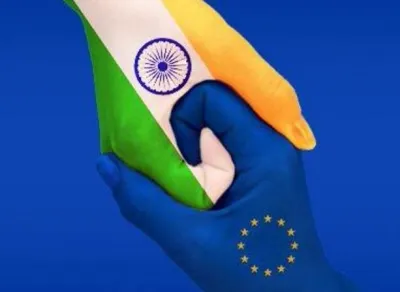
New Delhi, Jan 22 (NationPress) The negotiations for the India-European Union Free Trade Agreement (FTA) are nearing completion and have taken on a strategic importance that extends beyond mere trade liberalization. Industry leaders and policymakers now view the proposed agreement as a crucial stabilizing force for global commerce amidst escalating geopolitical fragmentation and the weaponization of trade.
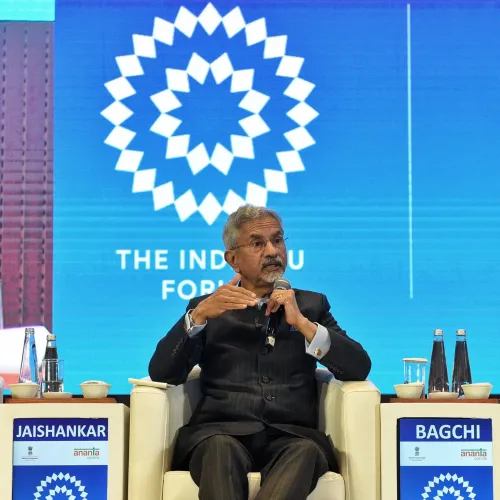
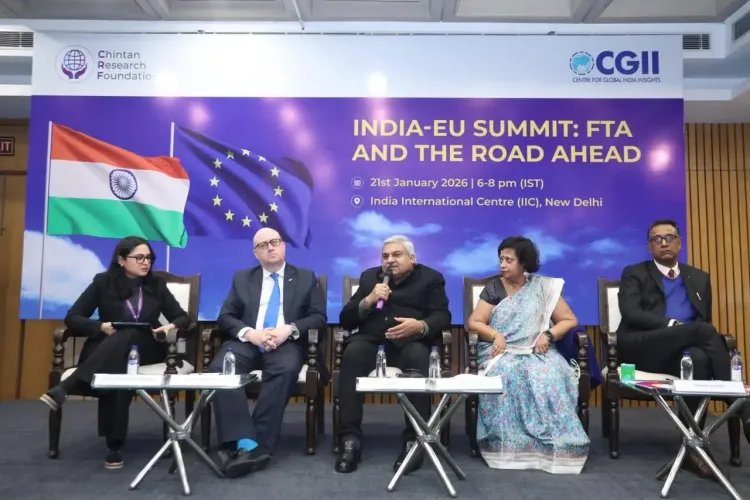
This sentiment was voiced during a high-level dialogue entitled “India-EU Summit: FTA and the Road Ahead”, co-hosted by the Chintan Research Foundation (CRF) and the Centre for Global India Insights (CGII) at the India International Centre in the capital.
The forthcoming India-EU Summit, set for January 27, signifies the ongoing enhancement of economic ties between the two regions.
During the dialogue, industry leaders, diplomats, and policymakers united in advocating for the prompt finalization of the India-EU FTA, asserting that this deal is vital for boosting export growth, enhancing supply-chain resilience, and securing long-term investments amid rising global uncertainties.
This discussion occurred against the backdrop of renewed political momentum surrounding the India-EU FTA, particularly following talks at the annual World Economic Forum (WEF) in Davos.
Shishir Priyadarshi, President of CRF, emphasized the significance of the FTA's timing, stating that in a world of disrupted supply chains and geopolitical instability, the India-EU FTA symbolizes a unique alignment of economic rationale and strategic trust.
A finalized agreement, he noted, could yield measurable benefits by fostering predictability, resilience, and collaboration in global trade.
For the European Union, speakers highlighted that India is a rapidly growing economy, a reliable partner for diversifying supply chains, and an increasingly appealing destination for long-term investment.
They anticipate that enhanced market access and regulatory transparency under the FTA will decrease transaction costs and empower businesses on both sides to expand operations and collaborate more efficiently.
Numerous speakers pointed out that the Indian industry stands to significantly benefit from increased European investments and technologies, especially in sectors like advanced manufacturing, clean energy, electronics, pharmaceuticals, chemicals, and automotive components.
A clear FTA structure, they argued, would provide reassurance to investors that India remains a stable, rules-based ally.
A recurring theme was that the Indian industry is keenly pursuing the FTA, viewing it as an opportunity to diversify exports, ascend global value chains, and deepen ties with advanced markets.
Industry representatives stressed that the agreement's effectiveness will ultimately rely on its usability—particularly in terms of standards, regulatory compliance, logistics, and services trade.
The strategic importance of the agreement was further highlighted by comparisons to the EU-Vietnam FTA, which reportedly led to a more than 50% increase in Vietnam's exports to the EU within four years of implementation, along with a significant surge in foreign investment.
As global trade becomes increasingly politicized, a nearly finalized India-EU FTA sends a strong and timely message.
By aligning strategic interests with commercial realities, this agreement has the potential to become a cornerstone of a modern, mutually beneficial economic partnership—one that the Indian industry is now openly and emphatically supporting, participants noted.
Point of View
I believe the India-EU FTA represents a pivotal moment for both regions. It not only enhances trade but also strengthens political ties amid global uncertainties. The active pursuit of this agreement by Indian industry underscores its potential to navigate complex geopolitical landscapes, reinforcing India's role as a reliable partner in global commerce.
NationPress
8 Oct 2026
Frequently Asked Questions
What is the India-EU Free Trade Agreement (FTA)?
The India-EU FTA is a proposed trade agreement aimed at reducing tariffs and enhancing trade relations between India and the European Union.
Why is the India-EU FTA important?
The FTA is seen as crucial for boosting exports, ensuring supply-chain resilience, and attracting long-term investments amid global uncertainties.
When is the India-EU Summit taking place?
The India-EU Summit is scheduled for January 27.
How will the FTA benefit India?
The FTA is expected to provide Indian industries with better market access, reduced transaction costs, and increased flows of European capital and technology.
What sectors could benefit the most from the FTA?
Key sectors include advanced manufacturing, clean energy, electronics, pharmaceuticals, chemicals, and automotive components.