How are India and the EU strengthening their economic ties amidst global uncertainties?
Synopsis
The imminent India-EU summit on January 27 marks a significant milestone in fortifying economic relations between these two regions. As global uncertainties rise, this partnership aims to navigate challenges and enhance mutual growth through strategic collaborations. Discover the expectations and implications of this summit for both India and the EU.
Key Takeaways
India-EU Summit set for January 27, 2024.
Completion of FTA negotiations expected.
India's trade with the EU valued at USD 136 billion .
Growth in bilateral trade in services from EUR 19 billion to EUR 37 billion .
Focus on technology and climate cooperation .
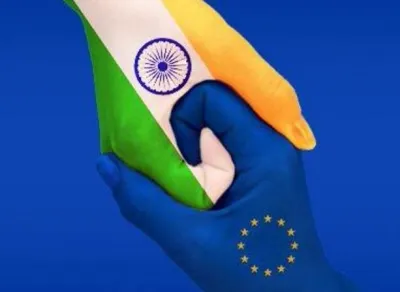
New Delhi, Jan 20 (NationPress) The upcoming India-EU summit on January 27 is a crucial step in the ongoing enhancement of economic partnerships between the two regions, driven by increasing uncertainties in global markets due to US tariff issues and significant geopolitical changes.
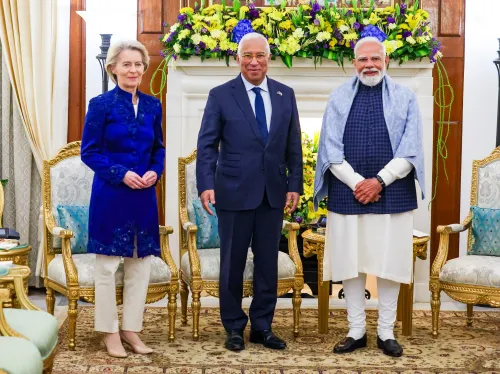
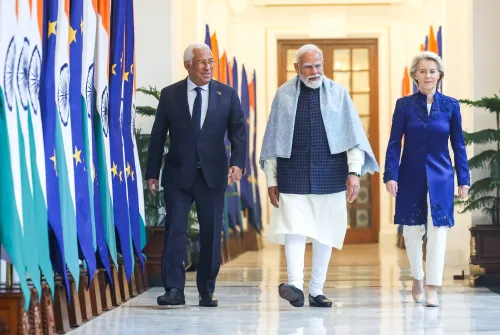
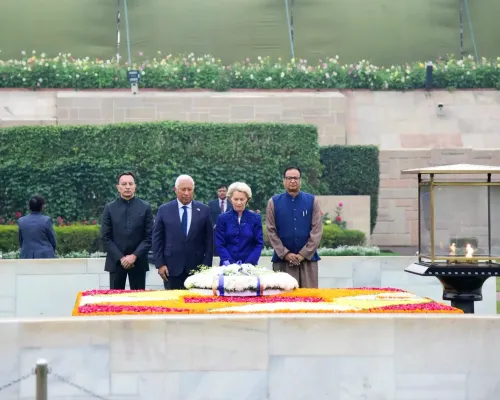
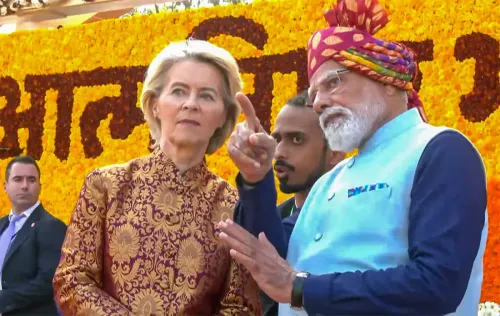
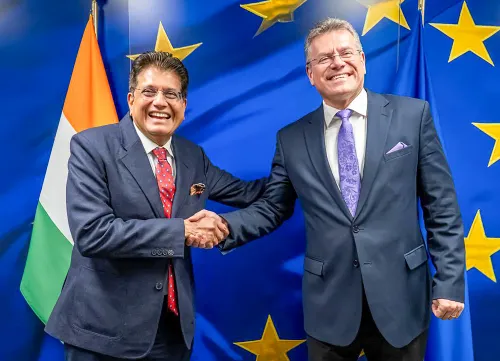
The summit, which will be led by Prime Minister Narendra Modi and co-chaired by European Council President Antonio Costa and European Commission President Ursula von der Leyen, is expected to formalize the completion of Free Trade Agreement (FTA) negotiations, paving the way for necessary legal processes and ratification by the European Parliament and Council.
The EU remains India’s largest trading partner when it comes to goods. For the fiscal year 2024-25, the total trade volume between India and the EU reached approximately USD 136 billion, comprising USD 76 billion in exports and USD 60 billion in imports.
Between 2019 and 2024, bilateral trade in services between India and the EU saw significant growth, with Indian exports climbing from EUR 19 billion in 2019 to EUR 37 billion in 2024, while imports rose to EUR 29 billion.
Prime Minister Modi and President von der Leyen initiated the foundation for closer ties with the establishment of the India-EU Trade and Technology Council in April 2022, which serves as a strategic framework to address challenges at the intersection of trade, trusted technology, and security.
This collaboration led to the signing of a Memorandum of Understanding (MoU) on Semiconductors and another MoU between the Bharat 6G Alliance and the EU 6G Smart Networks and Service Industry Association in November 2023 and March 2024, respectively.
Additionally, ongoing discussions are taking place regarding Artificial Intelligence, collaborative research in High Performance Computing, and partnerships in electric vehicle battery startups.
India and the EU maintain strong cooperation in the fields of energy and climate. The EU has been a supportive partner of the International Solar Alliance, which India spearheads, since 2018. The third phase of the India – EU Clean Energy and Climate Partnership (CECP), initiated in 2016, was adopted in November 2024.
The European Investment Bank is backing India’s transition towards sustainable energy by funding projects related to urban transit and mobility, such as urban rail and metro systems in several Indian cities.
Other collaboration areas include offshore wind energy, the advancement of gas infrastructure in India, methane emission reduction, and technology transfer.
An agreement regarding research and development cooperation for peaceful nuclear energy applications was signed between India’s Department of Atomic Energy and EURATOM in July 2020.
The India - EU Connectivity Partnership, launched in 2021, emphasizes transportation, digital networks, energy systems, and the seamless movement of people, goods, services, data, and capital. In June 2025, both parties reached an agreement on administrative arrangements for trilateral development cooperation on joint initiatives in third countries.
During the G20 Leaders’ Summit in New Delhi in September 2023, leaders from India, the EU, France, Germany, Italy, Saudi Arabia, the UAE, and the US announced an MoU to collaboratively develop a new India-Middle East-Europe Economic Corridor (IMEC).
Furthermore, the India–EU Common Agenda on Migration and Mobility lays out a structured approach towards cooperative goals, recommendations, and actions.
In 2024, Indian nationals received the highest number of residence permits for study, research, and other endeavors in the EU. Indian professionals emerged as the leading recipients of EU blue cards, accounting for nearly 20.8 percent of the total issued.
Point of View
It is crucial to highlight that strengthening ties between India and the EU is not merely a response to global uncertainties but a proactive approach to solidifying economic resilience. This partnership is expected to yield significant benefits for both sides, enhancing trade and collaboration in technology, energy, and climate initiatives. It is imperative that we remain informed on the developments of this summit, as it holds potential implications for international economic stability.
NationPress
29 Sept 2026
Frequently Asked Questions
What is the significance of the India-EU summit?
The India-EU summit serves as a platform to strengthen economic ties, finalize FTA negotiations, and enhance collaborative efforts in various sectors amid global uncertainties.
When is the India-EU summit taking place?
The summit is scheduled for January 27, 2024.
Who will be attending the summit?
The summit will be hosted by Prime Minister Narendra Modi and co-chaired by European Council President Antonio Costa and European Commission President Ursula von der Leyen.
What are some key topics to be discussed at the summit?
Key topics include the conclusion of Free Trade Agreement negotiations, discussions on technology, climate initiatives, and strategic cooperation in various sectors.
How has trade between India and the EU evolved?
Trade in goods between India and the EU reached approximately USD 136 billion in FY 2024-25, with substantial growth noted in both exports and imports.