Is India and the EU Ready to Unveil the Ultimate Trade Agreement?
Synopsis
As the world watches, India and the EU prepare to unveil a monumental Free Trade Agreement during the 16th EU-India Summit. This strategic collaboration aims to reshape trade dynamics and open new avenues for economic growth. What transformations can we expect in the India-EU trade landscape?
Key Takeaways
India and the EU are finalizing a historic Free Trade Agreement.
The summit will reinforce strategic partnerships across multiple sectors.
Reduction in tariffs may lead to increased European vehicle sales in India.
The agreement aims to enhance trade relations and economic integration.
India's global trade footprint is expected to expand significantly.
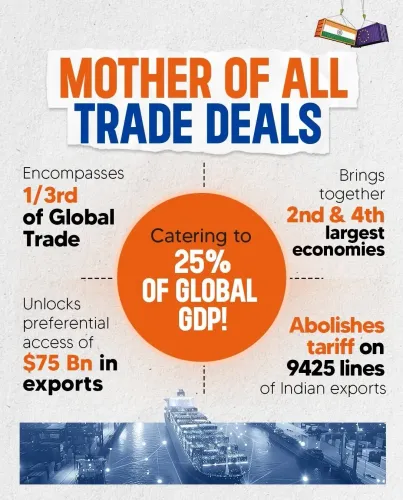
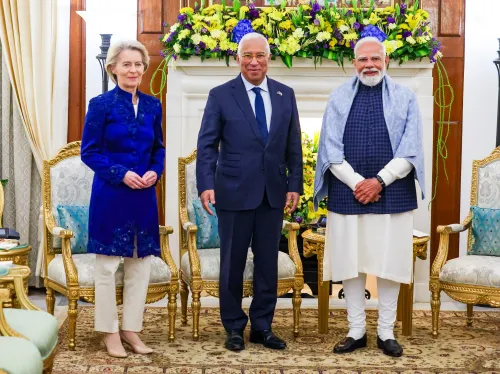
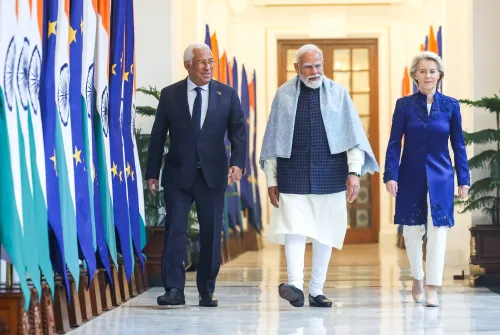
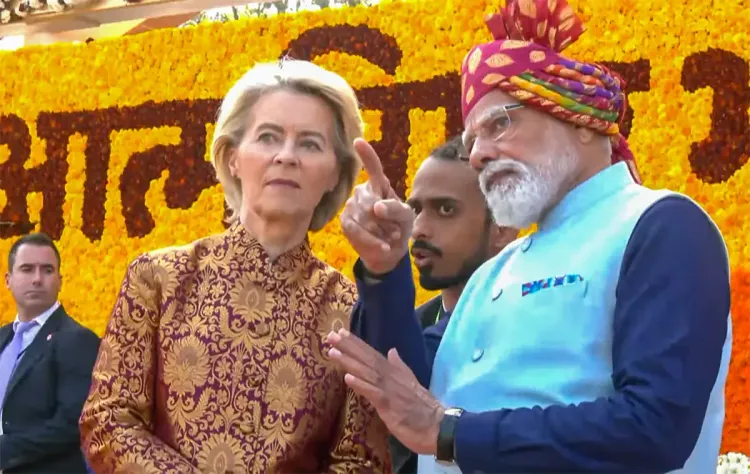
New Delhi, Jan 27 (NationPress) Prime Minister Narendra Modi is preparing to preside over the 16th European Union-India Summit in the capital city on Tuesday. He will be joined by Ursula von der Leyen, the President of the European Commission, and Antonio Costa, the visiting President of the European Council, to publicly announce the ‘mother of all trade deals’.
As per Commerce Secretary Rajesh Agrawal, the negotiations for the highly anticipated Free Trade Agreement (FTA) between India and the EU have been successfully concluded, and the official announcement will be made during the summit.
This summit serves as a platform to enhance the EU-India strategic partnership and to reinforce collaboration in critical areas including trade, security and defense, clean energy transition, and people-to-people ties.
Officials indicate that the signing of the agreement is expected to occur approximately six months after the legal review, with implementation anticipated sometime next year.
This summit is set against a backdrop of growing positivity in EU-India relations observed in recent years.
Agrawal described the upcoming agreement as both balanced and forward-looking, emphasizing that it will enhance economic integration between India and the EU, while significantly increasing trade and investment.
The India-EU FTA is regarded as a crucial advancement in broadening India’s global trade influence. This agreement may mitigate the adverse effects of high US tariffs, thereby unlocking greater opportunities in the European market, particularly for Indian exports like textiles and jewelry.
One of the most notable implications of this deal is the potential opening of India’s automobile sector to European manufacturers. Import duties on European vehicles are projected to be significantly reduced from the current 110% to approximately 40%, allowing brands like Volkswagen, Mercedes-Benz, and BMW to become more affordable in India.
Currently, European firms possess only about 4% of India’s annual car market, which totals 4.4 million units. The EU already holds a vital role in India’s trade ecosystem, representing around 17% of India’s total exports, while exports from India account for about 9% of the EU’s external shipments.
For the financial year 2024–25, India's bilateral trade in goods with the EU reached $136.53 billion, comprising $75.85 billion in exports and $60.68 billion in imports, making the EU India’s largest trading partner in goods. Trade in services between both parties escalated to $83.10 billion in 2024.
Point of View
The forthcoming agreement between India and the EU is a significant step towards strengthening economic ties and enhancing trade relations. It reflects India's commitment to global commerce and could have far-reaching implications for businesses and consumers alike, fostering a more integrated economic environment.
NationPress
24 Sept 2026
Frequently Asked Questions
What is the Free Trade Agreement (FTA) between India and the EU?
The FTA is a trade pact aimed at reducing tariffs and enhancing trade relations between India and the EU, facilitating smoother market access for goods and services.
When will the FTA be signed?
The signing of the FTA is expected to occur approximately six months after the legal review of the agreement.
How will the FTA affect Indian exports?
The FTA is expected to open up new markets for Indian exports, particularly in sectors like textiles and jewellery, by reducing trade barriers.
What impact will the FTA have on the automobile sector?
The FTA is likely to significantly reduce import duties on European cars, making them more affordable for Indian consumers and opening up the Indian automobile market to European manufacturers.
What are the expected benefits of the India-EU FTA?
The FTA is anticipated to boost trade and investment flows, strengthen economic integration, and enhance collaboration across key policy areas such as security and clean energy.