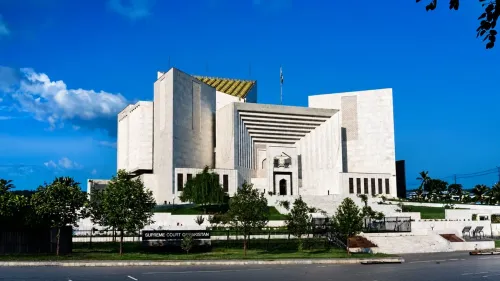
Imran Khan's sister moves Pakistan Supreme Court for urgent hearing
Synopsis
Pakistan's Supreme Court faces a direct accountability test: Imran Khan's sister has filed a second urgent plea after authorities ignored a court order to transfer the jailed former PM to Shifa International Hospital — sending him to a different facility instead. With a UN Special Rapporteur already raising alarms over his detention conditions, the court's next move carries consequences far beyond one hearing date.
Key Takeaways
Uzma Khan filed a fresh application before Pakistan's Supreme Court on 27 August , seeking an urgent hearing of a contempt petition.
The contempt petition concerns non-implementation of the court's 18 August order directing Imran Khan's transfer to Shifa International Hospital .
Authorities reportedly took Khan to PIMS instead, in what the plea calls a 'wilful and blatant' violation of the court order.
The Supreme Court had scheduled the contempt hearing for 16 September ; an earlier urgent request was rejected on 25 August .
UN Special Rapporteur Alice Jill Edwards had previously raised concerns over Khan's detention conditions and access to medical care.
Imran Khan has been in prison since August 2023 ; his party PTI calls the convictions politically motivated.
Uzma Khan, sister of Pakistan's jailed former Prime Minister Imran Khan, on Thursday, 27 August filed a fresh application before the Pakistan Supreme Court, seeking an expedited hearing of a contempt petition over the non-implementation of the court's 18 August order directing Khan's transfer to Shifa International Hospital. The move comes after the apex court scheduled the contempt petition for 16 September — a date Uzma Khan's plea argues is far too late given her brother's deteriorating health.
What Prompted the Fresh Plea
Uzma Khan filed the application after the Supreme Court Registrar's Office rejected an earlier request for an urgent hearing on 25 August. In the fresh plea, she has urged the court to fix the contempt hearing during the current week or the next, citing the urgency of her brother's medical condition.
She stated that despite the apex court's 18 August directive, authorities took Imran Khan to the Pakistan Institute of Medical Sciences (PIMS) rather than Shifa International Hospital as specifically ordered. The plea contends that this constitutes a deliberate and blatant violation of the court's directive.
Key Allegations in the Petition
According to the plea, the continued non-implementation of the court's orders is described as 'wilful, blatant and contumacious.' Uzma Khan argued that the failure to comply is directly linked to Imran Khan's fundamental rights, life, health, and physical well-being. She requested the court to ensure immediate enforcement of its 18 August order, which also mandated weekly family meetings for the former premier.
Imran Khan's Detention Background
Imran Khan has remained in prison since August 2023, following convictions that his party, Pakistan Tehreek-e-Insaf (PTI), has consistently termed politically motivated. Since his removal from office in 2022 through a no-confidence vote, Khan has faced multiple legal cases, including allegations involving state gifts and an unlawful marriage case.
Notably, last month, UN Special Rapporteur on torture and cruel, inhuman, or degrading treatment, Alice Jill Edwards, reportedly expressed concerns over the conditions of Khan's detention and his alleged lack of access to adequate medical care. She urged Pakistan to restore humane detention conditions and allow the former Prime Minister access to medical examination and treatment of his own choosing.
What Happens Next
The matter now rests with the Pakistan Supreme Court, which must decide whether to advance the hearing from the currently scheduled date of 16 September. Legal observers note that the court's response will be a significant indicator of judicial independence in Pakistan's politically charged environment. The case is being closely watched by rights groups and international observers alike.
Point of View
The institutional cost of inaction is rising. The pattern of legal attrition against Khan since 2022 also raises a broader question mainstream coverage underweights — whether Pakistan's judicial and executive machinery are operating in sync against a political opponent, and what that means for the rule of law beyond this single case.
NationPress
12 Oct 2026
Frequently Asked Questions
Why has Uzma Khan filed a fresh plea in Pakistan's Supreme Court?
Uzma Khan filed the plea because the Supreme Court scheduled the contempt petition hearing for 16 September, which she argues is too late given Imran Khan's worsening health in prison. She is seeking an urgent hearing during the current or following week.
What was the Pakistan Supreme Court's 18 August order?
On 18 August, Pakistan's Supreme Court directed authorities to transfer Imran Khan to Shifa International Hospital and arrange weekly family meetings. Uzma Khan's plea alleges this order was deliberately not followed, with Khan instead taken to PIMS.
How long has Imran Khan been in prison?
Imran Khan has been in prison since August 2023, following convictions that his party, PTI, has described as politically motivated. He has faced several cases since his removal from office in 2022 through a no-confidence vote.
What has the United Nations said about Imran Khan's detention?
UN Special Rapporteur on torture Alice Jill Edwards reportedly expressed concerns over Imran Khan's detention conditions and his alleged lack of access to proper medical care. She urged Pakistan to restore humane conditions and allow him access to medical treatment of his own choice.
What happens next in the contempt case?
The Pakistan Supreme Court must now decide whether to advance the hearing from the scheduled 16 September date. Its response will be closely watched by legal observers, rights groups, and international bodies as a test of judicial independence.