Does India Reinforce ‘Vasudhaiva Kutumbakam’ and Religious Harmony at the 11th UNAOC?
Synopsis
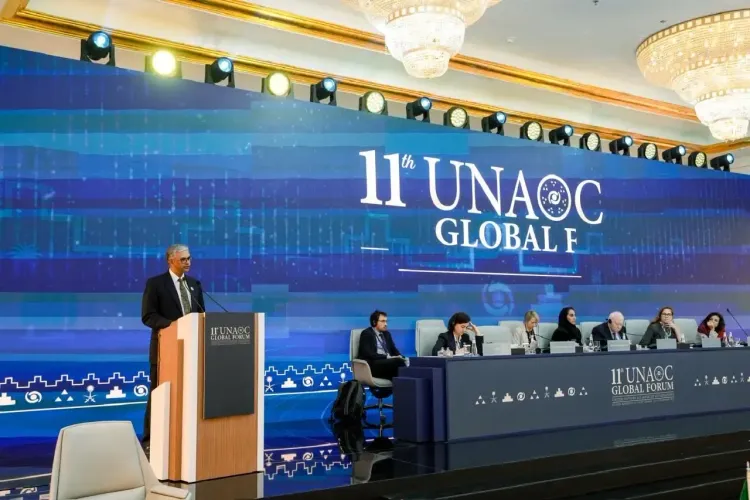
In a powerful address at the 11th UNAOC in Riyadh, P Kumaran reiterated India's commitment to global harmony through the principles of Vasudhaiva Kutumbakam and Sarva Dharma Samabhav. This event marks a significant moment in promoting dialogue and understanding in an increasingly polarized world.
Key Takeaways
Vasudhaiva Kutumbakam promotes the idea of global unity.
Sarva Dharma Samabhav advocates for respect among all religions.
UNAOC serves as a platform for dialogue in a polarized world.
The forum brings together diverse stakeholders for collaborative efforts.
UNAOC celebrates its 20th anniversary this year.
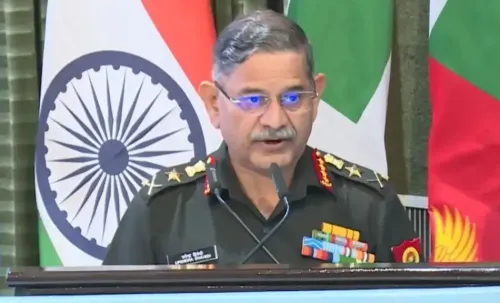
Riyadh, December 15 (NationPress) The Secretary (East) of the Ministry of External Affairs (MEA), P Kumaran, emphasized India's prominent position on the global platform as a nation steeped in an ancient civilization and abundant diversity, referencing the ideals of Vasudhaiva Kutumbakam—the world as one family—and Sarva Dharma Samabhav, which champions equal respect for all faiths.
As per the MEA, P. Kumaran led the Indian delegation at the 11th United Nations Alliance of Civilizations (UNAOC) in Riyadh, Saudi Arabia, where he presented India's national statement during the High-Level Meeting of the Group of Friends of UNAOC.
In his address, he underscored the significance of UNAOC in fostering harmony across nations and cultures globally.
Hosted by Saudi Arabia in Riyadh from December 14–15, the 11th UNAOC convenes under the unifying theme, “UNAOC: Two Decades of Dialogue for Humanity — Advancing a New Era of Mutual Respect and Understanding in a Multipolar World.”
A press release from UNAOC indicated that this global forum arises at a pivotal moment in history, characterized by increasing divides, widespread conflicts, and diminishing confidence in the efficacy of global governance frameworks and the multilateral system.
The event united political leaders, international and regional organizations, spiritual leaders and faith representatives, along with stakeholders from the private sector, civil society, academia, youth, arts, sports, and media, with a collective goal to renew their commitment to the enduring influence of dialogue, mutual respect, and understanding.
As UNAOC embarks on its third decade, this forum represents an ideal moment to commemorate the 20th anniversary of UNAOC and to outline its future trajectory toward achieving lasting peace.
Founded in 2005 under the leadership of Kofi Annan, former UN Secretary-General, the UNAOC was co-sponsored by the Governments of Spain and Turkey.
An expert High-Level Group was established by Annan to investigate the roots of polarization between societies and cultures and to propose actionable strategies to address the issue. The group's findings offered valuable insights and practical suggestions that have shaped the implementation plan of UNAOC.
Point of View
It is essential to recognize India's proactive stance in promoting global harmony through dialogue. The principles of Vasudhaiva Kutumbakam and Sarva Dharma Samabhav resonate deeply in today's world, where understanding and respect are critical for peace and collaboration among nations.
NationPress
23 Sept 2026
Frequently Asked Questions
What is the significance of the UNAOC?
The UNAOC plays a crucial role in fostering dialogue and mutual respect among different cultures and nations, particularly in a world facing increasing polarization.
What principles were highlighted by India at the UNAOC?
India emphasized the principles of Vasudhaiva Kutumbakam —the world as one family—and Sarva Dharma Samabhav , promoting equal respect for all religions.
Who founded the UNAOC?
The UNAOC was established in 2005 under the initiative of Kofi Annan, former UN Secretary-General, and was co-sponsored by the Governments of Spain and Turkey.